
Choosing between Bluetooth and Wi-Fi air quality sensors depends on your priorities. If you want quick setup, local control, and better privacy, Bluetooth is a good fit, though it may offer fewer features. For continuous monitoring, remote access, and smart home integration, Wi-Fi sensors perform better, but they’re less private and need more setup. To understand which option aligns best with your needs, explore how calibration, security, and convenience come into play.

Get home appliances delivered free — and shop member deals
- Fast, free delivery on millions of items
- Access to Prime Big Deal Days deals on October 6–7
- Prime Video, Amazon Music and more included
Key Takeaways
- Bluetooth sensors are easier to set up and prioritize privacy with local data transmission, while Wi-Fi sensors support remote access and smart home integration.
- Wi-Fi sensors offer continuous monitoring and advanced features, whereas Bluetooth sensors are portable and suitable for quick, local use.
- Bluetooth sensors require more frequent calibration, but their limited range enhances data security; Wi-Fi sensors depend on network stability.
- Wi-Fi sensors enable remote monitoring and extensive data analysis, whereas Bluetooth sensors are ideal for simple, immediate local checks.
- The best choice depends on whether you prioritize privacy and ease (Bluetooth) or continuous, connected monitoring (Wi-Fi).
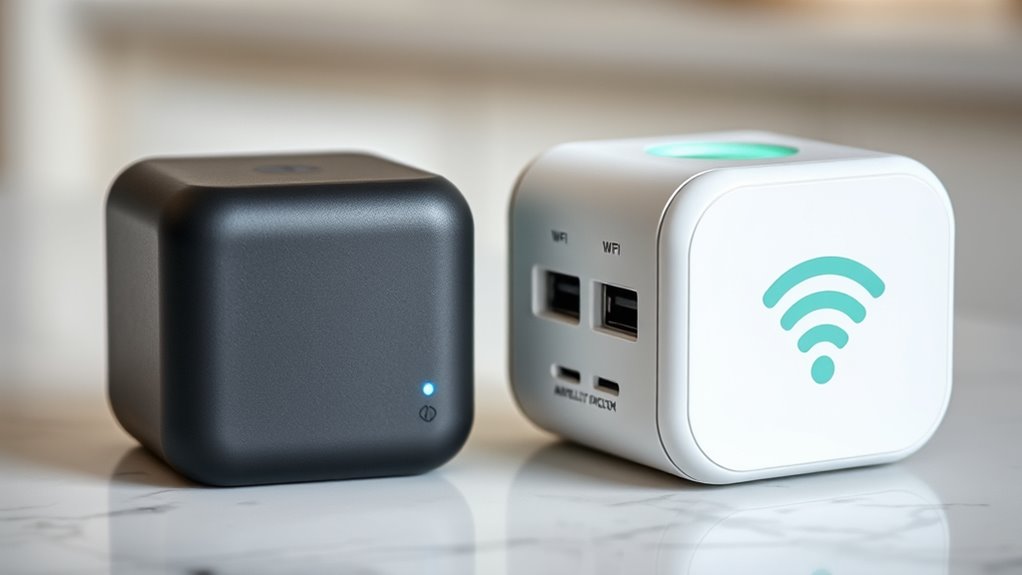
Are Bluetooth and Wi-Fi air quality sensors truly different in performance and convenience? When you’re choosing between them, understanding their strengths and limitations is vital. One key factor is sensor calibration. Bluetooth sensors often require more frequent calibration to maintain accuracy because they tend to be more sensitive to environmental changes and battery life. If you don’t calibrate them properly, you might get skewed data, which can lead to misjudging your indoor air quality. Wi-Fi sensors, on the other hand, usually come with more advanced calibration routines built into their firmware or companion apps, making it easier to guarantee reliable readings over time. This means you’re less likely to have to fiddle with calibration settings, saving you time and reducing the risk of inaccuracies.
Data privacy also plays a significant role in your decision. Bluetooth sensors typically transmit data directly to your smartphone or local device via a secure connection, which limits exposure and makes privacy easier to control. Since they operate within a shorter range, there’s less chance of your data being intercepted or accessed remotely by malicious actors. Conversely, Wi-Fi sensors connect to your home network and often upload data to cloud servers for analysis or storage. While this setup enables remote monitoring from anywhere, it also raises concerns about data privacy. You need to trust the manufacturer’s security measures, as sensitive air quality data could potentially be accessed if proper safeguards aren’t in place. If privacy is a high priority, Bluetooth sensors might appeal more because they keep your data local, whereas Wi-Fi sensors offer convenience at the cost of increased exposure risk.
Bluetooth sensors offer enhanced privacy by keeping data local, while Wi-Fi sensors enable remote access with increased exposure risks.
In terms of performance, Wi-Fi sensors generally provide more extensive features, such as continuous monitoring and integration with smart home systems. They tend to have broader connectivity options, making it easier to view and analyze data on your preferred devices. Bluetooth sensors are more portable and straightforward to set up, often requiring less technical knowledge but sometimes offering fewer advanced features. When it comes to convenience, Bluetooth sensors excel in quick, easy installations and local-only use, while Wi-Fi sensors excel in remote access and integration with other smart devices.
Ultimately, your choice hinges on what matters most: if you prioritize ease of setup, local control, and privacy, Bluetooth might be better. If you want continuous monitoring, remote access, and integration with your smart home ecosystem, Wi-Fi sensors could be the way to go. Both options have their perks, but understanding these differences helps you make an informed decision tailored to your needs.
As an affiliate, we earn on qualifying purchases.
Frequently Asked Questions
How Do Bluetooth and Wi-Fi Sensors Compare in Battery Life?
Bluetooth sensors typically consume less power, offering longer battery longevity compared to Wi-Fi sensors. You’ll find that Bluetooth’s lower power consumption helps extend battery life, making it ideal for devices that need to last months or even years without replacement. On the other hand, Wi-Fi sensors, while more power-hungry, provide faster data transfer and better connectivity, but you’ll need to recharge or replace batteries more often.
Which Sensor Type Offers Better Data Security?
You’re in a digital fortress, and data security is your shield. Wi-Fi sensors often use robust data encryption, making them harder for intruders to breach, while Bluetooth sensors, though secure, may pose higher privacy concerns if not properly protected. You can trust Wi-Fi for better data security, especially if you prioritize privacy, but always guarantee your network has strong encryption to keep your air quality data safe from prying eyes.
Can Bluetooth Sensors Operate Over Long Distances?
Bluetooth sensors generally can’t operate over long distances due to range limitations, typically only reaching about 10 meters. Signal interference from other devices or obstacles can further reduce this range, making it difficult to rely on Bluetooth for large spaces. If you need sensors that cover greater areas, Wi‑Fi sensors are a better choice since they can operate over much longer distances and handle signal interference more effectively.
Are Wi-Fi Sensors More Cost-Effective Than Bluetooth?
Wi-Fi sensors are generally more cost-effective when considering the overall cost comparison, especially for larger spaces or multiple sensors. While initial setup might seem pricier, their scalability options make them a smarter investment long-term. You can easily expand your network without significant additional costs. Bluetooth sensors, in contrast, often require more devices and maintenance for extensive coverage, which can increase expenses over time.
How Do Installation Complexities Differ Between the Two?
You’ll find that Wi-Fi air quality sensors often have more complex installation challenges due to their setup procedures, requiring you to connect to your network and configure settings. Bluetooth sensors are typically easier, with simpler setup procedures that involve pairing with your device. While Wi-Fi sensors might need more time and technical steps, Bluetooth sensors usually offer a quicker, more straightforward installation process.
Wi-Fi indoor air quality monitor
As an affiliate, we earn on qualifying purchases.
As an affiliate, we earn on qualifying purchases.
Conclusion
Choosing between Bluetooth and Wi-Fi air quality sensors depends on your needs. Both offer reliable data, but their effectiveness often hinges on your environment and your priorities. Sometimes, it feels like the right sensor finds you just when you need it most—like a coincidence that guides you to better air quality. Trust your instincts, and remember, whether by chance or choice, the right sensor can make all the difference in breathing easier every day.
As an affiliate, we earn on qualifying purchases.
portable Bluetooth air quality device
As an affiliate, we earn on qualifying purchases.
As an affiliate, we earn on qualifying purchases.
Fall yard work Picks
leaf blowers
As an affiliate, we earn on qualifying purchases.