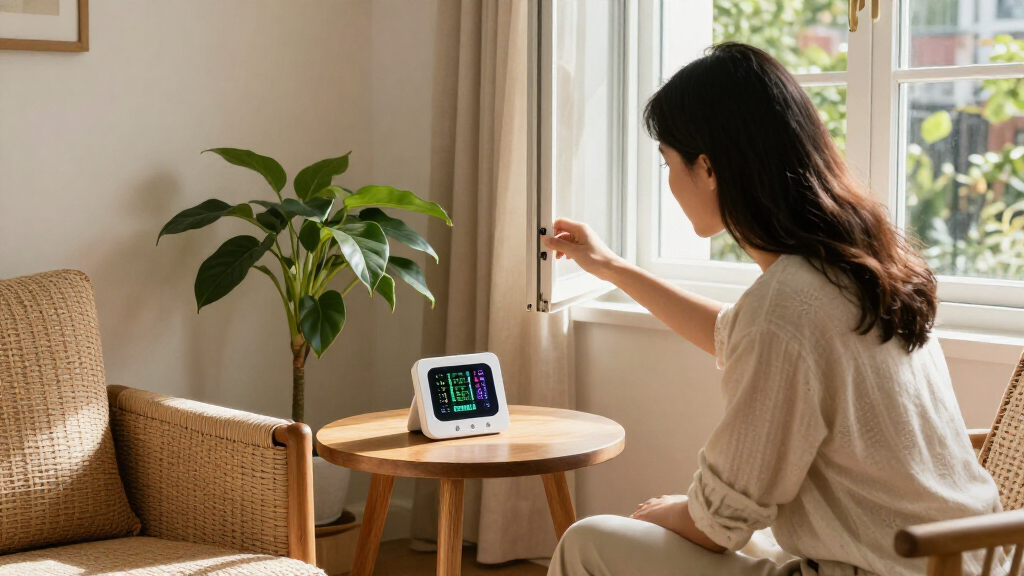

Indoor air quality monitors can track different things, from carbon dioxide and particles to humidity and radon, so the right choice depends on what you want to learn about your home. I rank the Airthings View Plus as the best overall for buyers who want broad coverage that includes radon, while the Aranet4 stands out for focused CO2 tracking and the Amazon Smart Air Quality Monitor for straightforward smart-home use. Many multi-sensor models offer a long list of readings, but that does not automatically mean every sensor is equally useful or clearly explained. The main tradeoffs are breadth versus measurement focus, screen and app convenience versus simplicity, and standalone monitoring versus smart-home integration. Read on for the full breakdown and help matching a monitor to your priorities.

Get home appliances delivered free with Prime
- Fast, free delivery on millions of items
- Prime Video, Amazon Music and more included
- Member-only deals all year
Complete the kit


Key Takeaways
- Sensor purpose mattered more than sensor count: The Airthings View Plus earns the broad-coverage lead with radon included, while the amazon.com/dp/B0GKHCXBG8?tag=pureairadviser-20&ascsubtag=dc-1275185″ target=”_blank” rel=”nofollow sponsored noopener”>amazon.com/dp/B07YY7BH2W?tag=pureairadviser-20&ascsubtag=dc-1275185″ target=”_blank” rel=”nofollow sponsored noopener”>Aranet4 is a more focused choice for CO2 awareness.
- Large displays favor at-a-glance use: The YNAK AK22A’s 7-inch display and the YNAK 5.5-inch model suit readers who want visible readings in a room, but a large screen does not replace checking what each measurement means.
- Smart-home simplicity has a narrower job: The Amazon monitor is easier to place in a connected household than many screen-led multi-sensor devices, but it does not offer the same breadth as dedicated radon or CO2-focused options.
- Two-monitor coverage solves a different problem: The Amazon 2-Pack can help compare rooms or monitor separate areas, while a single broad-coverage unit may be more useful when the goal is to understand multiple pollutants in one location.
- Repeated 16-in-1 formats make verification important: Several listings emphasize high sensor counts, so buyers should prioritize clearly identified readings, placement guidance, and usable alerts over the number in the product name.
| MORPTRA 16-in-1 Indoor Air Quality Monitor with Color Display |  | Best for Quick Portable Checks | Measurements: PM1.0, PM2.5, PM10, TVOC, HCHO, temperature, and humidity | Update interval: 1.5 seconds | Display: HD color screen | VIEW LATEST PRICE | See Our Full Breakdown |
| Aranet4 Indoor Air Quality Monitor with Wireless CO2 Detector |  | Best for Long-Term CO2 Tracking | Measurements: CO2, temperature, relative humidity, and atmospheric pressure | Sensor: NDIR | Display: E-ink | VIEW LATEST PRICE | See Our Full Breakdown |
| AprilAire ZAWTHCPV Smart Indoor Air Quality Monitor |  | Best for AprilAire Smart-Home Integration | Measurements: CO2, VOCs/TVOC, PM2.5, humidity, and temperature | Connectivity: Wi-Fi | App: AprilAire Healthy Air App required | VIEW LATEST PRICE | See Our Full Breakdown |
| YNAK 16-in-1 Indoor Air Quality Monitor with 5.5-Inch HD Display | 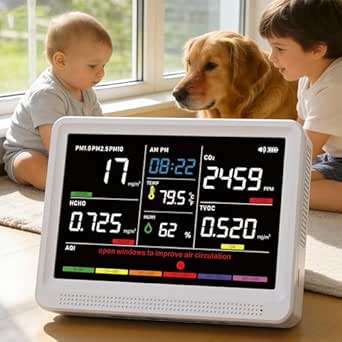 | Best for an Easy-to-Read Room Display | Measurements: CO2, PM2.5, PM1.0, PM10, HCHO, TVOC, temperature, humidity, AQI, and time | Display: 5.5-inch HD LED display | Alert functions: 7 AQI alert types | VIEW LATEST PRICE | See Our Full Breakdown |
| Amazon Smart Air Quality Monitor (2-Pack) |  | Best for Alexa-Based Multi-Room Monitoring | Monitored factors: Temperature, humidity, PM2.5, VOCs, and carbon monoxide | Connectivity: Alexa | Alerts: Phone notifications or Echo announcements | VIEW LATEST PRICE | See Our Full Breakdown |
| Amazon Smart Air Quality Monitor | | Best for Alexa Automation | Sensors: Temperature, humidity, carbon monoxide, PM2.5, and VOCs | Connectivity: 2.4 GHz Wi-Fi and Bluetooth Low Energy 4.2 | Status indicator: Multicolor LED | VIEW LATEST PRICE | See Our Full Breakdown |
| AirWhisper 16-in-1 Indoor Air Quality Monitor with Color Display | 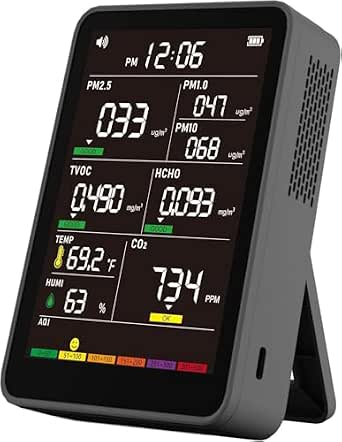 | Best for Rapid, Broad On-Screen Readings | Measurements: PM1.0, PM2.5, PM10, CO2, TVOC, HCHO, temperature, and humidity | Sampling interval: 1.5 seconds | Battery runtime: 4–5 hours | VIEW LATEST PRICE | See Our Full Breakdown |
| Airthings View Plus Battery-Powered Radon and Air Quality Monitor |  | Best for Radon and Long-Term Trends | Model: 2960 | Sensors: Radon, PM2.5, CO2, VOCs, humidity, temperature, and air pressure | Connectivity: Wi-Fi | VIEW LATEST PRICE | See Our Full Breakdown |
| Heouakc 10-in-1 Indoor Air Quality Monitor |  | Best for Offline Portable Monitoring | Model: MT13 | Measurements: PM0.3, PM2.5, PM10, CO2, CO, HCHO, TVOC, AQI, temperature, and humidity | Update interval: 1.2 seconds | VIEW LATEST PRICE | See Our Full Breakdown |
| 16-in-1 Indoor Air Quality Monitor with Color Display |  | Best for Adjustable Audio Prompts | Model: AK16C | Measured parameters: PM1.0, PM2.5, PM10, TVOC, HCHO, carbon dioxide, temperature, and humidity | Update interval: 1.5 seconds | VIEW LATEST PRICE | See Our Full Breakdown |
| 16-in-1 Indoor Air Quality Monitor with Color Display |  | Best for Fast, At-a-Glance Readings | Measurements: PM1.0, PM2.5, PM10, CO2, TVOC, HCHO, temperature, humidity | Display: HD color screen with color-coded readings | Sampling interval: 1.5 seconds | VIEW LATEST PRICE | See Our Full Breakdown |
| Zemeollo 10-in-1 Portable Indoor Air Quality Monitor | 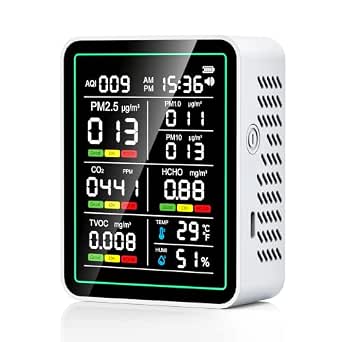 | Best for Longer Portable Monitoring | Measurements and display: CO₂, HCHO, TVOC, benzene, PM1.0, PM2.5, PM10, temperature, AQI, and time | Battery: 2000mAh rechargeable lithium battery | Battery life: Up to 20 hours | VIEW LATEST PRICE | See Our Full Breakdown |
| BREATHE Airmonitor Plus Gen 2 Indoor Air Quality Monitor |  | Best for App-Based Tracking | Measurements: CO₂, PM1, PM2.5, PM10, TVOCs, formaldehyde, temperature, humidity | Sensors: NDIR CO₂, laser particle, TVOC, and formaldehyde sensors | Connectivity: 2.4 GHz Wi-Fi | VIEW LATEST PRICE | See Our Full Breakdown |
| YNAK AK22A 16-in-1 Indoor Air Quality Monitor with 7-Inch Display |  | Best for Large, Readable Room Displays | Display: 7-inch LED with three brightness settings | Monitored parameters: CO2, PM2.5, PM1.0, PM10, HCHO, TVOC, temperature, humidity, AQI, and time | Alert functions: Seven AQI alert buzzers with mute button | VIEW LATEST PRICE | See Our Full Breakdown |
| indoor air quality monitor | Measurements | Display | Charging |
|---|---|---|---|
| MORPTRA 16-in-1 Indoor Air Qua | PM1.0, PM2.5, PM10, TVOC, HCHO, temperature, and humidity | HD color screen | — |
| Aranet4 Indoor Air Quality Mon | CO2, temperature, relative humidity, and atmospheric pressure | E-ink | — |
| AprilAire ZAWTHCPV Smart Indoo | CO2, VOCs/TVOC, PM2.5, humidity, and temperature | — | — |
| YNAK 16-in-1 Indoor Air Qualit | CO2, PM2.5, PM1.0, PM10, HCHO, TVOC, temperature, humidity, AQI, and time | 5.5-inch HD LED display | USB-C; AC adapter included |
| Amazon Smart Air Quality Monit | — | — | — |
| Amazon Smart Air Quality Monit | — | — | — |
| AirWhisper 16-in-1 Indoor Air | PM1.0, PM2.5, PM10, CO2, TVOC, HCHO, temperature, and humidity | — | USB Type-C |
| Airthings View Plus Battery-Po | — | Customizable eInk | — |
| Heouakc 10-in-1 Indoor Air Qua | PM0.3, PM2.5, PM10, CO2, CO, HCHO, TVOC, AQI, temperature, and humidity | — | USB-C |
| 16-in-1 Indoor Air Quality Mon | — | HD color screen with color-coded readings | USB Type-C |
| 16-in-1 Indoor Air Quality Mon | PM1.0, PM2.5, PM10, CO2, TVOC, HCHO, temperature, humidity | HD color screen with color-coded readings | USB Type-C |
| Zemeollo 10-in-1 Portable Indo | — | HD color LED screen | USB charging cable |
| BREATHE Airmonitor Plus Gen 2 | CO₂, PM1, PM2.5, PM10, TVOCs, formaldehyde, temperature, humidity | — | — |
| YNAK AK22A 16-in-1 Indoor Air | — | 7-inch LED with three brightness settings | USB-C |
More Details on Our Top Picks
MORPTRA 16-in-1 Indoor Air Quality Monitor with Color Display
The MORPTRA is a practical pick for moving between rooms and checking a broad set of readings at a glance. It tracks PM1.0, PM2.5, PM10, TVOC, formaldehyde, temperature, and humidity, with color-coded results refreshing every 1.5 seconds. That makes it more suited to spot checks than the Aranet4, which focuses on CO2, temperature, humidity, and pressure and is designed for long-running monitoring.
The tradeoff is endurance: its rechargeable battery lasts 4–5 hours, so a full day of untethered monitoring is out of reach. Also, despite the 16-in-1 name, the supplied description identifies seven measured indicators, so I would not assume it reports 16 separate readings. The one-button controls keep operation simple, while the audio prompt can be switched off when alerts are unwanted.
Pros:- Tracks particulate matter, TVOC, formaldehyde, temperature, and humidity in one unit
- Color-coded display refreshes readings every 1.5 seconds
- Portable, rechargeable design with a switchable audio prompt
- Includes USB-C cable, AC adapter, and manual
Cons:- Battery runtime is limited to 4–5 hours per charge
- Product title claims 16-in-1, while the description names seven measured indicators
- Does not list CO2 among its measurements
Best for: People who want a portable monitor for short checks of particulate matter, gases, temperature, and humidity in different rooms.
Not ideal for: Buyers seeking continuous, low-maintenance CO2 tracking or a clearly documented set of 16 distinct measurements.
- Measurements:PM1.0, PM2.5, PM10, TVOC, HCHO, temperature, and humidity
- Update interval:1.5 seconds
- Display:HD color screen
- Battery runtime:4–5 hours
- Charging port:USB Type-C
- Weight:14.4 ounces
- Model:AK16C
- Warranty:12 months
Our verdict“Choose the MORPTRA for portable, short-duration checks across several pollutant types, but skip it if CO2 monitoring or extended battery operation is a priority.”
Aranet4 Indoor Air Quality Monitor with Wireless CO2 Detector
The Aranet4 takes a more focused approach than broad-indicator monitors such as the YNAK 16-in-1: its core strength is tracking CO2 with an NDIR sensor, alongside temperature, relative humidity, and atmospheric pressure. That makes it a strong fit for people who want to follow ventilation conditions over time rather than see a long list of pollutant categories on one screen.
Its e-ink display, color alerts, and optional buzzer make readings accessible without relying on the app, while app graphs retain up to 90 days of history. The standout convenience is battery life of up to four years on two AA batteries, a major contrast with rechargeable monitors that need regular charging. The tradeoff is narrower coverage: it does not list particulate matter or VOC measurements, and its app history is capped at 90 days.
Pros:- NDIR sensor measures CO2 alongside temperature, humidity, and atmospheric pressure
- Up to four years of battery life on two included AA batteries
- E-ink display with color alerts and optional buzzer
- Companion app graphs up to 90 days of historical data
Cons:- Does not list PM, VOC, or formaldehyde measurements
- App history is limited to 90 days
- Requires two AA batteries rather than USB charging
Best for: Households, classrooms, and home-office users who want persistent CO2 and ventilation tracking with minimal battery upkeep.
Not ideal for: Buyers who need particulate matter, VOC, or formaldehyde readings from the same monitor.
- Measurements:CO2, temperature, relative humidity, and atmospheric pressure
- Sensor:NDIR
- Display:E-ink
- Battery life:Up to 4 years
- Batteries:2 AA batteries, included
- App history:Up to 90 days
- Dimensions:2.76 x 2.76 x 0.94 inches
- Weight:3.67 ounces
Our verdict“Pick the Aranet4 for low-maintenance CO2 and ventilation tracking, not for broad pollutant coverage like the YNAK or MORPTRA.”
AprilAire ZAWTHCPV Smart Indoor Air Quality Monitor
The AprilAire ZAWTHCPV makes the most sense as part of an existing AprilAire setup. It tracks CO2, VOCs, PM2.5, humidity, and temperature, then presents readings, trends, tips, and alerts in the Healthy Air App. Compared with the standalone Aranet4, it covers particulates and VOCs as well as CO2; compared with the Amazon Smart Air Quality Monitor, it does not list carbon monoxide but can connect with compatible AprilAire equipment.
That integration is its defining advantage, not a requirement for everyone. Wi-Fi and the app are needed to access its guidance, and compatible filtration or ventilation equipment and specified thermostats are sold separately. Buyers without AprilAire devices may find less value in those connections. A three-year manufacturer warranty adds reassurance, but the product’s usefulness depends on whether its app-based approach and ecosystem fit the home.
Pros:- Measures CO2, VOCs, PM2.5, humidity, and temperature
- App provides readings, trends, alerts, and guidance
- Can integrate with compatible AprilAire air-quality equipment and specified thermostats
- Includes a three-year manufacturer warranty
Cons:- Requires the AprilAire Healthy Air App
- Compatible thermostat and mitigation equipment are sold separately
- The listed measurements do not include carbon monoxide
Best for: Homeowners using compatible AprilAire filtration, ventilation, or Wi-Fi thermostat equipment who want readings and air-quality guidance in one app.
Not ideal for: People seeking a self-contained monitor with an on-device display, or buyers who do not want app-dependent monitoring and separate ecosystem purchases.
- Measurements:CO2, VOCs/TVOC, PM2.5, humidity, and temperature
- Connectivity:Wi-Fi
- App:AprilAire Healthy Air App required
- Included items:Healthy Air Monitor and power supply
- Manufacturer warranty:3 years
- Thermostat compatibility:AprilAire S86WMUPR or 8920W Wi-Fi Thermostat
- Indicator lights:Three settings
Our verdict“Choose this monitor if AprilAire integration matters to your home; otherwise, the Aranet4 offers simpler standalone CO2 tracking and the Amazon monitor adds Alexa-based routines.”
YNAK 16-in-1 Indoor Air Quality Monitor with 5.5-Inch HD Display
The YNAK is the display-first choice here: its 5.5-inch HD screen makes a wide spread of readings easier to check from across a room than the compact Aranet4’s e-ink panel. Its listed measurements include CO2, PM1.0, PM2.5, PM10, HCHO, TVOC, temperature, humidity, and AQI, with audible alerts for changing air conditions. Three brightness levels and a mute button help adapt the display and alerts to shared living spaces.
Portability is useful for checking different rooms, and its up-to-10-hour runtime exceeds the MORPTRA’s 4–5 hours. Still, it is a rechargeable device that needs regular power for continuous use. The product also warns that perfumes and strong odors may affect sensor accuracy, which can complicate readings near cleaning products or scented items. Its broad monitoring is appealing, but buyers should weigh those caveats against the simpler, longer-running CO2 focus of the Aranet4.
Pros:- Large 5.5-inch HD display with three brightness levels
- Lists CO2, several particulate sizes, HCHO, TVOC, temperature, humidity, and AQI
- Up to 10 hours of rechargeable operation
- Audible alerts include a mute option
Cons:- Up to 10 hours of runtime may require frequent recharging for continuous monitoring
- Strong odors and perfumes may affect sensor accuracy
- Temperature and humidity accuracy ranges are specified as ±1 to ±3 °F and ±2% to ±3% RH
Best for: People who want a large, visible room display and a portable monitor covering CO2, particulates, formaldehyde, and TVOC.
Not ideal for: Buyers who need uninterrupted monitoring without frequent charging, or who plan to use the monitor near perfumes and strong odors.
- Measurements:CO2, PM2.5, PM1.0, PM10, HCHO, TVOC, temperature, humidity, AQI, and time
- Display:5.5-inch HD LED display
- Alert functions:7 AQI alert types
- Runtime:Up to 10 hours
- Charging:USB-C; AC adapter included
- Temperature accuracy:±1 to ±3 °F
- Humidity accuracy:±2% to ±3% RH
- Warranty:12 months
Our verdict“Choose the YNAK for broad readings that are easy to see at a glance, but favor the Aranet4 for longer-running, low-maintenance CO2 tracking.”
Amazon Smart Air Quality Monitor (2-Pack)
This two-unit pack stands apart from screen-based monitors such as the YNAK 16-in-1 by emphasizing app alerts and smart-home response over a large on-device readout. It tracks PM2.5, VOCs, carbon monoxide, temperature, and humidity; the color-coded LED gives a quick status cue, while the Alexa app provides more detail. With two monitors, buyers can place units in separate rooms rather than carry one device from place to place.
Its clearest advantage is the link to Alexa notifications, Echo announcements, and Routines, which can prompt compatible devices when air conditions change. That makes it more automation-oriented than the Aranet4, but it depends on Alexa for setup and detailed information. Routine control also requires compatible Alexa devices, and buyers who want a large display or readings without an app should look elsewhere. The listed measurements include carbon monoxide, unlike the AprilAire monitor, but do not include CO2 or separate particulate sizes.
Pros:- Two monitors allow placement in separate rooms
- Tracks PM2.5, VOCs, carbon monoxide, temperature, and humidity
- Color-coded LED, app information, and phone or Echo alerts
- Alexa Routines can control compatible devices
Cons:- Alexa app is required for setup and detailed information
- Automations require compatible Alexa devices
- Does not list CO2 or particulate measurements beyond PM2.5
Best for: Alexa households that want to monitor two rooms and connect air-quality alerts to compatible smart-home devices.
Not ideal for: Buyers who want a stand-alone screen, do not use Alexa, or need CO2 readings and multiple particle-size measurements.
- Monitored factors:Temperature, humidity, PM2.5, VOCs, and carbon monoxide
- Connectivity:Alexa
- Alerts:Phone notifications or Echo announcements
- Pack size:2
- Status indicator:Color-coded LED
- Automation:Alexa Routines for compatible devices
Our verdict“Pick the two-pack for Alexa-connected monitoring across rooms, but choose the YNAK for a large on-device display or the Aranet4 for CO2 tracking.”
Amazon Smart Air Quality Monitor
I’d choose the Amazon Smart Air Quality Monitor for an Alexa household that wants air readings to prompt a practical response. It tracks temperature, humidity, carbon monoxide, PM2.5, and VOCs, then shows an air quality score in the Alexa app and can send alerts or trigger compatible devices through Routines. That makes it more useful for automated purifier or fan control than the Heouakc 10-in-1, which offers more readings and longer portable operation but no app connection. The tradeoff is a narrower set of measurements: it does not report CO2 or radon, unlike the Airthings View Plus. Alerts and automation also depend on Alexa and compatible devices, so this is a less compelling choice for people who want a standalone screen or a platform-independent monitor.
Pros:- Tracks temperature, humidity, carbon monoxide, PM2.5, and VOCs
- Shows an air quality score and can send phone notifications or Echo announcements
- Alexa Routines can automate compatible air-cleaning and ventilation devices
- Compact plug-in setup includes a power adapter and Micro-USB cable
Cons:- Alerts and automation rely on Alexa and compatible devices
- Does not measure CO2 or radon, unlike the Airthings View Plus
- Indoor-only operation limits use outside the home
Best for: Alexa users who want indoor readings to trigger compatible purifiers, dehumidifiers, or fans and prefer phone alerts over a dedicated display
Not ideal for: Buyers who need CO2 or radon readings, want a standalone screen, or do not use Alexa-compatible devices
- Sensors:Temperature, humidity, carbon monoxide, PM2.5, and VOCs
- Connectivity:2.4 GHz Wi-Fi and Bluetooth Low Energy 4.2
- Status indicator:Multicolor LED
- Dimensions:65 × 65 × 45 mm
- Weight:120 g without cable or adapter
- Power supply:5 W adapter; 100–240 V AC input, 5.0 V 1 A output
- Compatibility:Echo devices and Alexa app version 2021.16 or later
- Operating conditions:Indoor use; 0–40 °C and 0–80% humidity
Our verdict“Choose this monitor if Alexa automation matters more to you than a broad sensor set or a built-in display.”
AirWhisper 16-in-1 Indoor Air Quality Monitor with Color Display
The AirWhisper 16-in-1 suits buyers who want a wide range of readings visible at once, without relying on a phone app. Its color screen covers PM1.0, PM2.5, PM10, CO2, TVOC, formaldehyde, temperature, and humidity, with updates every 1.5 seconds. Compared with the Amazon Smart Air Quality Monitor, it adds CO2 and formaldehyde readings and puts information on the device itself, though it gives up Alexa alerts and automation. It is also easier to carry between rooms than the cable-free, app-connected Airthings View Plus if you want a direct display rather than cloud-based trends. The main compromise is portability on battery: 4–5 hours per charge means it is better for short checks or use near an outlet than for all-day monitoring away from power.
Pros:- Measures particulate matter, CO2, TVOC, formaldehyde, temperature, and humidity
- Color display presents readings directly on the device
- Updates measurements every 1.5 seconds
- Portable format includes USB-C charging cable and AC adapter
Cons:- Battery runtime is limited to 4–5 hours per charge
- No app connectivity or remote notifications are specified
- Does not measure radon, unlike the Airthings View Plus
Best for: People who want quick, on-device readings across particles, gases, temperature, and humidity, especially for moving the monitor between rooms
Not ideal for: Buyers seeking continuous battery-powered monitoring, app alerts, or long-term cloud trends
- Measurements:PM1.0, PM2.5, PM10, CO2, TVOC, HCHO, temperature, and humidity
- Sampling interval:1.5 seconds
- Battery runtime:4–5 hours
- Charging:USB Type-C
- Dimensions:1.6 × 5.3 × 6.7 inches
- Weight:12.3 ounces
- Model:AK16C
- Included accessories:USB Type-C charging cable, AC power adapter, and user manual
Our verdict“Pick the AirWhisper if you want a broad, fast-refreshing display for room-to-room checks and can keep it near power for longer sessions.”
Airthings View Plus Battery-Powered Radon and Air Quality Monitor
The Airthings View Plus is the strongest fit here for buyers who want radon monitoring alongside everyday air measures. It tracks radon, PM2.5, CO2, VOCs, humidity, temperature, and air pressure, then pairs continuous readings with app notifications and trends. That broader long-term view sets it apart from the Amazon Smart Air Quality Monitor, which can automate Alexa devices but does not measure radon or CO2. Its battery-powered design also avoids a fixed cable, while the customizable eInk display keeps readings available on the device. The tradeoff is reliance on Wi-Fi, an account, and internet access, with data saved in the cloud. Compared with the locally readable Heouakc 10-in-1, this is better for remote tracking and trends but less independent of connected services.
Pros:- Measures radon alongside PM2.5, CO2, VOCs, humidity, temperature, and air pressure
- App supports live readings, notifications, and trends
- Battery power allows placement without a nearby outlet
- Can connect with other Airthings monitors for multi-room monitoring
Cons:- Requires an account, internet access, and Wi-Fi for connected features
- Air quality data is saved in the cloud
- Less suitable for buyers who want offline, self-contained monitoring like the Heouakc 10-in-1
Best for: Homeowners who want ongoing radon monitoring plus app-based readings and trends across several rooms
Not ideal for: Buyers who want a monitor that works without Wi-Fi, an account, or cloud-stored data
- Model:2960
- Sensors:Radon, PM2.5, CO2, VOCs, humidity, temperature, and air pressure
- Connectivity:Wi-Fi
- Power:Battery-powered
- Display:Customizable eInk
- Operating temperature:4 to 40°C (39 to 104°F)
- Sensor type:Electrochemical
- Warranty:Optional five-year extended warranty; registration required within 30 days
Our verdict“Choose the View Plus if radon and ongoing app-based trends matter more than offline operation or freedom from cloud storage.”
Heouakc 10-in-1 Indoor Air Quality Monitor
The Heouakc 10-in-1 is a practical pick for buyers who want readings and alerts without setting up Wi-Fi, Bluetooth, or an app. It measures PM0.3, PM2.5, PM10, CO2, CO, HCHO, TVOC, AQI, temperature, and humidity, while its color-coded screen and audible alerts make changes easier to spot in the room. Its stated up to 96-hour battery life gives it a clear portability advantage over the AirWhisper 16-in-1, which runs for just 4–5 hours per charge. The tradeoff is that readings stay on the device: unlike the Airthings View Plus, it does not provide app notifications, remote access, or multi-room trends. It makes more sense as a movable, self-contained monitor than as part of a connected home system.
Pros:- Measures 10 air and environmental indicators, including CO and CO2
- Color-coded display and audible alerts help flag changing readings
- Rechargeable battery offers up to 96 hours of monitoring
- USB-C charging and one-button controls support straightforward portable use
Cons:- No Wi-Fi, Bluetooth, or app connectivity for remote access
- Cannot provide connected trends or automations like the Airthings View Plus or Amazon monitor
- The stated battery life is an upper limit rather than a guaranteed runtime for every use
Best for: Renters, travelers, and households wanting portable indoor readings and audible alerts without app or network setup
Not ideal for: Buyers who need remote monitoring, stored trends, or smart-home automation
- Model:MT13
- Measurements:PM0.3, PM2.5, PM10, CO2, CO, HCHO, TVOC, AQI, temperature, and humidity
- Update interval:1.2 seconds
- Battery capacity:2000 mAh
- Battery life:Up to 96 hours
- Charging:USB-C
- Color:Black
- Included components:Air quality monitor, charging cable, and user manual
Our verdict“Choose the Heouakc if you want long-running, offline monitoring you can move around without depending on an app.”
16-in-1 Indoor Air Quality Monitor with Color Display
This 16-in-1 monitor suits buyers who want a broad set of readings plus on-device sound prompts. It tracks PM1.0, PM2.5, PM10, TVOC, HCHO, CO2, temperature, and humidity, refreshing every 1.5 seconds on a color-coded screen. Its adjustable audio prompts give it a more direct alert option than the AirWhisper 16-in-1, whose listed strengths center on display, portability, and frequent updates. Both share the same short 4–5-hour battery runtime, so neither is a strong choice for extended monitoring away from an outlet. Compared with the Heouakc 10-in-1, this model offers a broader listed measurement set, but the Heouakc has a much longer stated battery life and does not need frequent recharging. Sensor accuracy and calibration details are not specified, which limits confidence for buyers seeking documented measurement performance.
Pros:- Tracks particulate sizes, TVOC, formaldehyde, CO2, temperature, and humidity
- Color-coded screen makes readings available without a phone app
- Updates readings every 1.5 seconds
- Includes USB Type-C cable, AC adapter, and user manual
Cons:- Battery runtime is limited to 4–5 hours per charge
- Measurement accuracy and sensor calibration details are not specified
- Does not list radon monitoring, unlike the Airthings View Plus
Best for: People who want multiple air readings on a color screen and prefer adjustable audible prompts over app-based alerts
Not ideal for: Buyers who need long battery operation, documented sensor calibration, or radon monitoring
- Model:AK16C
- Measured parameters:PM1.0, PM2.5, PM10, TVOC, HCHO, carbon dioxide, temperature, and humidity
- Update interval:1.5 seconds
- Battery runtime:4–5 hours
- Charging:USB Type-C
- Display:HD color screen with color-coded readings
- Package dimensions:6.93 × 5.28 × 1.54 inches
- Item weight:14.4 ounces
Our verdict“Pick this model for frequent on-screen updates and adjustable sound prompts, but choose the Heouakc if extended battery life matters more.”
16-in-1 Indoor Air Quality Monitor with Color Display
This monitor earns its place for buyers who want many readings on one screen and frequent updates. It tracks particles across three sizes, CO2, TVOC, formaldehyde, temperature, and humidity, with color-coded results refreshed every 1.5 seconds. That makes it easier to spot changes while moving between rooms than a monitor focused on a narrower set of readings, such as the Aranet4, which centers on CO2. The tradeoff is that the advertised “16-in-1” label exceeds the eight measurements actually listed, so I would judge it by those stated readings rather than the title. Its 4–5-hour battery supports short portable checks, but it is less suited to all-day use away from an outlet.
Pros:- Combines particle readings, CO2, TVOC, formaldehyde, temperature, and humidity
- Color-coded display refreshes readings every 1.5 seconds
- Portable design can move between rooms, offices, and vehicles
- USB-C cable and AC adapter are included
Cons:- Battery life is limited to 4–5 hours
- The product title claims 16-in-1, while the description specifies only eight measured indicators
Best for: Households and office users who want a portable screen showing particle, gas, and comfort readings together during short room-to-room checks.
Not ideal for: People who need a monitor to run through a full workday on battery or who expect 16 clearly specified measurements.
- Measurements:PM1.0, PM2.5, PM10, CO2, TVOC, HCHO, temperature, humidity
- Display:HD color screen with color-coded readings
- Sampling interval:1.5 seconds
- Battery life:4–5 hours
- Charging:USB Type-C
- Weight:14.8 ounces
- Model:AK16C
Our verdict“Choose it for quick, broad air checks on a readable display, but skip it if you need long battery life or clearly documented 16-parameter coverage.”
Zemeollo 10-in-1 Portable Indoor Air Quality Monitor
The Zemeollo is the strongest fit here when cord-free runtime matters. Its stated battery life of up to 20 hours is longer than the 4–5 hours listed for the 16-in-1 Indoor Air Quality Monitor with Color Display and the six hours offered by the BREATHE Airmonitor Plus Gen 2. Its listed readings cover particles, CO2, formaldehyde, TVOC, benzene, temperature, and AQI, while the color display and one-button operation keep routine checks simple. The tradeoff is less connected follow-up: unlike BREATHE, it does not list Wi-Fi, app alerts, or historical graphs. Also, temperature defaults to Celsius, so Fahrenheit users need to change it manually. I would treat the stated ten functions as the listed measurements and time display, not as a reason to assume lab-grade precision.
Pros:- Up to 20 hours of stated battery life supports extended portable use
- Lists CO2, formaldehyde, TVOC, benzene, three particle sizes, temperature, and AQI
- Color screen provides live readings
- One-button operation keeps basic checks straightforward
Cons:- No Wi-Fi, app alerts, or data history are listed
- Temperature defaults to Celsius and requires a button press to switch to Fahrenheit
Best for: People who want to carry a monitor between home, car, and school or work settings without frequent recharging or complicated controls.
Not ideal for: Buyers who want remote app alerts, long-term data graphs, or temperature displayed in Fahrenheit without changing a setting.
- Measurements and display:CO₂, HCHO, TVOC, benzene, PM1.0, PM2.5, PM10, temperature, AQI, and time
- Battery:2000mAh rechargeable lithium battery
- Battery life:Up to 20 hours
- Display:HD color LED screen
- Controls:One-button operation
- Charging:USB charging cable
- Suitable for:Home, cars, schools, hotels
Our verdict“Pick the Zemeollo for long stretches of simple, portable monitoring; choose the BREATHE instead if app history and remote alerts matter more than battery runtime.”
BREATHE Airmonitor Plus Gen 2 Indoor Air Quality Monitor
The BREATHE stands apart from the simpler display-first monitors by pairing eight listed measurements with remote access and a record of past readings. Its app supports configurable alerts, 90-day history, and data export, which can help buyers track recurring changes rather than relying on a glance at the device. The sensor list names NDIR for CO2, laser sensing for particles, and dedicated TVOC and formaldehyde sensors; those details give more context than the broad “16-in-1” claims on the YNAK AK22A. The tradeoff is dependence on 2.4 GHz Wi-Fi for app connectivity, plus up to six hours of battery use. For a fixed location, USB-C allows continuous operation; for longer untethered use, the Zemeollo lists a substantially longer runtime.
Pros:- App provides remote readings, configurable alerts, 90-day history, and data export
- Lists CO2, three particle sizes, TVOCs, formaldehyde, temperature, and humidity
- Sensor types are specified for CO2, particles, TVOCs, and formaldehyde
- USB-C supports continuous operation when battery use is not needed
Cons:- App connectivity requires a 2.4 GHz Wi-Fi network
- Portable battery life is up to six hours
- App features add setup and connectivity requirements absent from simpler display-only options
Best for: People who want to review indoor air trends, receive configurable alerts remotely, or export readings for ongoing household or workplace monitoring.
Not ideal for: Buyers without 2.4 GHz Wi-Fi, those who prefer a fully offline monitor, or anyone needing a long-running portable unit.
- Measurements:CO₂, PM1, PM2.5, PM10, TVOCs, formaldehyde, temperature, humidity
- Sensors:NDIR CO₂, laser particle, TVOC, and formaldehyde sensors
- Connectivity:2.4 GHz Wi-Fi
- App features:Remote readings, configurable alerts, 90-day history, data export
- Battery life:Up to 6 hours
- Power:Rechargeable battery or continuous USB-C
- Warranty:2 years
Our verdict“Choose BREATHE if connected alerts and air-quality history are more useful to you than the longer unplugged runtime of the Zemeollo.”
YNAK AK22A 16-in-1 Indoor Air Quality Monitor with 7-Inch Display
The AK22A is the display-led choice in this group: its 7-inch screen, three brightness settings, and audible AQI alerts make readings easier to see across a room than on smaller portable screens such as the Zemeollo 10-in-1. It lists CO2, three particle sizes, HCHO, TVOC, temperature, humidity, AQI, and time, with a mute option for households that want alerts without a persistent buzzer. The larger screen suits a bedside table, office, or shared living space, but the unit is less discreet than a compact monitor. Its battery runs up to eight hours, still short of the Zemeollo’s stated 20 hours. The product notes that touching sensors or exposure to strong odors may affect sensor accuracy, so placement and handling matter.
Pros:- Large 7-inch LED display with three brightness settings
- Lists particle, gas, comfort, AQI, and time readings
- Seven AQI alert buzzers include a mute button
- Up to eight hours of rechargeable operation with USB-C
Cons:- Up to eight hours of runtime is shorter than the Zemeollo’s stated 20 hours
- Sensor accuracy may be affected by touching the sensors or exposure to strong odors
- The large display is less suited to discreet, compact placement
Best for: Households and shared offices that want a large, easy-to-read display with audible AQI alerts and the option to silence them.
Not ideal for: Travelers seeking a discreet, long-running portable monitor or buyers who cannot give the sensor a stable spot away from strong odors and frequent handling.
- Display:7-inch LED with three brightness settings
- Monitored parameters:CO2, PM2.5, PM1.0, PM10, HCHO, TVOC, temperature, humidity, AQI, and time
- Alert functions:Seven AQI alert buzzers with mute button
- Battery runtime:Up to 8 hours
- Charging:USB-C
- Included accessories:USB-C cable, AC power adapter, user manual
- Warranty:12 months
Our verdict“Choose the AK22A for a prominent room display and adjustable alerts, but choose the Zemeollo if portability and longer battery runtime are your priorities.”
How We Picked
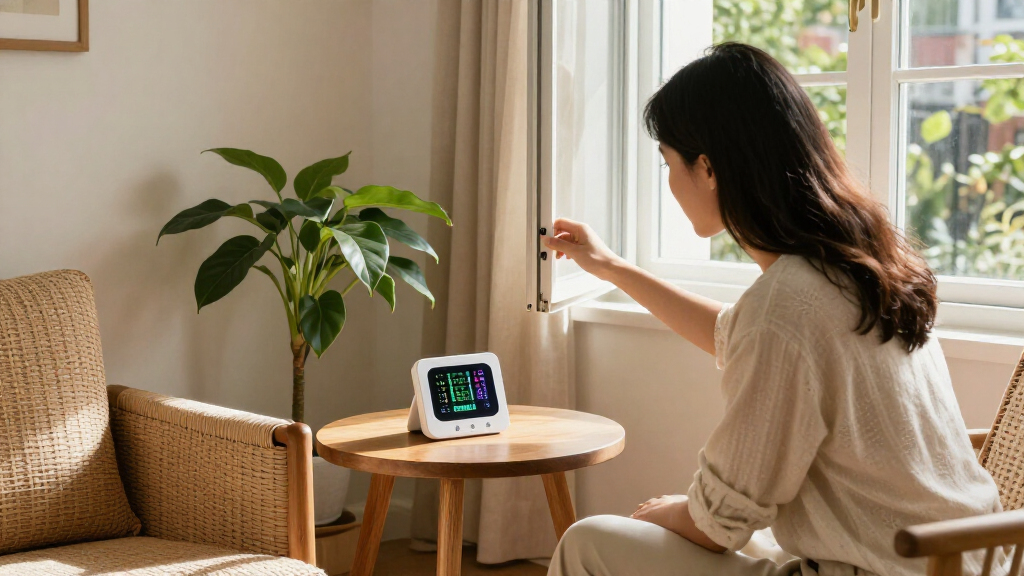
I compared these 14 indoor air quality monitors by the kinds of readings they target, how clearly their displays or connected features communicate those readings, and whether their design fits a specific household need. I gave more weight to useful measurement coverage and practical interpretation than to a large sensor count alone. Radon monitoring, focused CO2 tracking, room-to-room coverage, portability, and smart-home use each matter to different buyers, so I treated them as distinct strengths rather than interchangeable features.
The ranking favors products with a clear role and a useful balance of coverage, usability, and fit. The Airthings View Plus leads for buyers seeking a broad set of readings that includes radon; the Aranet4 ranks highly for focused CO2 monitoring; and Amazon’s monitor stands out for simpler connected use. Multi-sensor display models remain relevant for people who want several readings visible in one place, but they rank behind options with a more clearly defined advantage. I also considered tradeoffs such as reliance on an app, screen size, portability, and whether a single device or a two-pack better fits the monitoring plan.
| indoor air quality monitor | Charging |
|---|---|
| MORPTRA 16-in-1 Indoor Air Qua | — |
| Aranet4 Indoor Air Quality Mon | — |
| AprilAire ZAWTHCPV Smart Indoo | — |
| YNAK 16-in-1 Indoor Air Qualit | USB-C; AC adapter included |
| Amazon Smart Air Quality Monit | — |
| Amazon Smart Air Quality Monit | — |
| AirWhisper 16-in-1 Indoor Air | USB Type-C |
| Airthings View Plus Battery-Po | — |
| Heouakc 10-in-1 Indoor Air Qua | USB-C |
| 16-in-1 Indoor Air Quality Mon | USB Type-C |
| 16-in-1 Indoor Air Quality Mon | USB Type-C |
| Zemeollo 10-in-1 Portable Indo | USB charging cable |
| BREATHE Airmonitor Plus Gen 2 | — |
| YNAK AK22A 16-in-1 Indoor Air | USB-C |
Factors to Consider When Choosing Indoor Air Quality Monitors
Before choosing a monitor, I would start with the problem you want it to help clarify—not the number of readings on the box. A device can report conditions inside a room, but it does not diagnose a health issue or replace a specialist test when a serious concern arises.
Match the sensor to the question you need answered
Start by naming the concern: stale air in a busy room, fine particles, humidity, or possible radon exposure. CO2 is not a general air-quality score; it can help indicate ventilation conditions, but it does not measure every pollutant. Particle readings and radon monitoring address different questions, and a device that tracks one should not be treated as a substitute for the other. A broad monitor can be convenient, yet its readings are only useful if you know what each sensor measures and what action a reading might prompt. If you have a specific suspected hazard, check whether the monitor is designed for that measurement and use an appropriate dedicated test or professional assessment when needed.
Read beyond the sensor count
A label such as 10-in-1 or 16-in-1 can make devices seem easy to compare, but the count alone does not tell you how readings are produced or presented. Check the product information for the named measurements, units, stated accuracy, and any guidance on calibration or sensor life. Clarity and context matter: a readable value with a useful alert can be more actionable than a crowded screen full of unexplained numbers. Also distinguish direct measurements from calculated or estimated indicators. When product details leave those distinctions unclear, treat the extra readings as uncertain value rather than a reason by themselves to choose that model.
Choose a display and app setup you will actually use
A screen is helpful when you want to glance at conditions without opening a phone, especially in a shared room or workspace. App-connected models can make alerts and remote checks easier, but they may rely on Wi-Fi, accounts, or a compatible smart-home setup. Check what remains available without the app before choosing a connected monitor, including whether readings and alerts still work during an internet outage. Consider who needs to see the information: a large display may suit a household common area, while a compact device with phone access may fit a bedroom or travel use. The best interface is the one that makes it easy to notice a change and understand what it represents.
Plan where you will place the monitor
One monitor cannot describe every room in a home, and readings can vary with ventilation, occupancy, cooking, and nearby sources. Follow the manufacturer’s placement guidance rather than setting a device beside a window, vent, humidifier, or stove where local conditions may skew what it reports. Choose placement around the question: a CO2 monitor used to understand occupancy should be in the occupied space, while tracking a suspected room-specific issue may call for a different location. A two-pack can help compare separate rooms, but it is not automatically more useful than one well-placed device with the sensor coverage you need. For larger homes, decide whether you want a representative reading or room-by-room visibility.
Know when to pay for specialist coverage
Paying for more sensors makes sense only when those measurements support a real decision in your household. Radon monitoring is a distinct reason to spend more if that is a concern, while a CO2-focused unit may be a better fit when ventilation is the priority. Extra features can also bring more setup, a larger footprint, or greater reliance on an app. Compare ongoing needs such as power, battery replacement, sensor replacement, calibration, and software support, not only the initial feature list. If you need a formal result for a health, property, or compliance decision, check whether a consumer monitor is suitable for that purpose before relying on it.
Frequently Asked Questions
Can one indoor air quality monitor cover every room in my home?
Usually, one device gives you a reading for its immediate location, not a reliable picture of every room. Conditions can differ with cooking, occupancy, airflow, and the way each room is ventilated. A two-pack such as the Amazon Smart Air Quality Monitor (2-Pack) can help compare spaces, while one broader monitor may be more useful if you want several readings from a single location. Start by deciding whether your goal is a household overview or room-specific information. Place each unit according to its instructions and avoid treating one reading as a whole-home result.
Should I choose a multi-sensor monitor or a dedicated CO2 monitor?
Choose based on the question you want answered most often. A dedicated CO2 option such as the Aranet4 is a more focused fit for checking CO2 conditions, while multi-sensor models can show several types of indoor readings together. CO2 readings can help you understand ventilation patterns, but they do not stand in for particle, radon, or other pollutant measurements. If you have one clear priority, a focused device may make its information easier to interpret. If you want a broader snapshot, check that the multi-sensor model names its measurements and explains how to act on them.
Is a monitor with a large number of sensors always the better buy?
No. A high sensor count does not by itself show which readings are measured directly, how accurate they are, or whether they will help you make a decision. This roundup includes several 10-in-1 and 16-in-1 display models, so comparing the named sensors and their stated specifications is more useful than comparing the headline count. A smaller, focused monitor may be easier to use if you care mainly about CO2 or connected alerts. Choose breadth when you can identify a reason to use the added readings.
When should I choose a radon monitor instead of a general air-quality monitor?
If radon is the specific concern, choose a device designed to monitor radon, such as the Airthings View Plus, rather than assuming a general multi-sensor unit covers it. Radon is a separate measurement need from CO2, humidity, or particle monitoring. Check the device’s instructions for setup, placement, and how it reports readings over time, since the result may depend on how and how long it is used. For a formal property or health decision, check local guidance on suitable testing and whether a professional test is needed. A general monitor can still help with other indoor conditions, but it does not replace radon-specific monitoring.
Do I need Wi-Fi or an app to get useful readings?
Not always. A monitor with a built-in display can show readings locally, while an app-connected model may add remote access, alerts, or smart-home features. Before buying, check whether setup requires an account or network and what functions remain available if the connection fails. Amazon’s Smart Air Quality Monitor is a stronger fit for buyers who already want connected-home integration; a display-led device may suit someone who prefers direct access. Choose the interface that matches how you plan to check readings, rather than paying attention to connectivity features you will not use.
Conclusion
For the strongest all-around mix of monitoring scope, I would choose the Airthings View Plus, especially when radon belongs on your checklist. The Amazon Smart Air Quality Monitor is my value-oriented pick for buyers who want simple connected monitoring, while the Aranet4 is better for people focused on CO2 rather than a long list of sensors. For beginners who want readings visible without relying on an app, I would start with a clear-display model such as the MORPTRA 16-in-1, after checking its sensor details and placement guidance. The Amazon 2-Pack makes more sense for comparing separate rooms; the large-screen YNAK models suit buyers who prefer at-a-glance room displays. Pick the monitor around the measurement you need, then use its readings as guidance rather than a substitute for dedicated testing when a specific hazard is at stake.