To understand humidity ratios, you measure how much water vapor is present in the air compared to dry air, usually expressed in grams per kilogram. This involves collecting data on temperature and relative humidity, which are then used in psychometric analysis. By plotting these values, you can determine the moisture content accurately. Getting these measurements right helps you manage indoor humidity effectively, and if you keep exploring, you’ll discover even more about controlling moisture levels.
Key Takeaways
- Humidity ratio measures the grams of water vapor per kilogram of dry air, indicating moisture content.
- It is calculated using psychometric charts based on dry bulb temperature and relative humidity.
- Dew point corresponds to a specific humidity ratio, showing when condensation occurs.
- Accurate measurement involves sensors that assess moisture levels, often integrated into HVAC systems.
- Understanding humidity ratios helps control indoor humidity for comfort and air quality.
Have you ever wondered how moisture in the air affects comfort and air quality? Understanding humidity ratios starts with recognizing how moisture levels are measured and interpreted. One key concept is the dew point, which is the temperature at which air becomes saturated and water vapor begins to condense into dew. Knowing the dew point helps you gauge how humid or dry a space feels because it directly relates to the amount of moisture in the air. When the dew point is high, the air holds more moisture, making it feel muggy or sticky. Conversely, a low dew point indicates drier conditions, which can lead to discomfort like dry skin or respiratory irritation.
Understanding dew point helps gauge comfort by indicating moisture levels in the air.
To accurately assess humidity levels, professionals often turn to psychometric analysis. This process involves plotting temperature and humidity data on a psychometric chart, which provides a thorough view of the air’s properties. By analyzing these parameters, you can determine the humidity ratio—essentially, the amount of water vapor present in a given unit of air—expressed as grams of moisture per kilogram of dry air. Psychometric analysis allows you to see how temperature and humidity interact, helping you identify ideal conditions for comfort, health, or industrial processes. Additionally, understanding air moisture content** is fundamental for diagnosing environmental issues like mold growth or condensation**.
Using psychometric charts, you can also find the dew point corresponding to a specific humidity ratio. For example, if you measure the dry bulb temperature and relative humidity, you can locate the dew point on the chart, giving you a clear picture of moisture content. This is particularly useful in HVAC design and environmental control, where maintaining suitable humidity levels is vital for comfort and safety. It also helps in diagnosing issues like mold growth or condensation, which can arise from improper humidity regulation.
Understanding the relationship between dew point and psychometric analysis empowers you to make informed decisions about air quality management. Whether you’re adjusting a humidifier, dehumidifier, or ventilation system, knowing the dew point and humidity ratio helps you achieve desired comfort levels efficiently. It also guarantees that indoor environments stay within safe and comfortable humidity ranges, preventing problems associated with excess moisture or dryness.
In essence, grasping how moisture is measured through concepts like dew point and psychometric analysis gives you a practical way to control indoor air quality. You can better interpret humidity ratios and respond proactively to changing conditions. This knowledge makes it easier to create spaces that are not only comfortable but also healthier and more energy-efficient. So, next time you feel the air is too humid or too dry, understanding these fundamental measurements can guide you toward better environmental control.

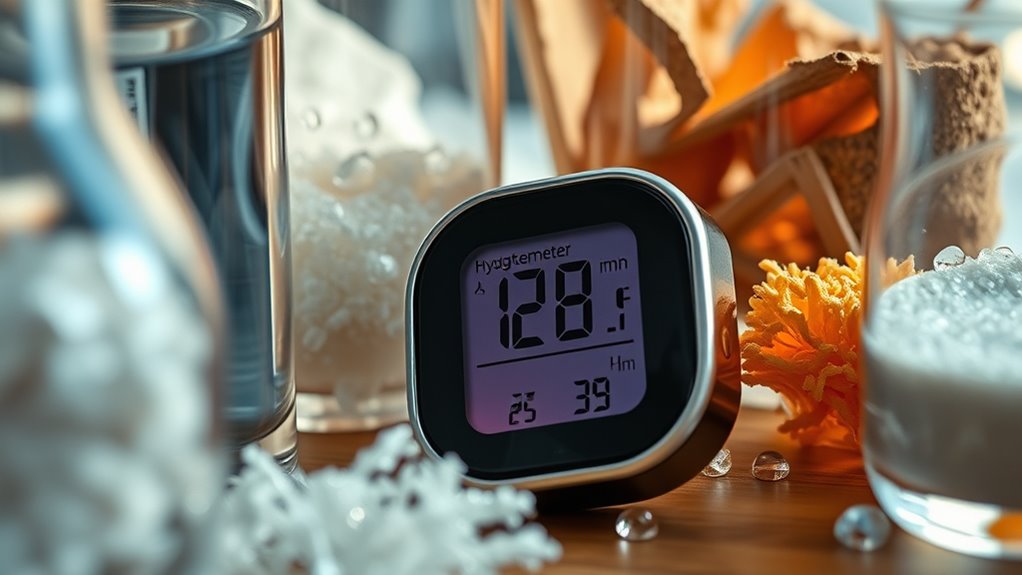
TempPro TP50 Digital Hygrometer Indoor Thermometer Room Thermometer and Humidity Gauge with Temperature Humidity Monitor(Previously ThermoPro)
- Wellness Indicator: Displays air condition levels
- High Accuracy & Fast Updates: Measures with ±2-3%RH and ±1°F, updates every 10 seconds
- Record Tracking: Displays high and low temperature and humidity
As an affiliate, we earn on qualifying purchases.
As an affiliate, we earn on qualifying purchases.
Frequently Asked Questions
How Does Humidity Affect Indoor Air Quality?
Humidity impacts your indoor air quality profoundly. High humidity can make rooms feel stuffy and promote mold growth, while low levels cause dryness and discomfort. Using humidity sensors helps you monitor moisture levels accurately, so you can adjust them accordingly. Maintaining ideal humidity prevents mold, improves air quality, and keeps your space comfortable. Proper control through humidity sensors ensures you’re creating a healthier environment and reducing mold risks effectively.
What Tools Are Best for Measuring Humidity Ratios?
Think of your tools as the guardians of comfort; a digital hygrometer is your best choice for measuring humidity ratios. Guarantee it’s properly calibrated for accuracy, and for precise moisture levels, use dew point measurement devices. These tools allow you to monitor indoor air quality effectively, helping you maintain ideal humidity. Regular calibration and using reliable dew point sensors will keep your readings trustworthy and your environment comfortable.
Can Humidity Levels Vary Throughout the Day?
Yes, humidity levels can vary throughout the day. In the morning, dawn humidity often rises as temperatures drop and dew forms. During the day, it can decrease as the sun heats the air, and in the evening, moisture levels tend to increase again as temperatures cool. These fluctuations happen naturally, affecting comfort and indoor air quality, so monitoring at different times helps you understand and control humidity better.
How Does Humidity Impact Energy Efficiency?
Humidity critically impacts energy efficiency by affecting your comfort and the workload on your HVAC system. When humidity control is poor, your space may feel stuffy or damp, causing you to use more energy for cooling or heating. Proper moisture management reduces the system’s effort, saving energy and lowering bills. Maintaining ideal humidity levels ensures better energy efficiency, making your environment more comfortable and reducing unnecessary energy consumption.
What Are Ideal Humidity Levels for Comfort?
You should aim for humidity comfort levels between 30-50% to feel most comfortable. Maintaining this range guarantees ideal moisture in the air, preventing dryness or excess humidity. When humidity is too low, your skin and respiratory system can become dry; too high, and you might experience mold or discomfort. Keeping humidity within this range balances comfort and health, creating an ideal environment for you to thrive.

Asurity WS-1 Wet Switch Flood Detector for Secondary Drain Pans, 24VAC Hydrophilic HVAC Flood Detection Shutoff Switch
- Flood Detection for HVAC: Automatically shuts off HVAC when water is detected
- Sensitive Water Detection: Detects as little as 1-2 drops of water
- Hydrophilic Sensor Pad: Uses capillary action for quick moisture detection
As an affiliate, we earn on qualifying purchases.
As an affiliate, we earn on qualifying purchases.
Conclusion
Understanding humidity ratios helps you grasp how moisture impacts comfort and equipment. By knowing how moisture is measured, you can make better decisions for indoor air quality and efficiency. Don’t forget, when it comes to humidity, it’s all about striking the right balance—too much or too little can throw things off. Keep your eyes open and stay informed, because in this game, knowledge is power, and you don’t want to be caught off guard.
As an affiliate, we earn on qualifying purchases.
TempPro TP50 Digital Hygrometer Indoor Thermometer Room Thermometer
- Wellness Indicator: Displays air condition levels
- High Accuracy & Fast Updates: Measures with ±2-3%RH and ±1°F, updates every 10 seconds
- Record Tracking: Displays high and low temperature and humidity
As an affiliate, we earn on qualifying purchases.
As an affiliate, we earn on qualifying purchases.