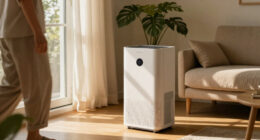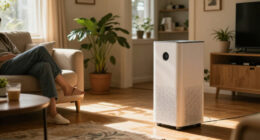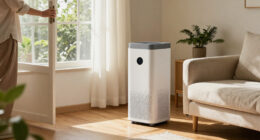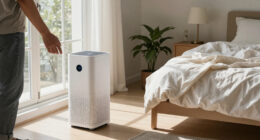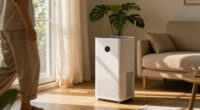
Choosing a whole-room air purifier is mainly a question of matching clean-air delivery to the room you actually use. A standard-capacity HEPA purifier can suit a bedroom or modest living room at a lower purchase cost. A high-capacity model moves more air, which can matter in a large open-plan space, a room with persistent particles, or a household that wants effective cleaning without running the fan at full speed.

Get home appliances delivered free with Prime
- Fast, free delivery on millions of items
- Prime Video, Amazon Music and more included
- Member-only deals all year

LEVOIT Vital 200S-P Smart Air Purifier for Large Rooms up to 1875 ft², Quiet 27 dB Operation, AHAM VERIFIDE, HEPA Sleep Mode, Whi…
- ✔ Coverage area: Up to 1,875 sq ft
- ✔ CADR, smoke: 250 CFM
- ✔ CADR, dust: 254 CFM

MOOKA PR1 Air Purifier – H13 True HEPA, Up to 2200 ft²
- ✔ Coverage area: Up to 2,200 sq ft
- ✔ Filter: Four-stage H13 True HEPA
- ✔ Sleep noise: 26 dB

KNKA APH4000 Air Purifier, White – Covers up to 1,695 ft²
- ✔ Coverage at 4.8 ACH: Up to 350 sq ft
- ✔ Maximum coverage: Up to 1,695 sq ft at lower efficiency
- ✔ CADR, smoke/dust/PM2.5: 226 CFM (384 m³/h)
The comparison is not simply about the largest advertised room size. Coverage claims depend on how often the unit cycles the room air, and a purifier rated for a very large area may clean more slowly there than its headline suggests. Standard units often make more sense for contained rooms and tighter budgets; high-capacity units are better suited to larger spaces, faster particle removal, or quieter operation at a useful setting. Filter costs, noise, and placement can change the value of either choice.
At a Glance
| Criteria | Standard-capacity HEPA air purifier | High-capacity HEPA air purifier | Winner |
|---|---|---|---|
| Suitable room size | Best matched to bedrooms and modest, enclosed rooms; check the clean-air delivery rate against room volume. | Better suited to large rooms and open-plan areas when its rated delivery matches the space. | B |
| Clean-air delivery | Lower airflow generally means slower particle removal in a larger room. | Higher airflow can clear airborne particles faster or maintain cleaning at a lower fan setting. | B |
| Noise at useful settings | May need a higher, louder fan setting to clean quickly. | Can be quieter than a smaller unit while delivering a similar amount of filtered air, but not necessarily quiet at maximum speed. | Depends |
| Purchase cost | Usually less expensive upfront. | Usually costs more upfront. | A |
| Filter upkeep | Replacement filters are often smaller or less costly, though model prices vary. | Larger or more frequent replacement filters can raise ongoing costs. | A |
| Placement and portability | Often compact and easier to position or move between rooms. | Often larger and heavier, requiring more floor space and a suitable outlet location. | A |
| Value for different households | Strong value when one unit serves a smaller room at an appropriate cleaning rate. | Worth the premium when extra capacity is used regularly; poor value if oversized for a small room. | Depends |
LEVOIT Vital 200S-P Smart Air Purifier for Large Rooms up to 1875 ft², Quiet 27 dB Operation, AHAM VERIFIDE, HEPA Sleep Mode, Whi…
For buyers trying to choose a purifier for an open living area or a connected set of rooms, the LEVOIT Vital 200S-P gives us the clearest basis for comparing whole-room performance. Its AHAM VERIFIDE certification and separate CADR figures—250 CFM for smoke, 254 CFM for dust, and 289 CFM for pollen—make the cleaning claims more interpretable than a coverage figure on its own. That transparency is why we rank it ahead of the MOOKA PR1, whose supplied specs list a larger maximum area but no CADR values.The LEVOIT is rated for spaces up to 1,875 square feet, and its stated 27 dB sleep operation makes it a plausible choice where the purifier will stay on near a bedroom. Buyers can also choose among filter options aimed at toxins, smoke, or pet allergies. That flexibility sets it apart from the KNKA APH4000, which offers Pet mode but provides less detail about filter variants. It also helps households narrow their filtration choice to a concern they actually have.There are real compromises. The body may take up too much floor space in a small room, and filter replacement is an ongoing maintenance expense. The large-room figure is not itself a promise of a particular air-change rate across every layout, so we would size the unit to the actual room and cleaning needs. Compared with the KNKA’s especially quiet sleep setting, the LEVOIT’s 27 dB is slightly higher on paper; its stronger case is the clearer performance documentation and broader stated room coverage.
Pros:
- AHAM VERIFIDE certification with separate smoke, dust, and pollen CADR figures
- Advertised for rooms up to 1,875 square feet
- Quiet 27 dB sleep operation is suited to bedrooms and living spaces
- Optional filters target toxins, smoke, or pet allergies
Cons:
- Large footprint may be awkward in compact rooms
- Regular filter replacement adds ongoing maintenance expense
- The maximum area does not specify an air-change rate for every room size
Best for: Households seeking a large-room purifier with independently certified performance context, distinct CADR figures, and filter choices for smoke, allergens, or pet concerns.
Not ideal for: Buyers with very limited floor space, or those who prioritize the lowest listed sleep-mode noise above performance benchmarks and filter choice.
Bottom line: We rank the LEVOIT first for whole-room use because its certified performance context and multiple CADR figures make its claims easier to evaluate than the lineup’s larger but less detailed coverage claims.
“We rank the LEVOIT first for whole-room use because its certified performance context and multiple CADR figures make its claims easier to evaluate than the lineup’s larger but less detailed coverage claims.”
MOOKA PR1 Air Purifier – H13 True HEPA, Up to 2200 ft²
The MOOKA PR1 earns its place for buyers who want pet-focused controls and the broadest advertised coverage in this group. Its stated maximum of 2,200 square feet exceeds the LEVOIT’s 1,875-square-foot rating, and the dedicated Pet Mode gives owners a straightforward way to select an operation setting aimed at pet-related air concerns. A washable pre-filter can also make routine hair and dust cleanup more manageable, while the real-time PM2.5 display offers a visible indication of measured fine particles.Its four-stage H13 True HEPA filtration and six fan modes, including Auto and Sleep, make the PR1 more configurable than the KNKA APH4000, which lists four fan speeds and four operating modes. At a stated 26 dB in sleep mode, it is close to the LEVOIT’s 27 dB and quieter on paper by one decibel. That small difference should not outweigh room fit, but it supports leaving the purifier running in a space where low noise matters.The tradeoff is that the MOOKA’s headline area is not accompanied here by CADR figures or a stated air-change rate, so we cannot compare its cleaning intensity as directly with the LEVOIT or KNKA. Buyers should avoid assuming that 2,200 square feet means equally rapid cleaning at that size. The aroma feature also takes extra preparation of its pad, and the preheating indicator may confuse first-time users. We would choose it over the LEVOIT when Pet Mode and maximum advertised coverage matter more than detailed performance benchmarks.
Pros:
- Highest advertised maximum coverage in this group at 2,200 square feet
- Dedicated Pet Mode and washable pre-filter support pet-focused upkeep
- Real-time PM2.5 monitoring provides visible air-quality feedback
- 26 dB sleep mode and six operating modes offer flexible use
Cons:
- Supplied specifications do not include CADR or an air-change rate for its maximum area
- Aroma pad requires extra preparation
- Preheating indicator may be confusing for new owners
Best for: Pet owners who want a dedicated Pet Mode, a washable pre-filter, real-time PM2.5 information, and a purifier advertised for a particularly large area.
Not ideal for: Buyers who need CADR-based comparisons or an air-change rate at the maximum stated coverage, or who prefer simpler controls without an aroma-pad feature.
Bottom line: We recommend the MOOKA for pet households that value its dedicated mode and high advertised coverage, while buyers who need clearer whole-room cleaning benchmarks should favor the LEVOIT.
“We recommend the MOOKA for pet households that value its dedicated mode and high advertised coverage, while buyers who need clearer whole-room cleaning benchmarks should favor the LEVOIT.”
KNKA APH4000 Air Purifier, White – Covers up to 1,695 ft²
The KNKA APH4000 is our pick for buyers who would rather match a purifier to a realistic room size than rely on its biggest coverage number. Its specifications distinguish 350 square feet at 4.8 air changes per hour from coverage up to 1,695 square feet at lower efficiency. That caveat is useful for whole-room decisions: the lower figure gives a more meaningful reference for frequent air cleaning, while the maximum describes a broader but less intensive use case.Its stated 22–24 dB sleep mode is the quietest in this lineup, below the MOOKA’s 26 dB and the LEVOIT’s 27 dB. That makes the KNKA a compelling option for a bedroom or other quiet room when its effective cleaning range fits. It has a washable pre-filter, HEPA and activated carbon stages, a real-time color-coded AQI display, and Pet, Eco, Sleep, and Auto modes. The LEVOIT offers more filter-choice detail and the MOOKA a dedicated pet-oriented pitch, but the KNKA combines a useful operating range with particularly low stated sleep noise.Its 226 CFM smoke, dust, and PM2.5 CADR and 244 CFM pollen CADR provide helpful comparison points, though they are lower than the LEVOIT’s listed values in each corresponding category. The main limitation is therefore scale: a buyer looking to clean a very large open-plan space should not treat 1,695 square feet as equivalent to the KNKA’s 350-square-foot, 4.8-ACH figure. Filters are listed for replacement every three to six months. We would choose it for quieter, appropriately sized rooms, and look to the LEVOIT for stronger listed CADR figures or the MOOKA for greater advertised maximum coverage.
Pros:
- Quietest stated sleep setting in this group at 22–24 dB
- Coverage is specified as 350 square feet at 4.8 air changes per hour
- Real-time AQI display and Pet, Eco, Sleep, and Auto modes
- Washable pre-filter plus HEPA and activated carbon filtration stages
Cons:
- Maximum 1,695-square-foot coverage is stated at reduced efficiency
- CADR figures are lower than the LEVOIT’s listed figures
- Filters require replacement every 3–6 months
Best for: Sleep-sensitive buyers who want very low stated noise, AQI feedback, and a room-sized recommendation anchored to a stated 4.8 air changes per hour.
Not ideal for: People seeking frequent air cleaning across a very large open-plan area, or those who need the highest listed CADR values in this comparison.
Bottom line: The KNKA is the strongest fit for quiet use in a room sized to its 350-square-foot, 4.8-ACH guidance, but its maximum coverage should not be read as equivalent high-intensity cleaning.
“The KNKA is the strongest fit for quiet use in a room sized to its 350-square-foot, 4.8-ACH guidance, but its maximum coverage should not be read as equivalent high-intensity cleaning.”
As an Amazon Associate we earn from qualifying purchases.
Key Differences
Capacity determines how well a purifier can serve the room at a tolerable speed. In a large or open space, a high-capacity model has the clearest advantage: it can move more air through its filter, helping it reduce airborne particles faster. It may also deliver a comparable cleaning rate at a lower fan setting than a smaller unit. A standard-capacity purifier can still be a sensible whole-room choice in a bedroom or smaller living area, but it may need to run harder to keep up in a bigger space.
The premium only pays off when the extra delivery suits the room or the way you use it. A larger purifier brings a higher initial price, more substantial filters in many models, and a bigger footprint. For a small bedroom, those costs and space demands may buy capacity you rarely use. For a large shared room, or when noise at the required cleaning rate matters, the additional airflow can make the room easier to serve. Compare clean-air delivery rates and filter costs for the exact models; a broad area claim alone does not establish how quickly a unit will clean your room.
Detailed Comparison
Suitable room size (High-capacity HEPA air purifier wins — major)
High-capacity wins for larger spaces; the gap is major when room size exceeds the standard unit’s practical range. A standard purifier is a good fit for a contained bedroom or modest room if its clean-air delivery rate matches the space. A high-capacity model can serve a larger room or open plan more effectively. Check the rating against your room’s area and ceiling height, and confirm what cleaning rate the manufacturer uses for its coverage figure. A single unit may have limited reach around walls, closed doors, and separated rooms.
Clean-air delivery (High-capacity HEPA air purifier wins — major)
High-capacity wins, usually by a moderate to major margin. A higher airflow rate gives more filtered air per hour, which can reduce airborne particles faster when conditions are otherwise similar. That is useful during cooking, after cleaning, or in a room with ongoing particle sources. A standard unit can still provide useful filtration in a smaller room, but is less likely to keep pace in a large one. Compare clean-air delivery rates for the relevant particle type rather than treating “HEPA” alone as a measure of whole-room speed.
Noise at useful settings (moderate difference)
Depends on how each unit is sized for the room; the difference is moderate. A high-capacity purifier may clean at a lower fan setting than a standard model, which can make it a better fit for a large bedroom or living area where constant noise is unwelcome. In a small room, the standard unit can often run gently too, while the larger unit may still be audible or take up more space. Maximum-speed noise is not the only useful measure: compare sound ratings at settings that deliver a suitable cleaning rate.
Purchase cost (Standard-capacity HEPA air purifier wins — moderate)
Standard-capacity wins on upfront cost; the difference is usually moderate. Smaller units generally cost less to buy, so they make more sense when their delivery rate is enough for the intended room. A high-capacity purifier charges more for airflow and often larger components. That additional price is justified only if you need its room coverage, faster cleaning, or lower fan speed for the same task. A cheap unit that is undersized for the room can become a false saving if it must run loudly or still cannot meet the cleaning need.
Filter upkeep (Standard-capacity HEPA air purifier wins — minor)
Standard-capacity often wins on replacement cost, with a minor to moderate gap that varies by model. Its filters may be smaller and less expensive, while high-capacity machines can use larger filters that cost more. Replacement intervals depend on use, air quality, and the manufacturer’s guidance, so purchase price alone does not show lifetime cost. Compare the price and recommended service life of replacement filters before buying. Both types need the right replacement filter and any routine prefilter cleaning the manual specifies.
Placement and portability (Standard-capacity HEPA air purifier wins — moderate)
Standard-capacity wins by a moderate margin for homes with limited floor space or changing needs. A compact unit is usually easier to place beside a bed or move between rooms. High-capacity models tend to take up more room and can be heavier, which may make repositioning less convenient. In return, the larger machine may be the more practical single-unit solution for a spacious shared room. Keep air inlets and outlets clear and follow the model’s placement guidance; hiding a purifier behind furniture can limit airflow.
Value for different households (major difference)
There is no universal winner; the difference is major when the unit’s capacity is mismatched to the room. A standard purifier offers better value for someone cleaning one enclosed, smaller room without demanding fast turnover. The high-capacity option delivers better value when the space is large, airborne particles are a recurring concern, or a lower fan setting is needed to keep the unit running. Oversizing a small room can waste purchase and filter money; undersizing a large room can compromise cleaning rate or comfort.
Standard-capacity HEPA air purifier: Pros and Cons
Pros:
- Lower purchase price in many product ranges.
- Compact size can suit bedrooms, small living rooms, and tighter floor plans.
- Often easier and less costly to move or maintain.
Cons:
- May clean a large room slowly or need a louder, higher fan setting.
- Coverage claims can be misleading if they do not state the assumed cleaning rate.
- One unit may not serve multiple closed or separated rooms effectively.
High-capacity HEPA air purifier: Pros and Cons
Pros:
- Higher airflow better suits large rooms and open-plan areas.
- Can clean faster or operate at a lower fan setting for a comparable delivery rate.
- More capacity leaves headroom when particle levels rise or the room is busy.
Cons:
- Higher upfront cost and potentially more expensive replacement filters.
- Larger footprint can constrain placement in a bedroom or apartment.
- Extra capacity offers little benefit if the intended room is small and already well served.
Who Should Choose What
Choose Standard-capacity HEPA air purifier if:
- You need filtration for one enclosed bedroom, office, or modest living room.
- The model’s clean-air delivery matches your room and preferred cleaning rate.
- You want a lower-cost, compact unit and accept that fast cleaning may require a higher fan setting.
Choose High-capacity HEPA air purifier if:
- You want to serve a large living room or open-plan area with one purifier.
- You prefer faster particle removal or quieter operation at the cleaning rate your room needs.
- Your household has recurring particle sources and the higher filter and purchase costs fit your budget.
Skip both if: Skip a single whole-room unit if your goal is to clean several closed rooms at once; compare room-by-room units or a system designed for whole-home filtration.
Value for Money
Paying more for high capacity is worthwhile when the extra airflow matches a large room, shortens the time particles remain airborne, or lets the unit run at a lower and more comfortable speed. In those cases, the premium buys useful performance rather than a larger number on the box. Check the clean-air delivery rate at the fan speed you can tolerate and include replacement filters in the cost comparison.
For a small room, the standard-capacity model is generally the better value if its delivery rate is adequate. A larger unit can cost more while providing little practical benefit in that setting. The best value is the least expensive model that can maintain the cleaning rate you need without forcing you to tolerate excessive noise or frequent filter expense.
Final Verdict
Choose a standard-capacity HEPA purifier for a bedroom or modest enclosed room when its clean-air delivery matches the space. It is the better buy for most people with that use case because it costs less and takes up less room. Choose a high-capacity model for a large or open-plan space, or when you need faster cleaning and want the option of running at a lower fan setting. The deciding factor is the delivery rate your room requires at a noise level you can live with. Do not pay the high-capacity premium just for a bigger coverage claim; pay it when the room and use make the extra airflow count.
Frequently Asked Questions
Does a high-capacity purifier clean the whole home?
Usually not if the home has several closed rooms. A purifier circulates and filters air in its surrounding space, and walls and doors limit that movement. Use a unit sized for the room people occupy, or compare a whole-home filtration system designed to work with central heating and cooling.
Is HEPA filtration enough to compare two whole-room purifiers?
No. HEPA describes filtration, while clean-air delivery indicates how much filtered air a unit supplies. Compare both the filter specification and delivery rate, then check the rate at the fan setting you expect to use.
Should I buy a purifier rated for a larger room than mine?
It can provide useful headroom or allow a lower fan setting, but it may cost more and occupy more space. If those benefits do not matter to you, choose a model whose delivery rate already meets your room’s needs.
Is a high-capacity purifier worth more for allergies?
It can be a better fit when the room is large or you want to remove airborne particles more quickly. Capacity alone does not resolve allergy symptoms, and performance depends on room size, placement, filter condition, and consistent use.