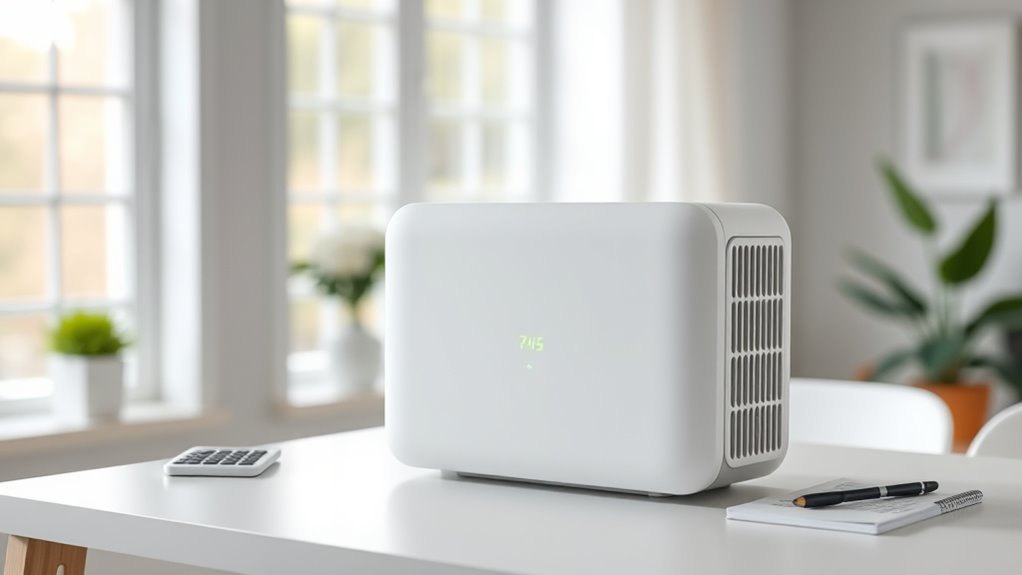

To estimate your air purifier’s running costs, first check its wattage, usually listed on the label or manual. Then, multiply that by the hours you run it each day to get daily energy use. Convert that to kilowatt-hours by dividing by 1000, and multiply by your local electricity rate to find your daily expense. Keep in mind, factors like fan speed and filter maintenance affect consumption—learn more to optimize your costs.
Key Takeaways
- Find the device’s wattage from labels or manuals to estimate energy use.
- Calculate daily energy consumption by multiplying watts by hours of operation.
- Convert watt-hours to kilowatt-hours by dividing by 1000 for cost calculations.
- Multiply kWh by your local electricity rate to determine daily and monthly costs.
- Use energy-efficient models and optimize settings to reduce overall power expenses.
Understanding how much energy your air purifier consumes is essential for managing both your electricity bill and environmental impact. Knowing the energy efficiency of your device helps you determine how much power it uses during operation and allows you to make informed decisions about its long-term costs. Air purifiers vary greatly in their energy consumption, depending on factors like size, filtration technology, and usage patterns. By understanding these elements, you can choose a model that balances effective air cleaning with low operating costs.
Most air purifiers list their power consumption in watts, typically on the product label or in the user manual. This number indicates how much energy the device uses when running at full capacity. However, actual consumption often fluctuates based on the fan speed setting. Higher speeds generally consume more power, while lower settings are more energy-efficient. If you’re concerned about reducing your electricity bill, operating your purifier at the lowest effective setting is usually the best approach. Many modern models also feature auto modes that adjust fan speed based on air quality, optimizing energy use without sacrificing performance.
To accurately estimate your operating costs, start by noting the wattage of your air purifier. For example, if your device uses 50 watts, and you run it for 8 hours daily, you’re consuming 400 watt-hours, or 0.4 kilowatt-hours (kWh) per day. Multiplying this by your local electricity rate, say $0.12 per kWh, gives you a daily cost of about 4.8 cents. Over a month, that adds up to roughly $1.44. This calculation highlights the importance of choosing an energy-efficient model, especially if you plan to run it continuously. Devices with better energy efficiency ratings can considerably reduce your overall operating costs over time.
Another aspect to consider is the device’s energy star rating, which indicates higher energy efficiency standards. An air purifier with this certification uses less power for the same level of air cleaning, helping you save money and reduce your environmental footprint. Regular maintenance, like changing filters as recommended, also ensures your purifier runs efficiently, preventing unnecessary energy drain. Keep in mind that newer models tend to be more energy-efficient thanks to advancements in motor and fan technology, making them a smarter investment in the long run. Additionally, understanding the air purifier features and technology can help you select a model that maximizes efficiency and health benefits.
Frequently Asked Questions
How Does Room Size Affect an Air Purifier’s Energy Use?
Room size directly impacts an air purifier’s power consumption because larger spaces require the device to work harder and run longer to clean the air effectively. If your room is bigger, expect higher energy use and increased electricity costs. To optimize efficiency, choose an air purifier with a suitable capacity for your room size, ensuring it runs efficiently without consuming unnecessary power.
Do Energy-Efficient Models Cost Less to Operate Long-Term?
If you choose an energy-efficient model, you’ll likely spend less on operation costs over time. For example, a recent case study showed that an ENERGY STAR-rated purifier saved users around 30% on energy bills. These models often have lower noise levels and require less frequent filter maintenance, further reducing costs. So, investing in an efficient unit can save you money and keep your space quieter and cleaner long-term.
Can Using an Air Purifier at Lower Settings Save Power?
Yes, using an air purifier at lower settings can save power. Look for models with Energy Star certifications, as they are designed to be energy-efficient. Keep noise level considerations in mind too, since quieter settings often mean less energy use. By adjusting the settings and choosing certified, quiet models, you reduce power consumption and keep your space comfortable without increasing costs.
How Often Should I Run My Air Purifier to Save Energy?
Think of your air purifier as a vigilant guardian—run it only when needed. To conserve energy, operate it during high pollution periods or when air quality monitoring indicates poor air. Regular maintenance keeps it efficient, so change filters timely. Running it 8-12 hours daily strikes a balance between clean air and power use, but adjusting based on air quality ensures you’re not wasting energy when it’s unnecessary.
Are There Eco-Friendly Air Purifiers With Minimal Power Consumption?
Yes, you can find eco-friendly air purifiers that focus on low power technology and eco-friendly features. Look for models with Energy Star certification, which guarantees minimal energy use. These purifiers often incorporate energy-efficient motors and filters that reduce power consumption while maintaining air quality. By choosing such devices, you save energy, lower your environmental impact, and enjoy cleaner air without high electricity costs.
Conclusion
Now that you know how to calculate your air purifier’s power, you can see it’s like tuning a delicate instrument—balancing clean air with energy costs. Think of it as guiding a gentle breeze through your home’s corridors without letting it turn into a storm. With this knowledge, you can keep your air fresh and your wallet happy, turning everyday choices into a symphony of efficiency and comfort. Your home’s air quality is now within your masterful grasp.