TL;DR

Get home appliances delivered free with Prime
- Fast, free delivery on millions of items
- Prime Video, Amazon Music and more included
- Member-only deals all year
Automatic air purifiers usually use particle sensors to adjust fan speed, but their readings do not measure every indoor pollutant. Choose a unit with suitable clean-air delivery for the room, clearly specified filters, tolerable noise, and affordable replacements; keep it unobstructed and address pollution sources too.
The purifier’s colored air-quality ring turns red just as you start frying onions. That glow can be useful, but it does not mean the machine has measured every smell or pollutant in your kitchen. Automatic air purifiers for home settings generally respond to particles in the air, then raise or lower fan speed.
This guide explains what “automatic” actually means, how to match a purifier to a room, and which features deserve your money. You’ll also see where sensors and smart controls help—and where they leave important questions unanswered.
With a few checks, you can pick a purifier that fits your room and routine, instead of buying a glowing display that cannot keep up with the air you want to clean.
Automatic mode usually changes fan speed in response to estimated particle readings; it may not detect gases or carbon dioxide.
Match CADR and stated coverage assumptions to the actual room, including its ceiling height and the cleaning rate you want.
Choose specified particle filtration for dust, pollen, smoke particles, or dander; odors and some gases may call for suitable activated carbon.
Compare noise, power, and replacement-filter cost at settings you can live with, especially if the purifier will run in a bedroom.
Keep the purifier unobstructed and use source control and ventilation alongside it; a portable unit does not reliably clean a whole home.
What automatic mode can—and can’t—tell you
An automatic air purifier uses a sensor to estimate changes in the air and adjusts its fan speed in response. Most commonly, the sensor tracks airborne particles, such as dust or smoke; the exact sensors and controls vary by model. That makes “automatic” a feature label, not a promise that the machine measures every pollutant.
Imagine you toast bread and the sensor detects a burst of particles. The purifier may ramp up with a louder rush of air, then slow as the reading falls. But that display may not detect carbon dioxide, gases, or every odor. Different brands may also calculate their color-coded scores differently, so a green light on one model does not necessarily match a green light on another.
Auto mode is a convenience feature, not a full indoor air-quality report. It can respond to short-lived particle bursts, too, which may mean a noisy fan during cooking even when the source is already fading. If you are comparing models, look for a clear explanation of what the sensor detects rather than relying on a vague “smart air” claim.
A sensor can help you spot particle changes; it cannot tell you everything that is in your air.
For example, a parent might use the reading to notice that a child’s room gets dusty after vacuuming. That is a helpful clue. It is not proof that every allergen or gas has disappeared.
Products Worth Considering

Bose SoundLink Max Portable Bluetooth Speaker, Black

Dyson V8 Cyclone Cordless Vacuum

Samsung 48 4K OLED Smart TV (2026) with WireLogic 8ft Ultra High Speed HDMI Cable
As an affiliate, we earn on qualifying purchases.
Match the purifier to the room, not the biggest coverage claim
Choose an air purifier by matching its clean-air delivery rate (CADR), where available, to the room and the pollutants you want to reduce. A manufacturer’s maximum coverage area can sound impressive, but it may assume a particular ceiling height and a low rate of air changes per hour. Compare the assumptions behind the number.
Start with the room where the purifier will run most: measure its floor area, note the ceiling height, and check the model’s CADR for the relevant pollutant. If wildfire smoke is your concern, for example, compare the smoke rating rather than choosing a device based only on a general square-footage figure. A large open living room with high ceilings places a different demand on a purifier than a small bedroom.
One portable unit usually serves the room it occupies. A purifier in the hallway cannot reliably clean a bedroom behind a closed door. If you want cleaner air in two separate spaces, you may need a suitable unit in each, or a practical way to run one where you spend the most time.
Picture a 12-by-14-foot bedroom with the door shut most nights. A purifier sized for that space, placed with clear airflow around its intake and outlet, has a much better chance of treating the room than a powerful unit tucked behind a curtain in the next room. Placement is part of performance.
Coverage numbers remain useful when the model states its assumptions. When the label offers only a huge area figure without CADR or cleaning-rate context, treat it as a starting point for questions, not a guarantee.
Choose filters for the particles, smoke, and smells you have
For dust, pollen, smoke particles, and pet dander, look for a clearly specified mechanical particle filter and check whether it is a certified HEPA filter or a less-defined “HEPA-type” product. That wording matters: “HEPA-type” does not necessarily mean the filter meets the same performance standard as certified HEPA. For odors and some gases, a particle filter alone may not be enough.
Activated carbon can help reduce some odors and gases, but results depend on the amount and type of carbon. A thin carbon-coated sheet may have limited capacity. If your main complaint is a lingering cooking smell, check the filter construction and the maker’s claims; a purifier designed mainly for pollen may not offer much odor control.
Match the filter to the problem. On a smoky evening, the particle portion of smoke is a reasonable target for mechanical filtration, while gas compounds and smells call for suitable sorbent media. No portable purifier removes every indoor contaminant, and it cannot fix the source of a problem such as a damp wall or poor ventilation.
For a concrete example, a home with two cats may benefit from a well-specified particle filter that captures airborne dander, plus regular vacuuming and washing of pet bedding. The purifier helps with what floats through the air; cleaning the sofa cushions addresses particles that have already settled. That teamwork is more realistic than expecting one machine to erase the source.
Use this five-step checklist before you buy
Compare a purifier’s room capacity, filters, noise, upkeep, and emissions before you buy. Those five checks tell you more about day-to-day usefulness than an app screenshot or a long feature list. Here’s a simple way to make the choice manageable.
- Define the room and concern. Measure the space and decide whether your priority is dust, pollen, smoke particles, pet dander, or odors. A bedroom choice may need a quieter setting than a workshop.
- Check CADR and coverage assumptions. Look for an independently reported CADR where available, and ask what room size and air-change rate the coverage claim assumes.
- Read the filter specification. Confirm what the particle filter is, whether carbon is included for odors or gases, and how replacement filters are sold.
- Compare noise and power at usable speeds. A high fan setting may clean faster, but a machine that wakes you up can end up switched off. Compare published figures at the settings you expect to use.
- Review upkeep and emissions. Check replacement-filter availability, price, and replacement guidance. Avoid devices that intentionally generate ozone; check whether ionizing or plasma features can be disabled and whether credible emissions information is provided.
Consider a light sleeper shopping for a bedroom purifier. They might pick the highest-CADR model, then discover its useful speed sounds like a hair dryer at midnight. A slightly different model with enough room capacity at a tolerable setting may serve them better over time.
Filter reminders are useful, but a light may count elapsed time rather than directly measuring filter performance. Follow the manufacturer’s guidance and inspect filter condition. Dust buildup or restricted airflow can reduce how well a unit works.
Make auto mode work with your real daily routine
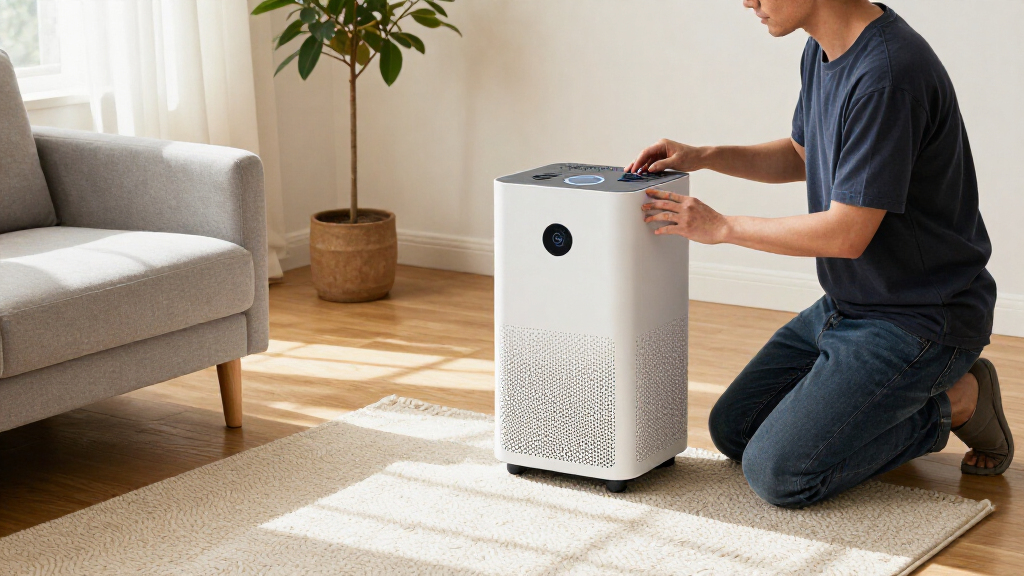
Automatic air purifiers work best when they have clear airflow and run in the room you want to treat. Leave space around the intake and outlet, follow the manufacturer’s placement instructions, and avoid hiding the machine behind furniture. A blocked purifier is a bit like a fan pressed against a wall: it cannot move air freely.
Auto mode can suit a room where pollution changes during the day. If someone cooks frequently, for instance, the sensor may raise the fan after a frying session and lower it later. But the brief burst can sound distracting in an open-plan home, so check whether the model offers a manual speed setting, schedule, or app control.
Continuous operation can help maintain cleaner air, but the right schedule depends on room conditions, noise, energy use, and the purifier’s capacity. Some people may run a unit at a quiet setting overnight and use a stronger setting while away. Others may prefer auto mode throughout the day. Compare published noise and power figures at the settings you are likely to use, not only the maximum setting.
Smart controls can add remote adjustments, schedules, and filter reminders. They may make operation easier, but they do not automatically mean better filtration or more dependable readings. If you like checking your phone before bed, remote control could be useful; if you never open the app, the feature may add little value.
Remember that a purifier supports source control and ventilation; it does not replace them. Open windows when outdoor conditions are suitable, deal with moisture problems at their source, and use appropriate alarms for carbon monoxide. A purifier cannot prevent carbon monoxide exposure.
Spend on performance before paying extra for smart features
The useful comparison is not “smart versus basic”; it is whether the model meets your cleaning needs at a noise level and running cost you can live with. Automatic controls can save you from adjusting the fan after every dusty task, but a phone app cannot compensate for an undersized unit or an unclear filter specification.
| What to compare | Why it matters | Example to ask |
|---|---|---|
| CADR and room assumptions | Shows whether the unit can deliver useful clean air for your space. | Does the rating suit my bedroom’s size and ceiling height? |
| Particle and carbon filters | Different media target particles, odors, and some gases differently. | Is this certified HEPA, HEPA-type, or another specified filter? |
| Noise and power | High speed may clean faster, but can be too loud for sleep. | What are the figures at a speed I’ll actually use? |
| Replacement filters | Availability and cost shape the ongoing expense. | Can I buy the right replacement filter reliably? |
| Sensors and emissions | Readings are estimates, and some features need scrutiny. | What does the sensor measure, and can ionizing features be disabled? |
Suppose two units both advertise automatic mode. One has a clear CADR, transparent replacement-filter costs, and a quiet low setting. The other offers voice control and a colorful display but provides little detail about room assumptions. For a bedroom, the first may be the stronger everyday choice—even if its app looks less exciting.
Buy for the air cleaning you can verify and afford to maintain. Think about total cost, not just the price on the box. A model with readily available filters may be easier to keep running than a bargain device whose replacements are hard to find.
Claims about capturing allergens or viruses deserve careful reading. Filtration can reduce airborne particles under suitable conditions, but it does not guarantee that nobody gets sick or remove every exposure. Use purifier claims as part of a comparison, not a promise about health outcomes.
Frequently Asked Questions
What does “automatic” mean on an air purifier?
It usually means a sensor estimates changes in airborne particles and adjusts the fan speed. Sensors and controls vary by model, and a particle sensor may not detect gases, carbon dioxide, or every pollutant.
Can one purifier clean my whole house?
Usually, no. A portable purifier generally treats the room or open area where it sits, and closed doors limit airflow between spaces. If you want cleaner air in separate bedrooms, consider where each unit would run.
Will an air purifier remove smoke odors?
A mechanical particle filter can capture much of the particle portion of smoke. Odors and some gases may call for suitable activated carbon, and effectiveness depends on the amount and type of carbon in the filter.
How often should I replace the filter?
Follow the manufacturer’s replacement guidance and check the filter condition. Timing varies with use and pollution; a reminder light may be based on elapsed time rather than a direct measurement of filter performance.
Are automatic air-quality readings accurate?
They can help you track particle changes, but they are estimates rather than a complete measure of indoor air. Different brands may use different sensors and scoring methods, so their displays are not always comparable.
Do smart features mean better air cleaning?
Not necessarily. Apps, schedules, voice controls, and reminders can make a purifier easier to use, but they do not prove stronger filtration or more reliable measurements. Check CADR, filter specifications, and upkeep costs as well.
Conclusion
Choose an automatic purifier by starting with the room, then checking its CADR, filter details, tolerable noise, and replacement costs. Treat the sensor as a useful particle-change clue, not a complete report on your home’s air.
Place the unit where air can move freely, maintain its filters, and tackle pollution at its source. The best purifier is the one that quietly keeps doing its job while you get on with yours.