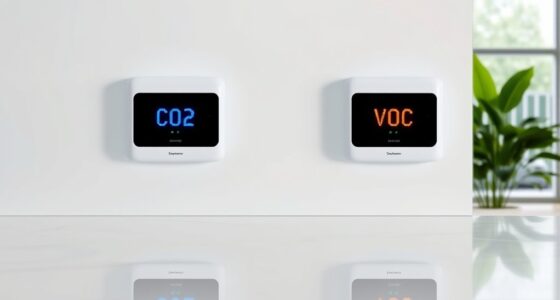

You might feel a room is spotless even if sensors detect elevated particle levels. Visual cues focus on surface cleanliness, but sensors measure airborne particles, microbes, or vapors that are invisible. Factors like calibration errors or airflow issues can cause discrepancies. Relying solely on your senses may not guarantee safety or compliance. Understanding how sensor data and perception differ helps you improve contamination control. Keep exploring to discover how to balance both for a truly clean environment.

Get home appliances delivered free with Prime
- Fast, free delivery on millions of items
- Prime Video, Amazon Music and more included
- Member-only deals all year
Key Takeaways
- Visual cleanliness may not correlate with airborne particle or microbial levels detected by sensors.
- Sensors can indicate contamination despite a room appearing spotless to the eye.
- Calibration and placement issues can cause sensor readings to differ from perceived cleanliness.
- Environmental factors and sensor limitations may lead to discrepancies between feeling and data.
- Combining sensor data with manual inspection ensures a more accurate assessment of cleanliness.

Have you ever wondered how sterilized room environments maintain their immaculate conditions? It’s a combination of strict protocols, advanced equipment, and continuous monitoring. At the heart of it all is air quality. You might assume that if you feel like a room is perfectly clean, the sensors would confirm that with high air purity levels. But that’s not always the case. Sensors measure contamination control by detecting particles, microbes, and chemical vapors, yet sometimes their readings don’t align with your perception of cleanliness. This disconnect can create confusion—why does the room feel so clean, but sensors indicate otherwise?
The key lies in understanding what sensors actually detect. They’re highly sensitive and calibrated to identify even microscopic contaminants that are invisible to the naked eye. But human perception is limited; you might focus on surface cleanliness or the absence of visible dust, which doesn’t necessarily match the airborne particle counts or microbial levels that sensors monitor. For instance, a room might look spotless, but if the air filtration system isn’t functioning perfectly, sensors could detect elevated particle levels. Conversely, you could feel confident based on visual cues, even if sensors pick up contaminants that aren’t immediately obvious.
Contamination control is a complex process. It involves not just air quality management but also controlling surfaces, personnel movement, and material introduction. Sensors play a vital role here, providing real-time data to meet standards. Yet, sensor limitations—such as calibration errors, placement issues, or sensitivity thresholds—mean their readings aren’t infallible. Sometimes, they might flag contamination where you see nothing, or they might show clean air when you sense residual odors or surface dust. This creates a feeling of dissonance, making it hard to reconcile your experience with sensor data. Regular sensor calibration and validation are essential to ensure accurate readings and reduce discrepancies. Additionally, understanding the limitations of sensor technology can help you interpret their data more effectively. Recognizing that sensor performance can be influenced by proper placement and environmental factors emphasizes the importance of comprehensive testing and maintenance.
Recognizing these factors can also improve your contamination control practices by encouraging a balanced approach that incorporates both technological monitoring and manual inspection. Understanding this gap helps you avoid over-relying on sensors alone. It reminds you that maintaining a sterile room isn’t just about what the instruments say but also about thorough contamination control practices. These include regular validation, proper airflow management, and strict gowning procedures. Your perception, combined with sensor data, provides a more complete picture of cleanliness. Recognizing that the “clean room” feeling can sometimes misalign with sensor readings encourages a balanced approach—trusting technology but also relying on your trained judgment. In the end, both elements are essential to uphold the integrity of the environment and maintain the highest standards of cleanliness. Additionally, ongoing calibration and maintenance of sensors ensure their accuracy over time, helping bridge the gap between perception and measurement.
air quality sensor for clean room
As an affiliate, we earn on qualifying purchases.
As an affiliate, we earn on qualifying purchases.
Frequently Asked Questions
How Do Individual Perceptions Vary in Clean Room Environments?
Your perception discrepancies in clean room environments stem from human intuition often conflicting with sensor data. You might feel the space isn’t as sterile or controlled as the sensors indicate, due to sensory cues like odors or sounds. These perceptions vary because individual sensitivities differ, and your brain interprets environmental signals differently. Trusting both your intuition and sensor readings helps you better understand the true cleanliness level, reducing discrepancies and ensuring safety.
Can Sensor Inaccuracies Influence Safety Decisions?
Sensor inaccuracies, like drift and calibration challenges, can seriously influence your safety decisions. Imagine trusting a sensor that’s slowly drifting, making the room seem cleaner than it is, or vice versa. This mismatch can lead you to overlook hazards or overreact. When sensors aren’t properly calibrated, your perception becomes unreliable, risking safety. Regular maintenance and calibration are essential to guarantee your decisions are based on accurate, trustworthy data.
Are There Standards for Calibrating Sensors in Clean Rooms?
Yes, there are standards for calibrating sensors in clean rooms. You should follow strict calibration procedures and conduct regular sensor validation to guarantee accuracy. These standards, often outlined by organizations like ISO and USP, help you verify that sensors perform correctly over time. Proper calibration and validation maintain sensor reliability, reducing discrepancies between sensor readings and the actual environment, ultimately safeguarding product quality and compliance.
How Do Environmental Factors Affect Sensor Readings?
Environmental factors like humidity fluctuations and airflow disturbances directly impact sensor readings in clean rooms. Increased humidity can skew humidity sensors, while airflow disturbances cause inconsistent temperature and particle measurements. You should monitor these factors closely and guarantee proper airflow management. Regular calibration and maintaining stable environmental conditions help sensors deliver accurate data, reducing discrepancies between sensor readings and the actual clean room environment, ensuring compliance and ideal performance.
What Training Helps Personnel Trust Sensor Data Over Their Senses?
Like a lighthouse guiding ships through fog, proper training helps you trust sensor data over perception bias. You’ll learn to interpret readings accurately and recognize that your senses can be deceived, especially in controlled environments. Training emphasizes understanding sensor limitations, calibration, and data analysis, empowering you to depend on objective measurements. This builds sensor trust, reduces doubt, and ensures safety even when your instincts tell you otherwise.
As an affiliate, we earn on qualifying purchases.
Conclusion
Imagine walking into a pristine, silent library, feeling a sense of calm and order. Yet, behind the scenes, a busy hive of activity buzzes away. Just like that library, your senses might tell you everything’s spotless, but sensors reveal a different story. Don’t rely solely on your feelings—look deeper. The truth often hides beneath the surface, waiting to be uncovered. Embrace the mystery, and let data guide your understanding beyond the surface.
As an affiliate, we earn on qualifying purchases.
air filtration system for sterile environments
As an affiliate, we earn on qualifying purchases.
As an affiliate, we earn on qualifying purchases.
NFL season / tailgating Picks
team gear
As an affiliate, we earn on qualifying purchases.