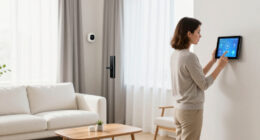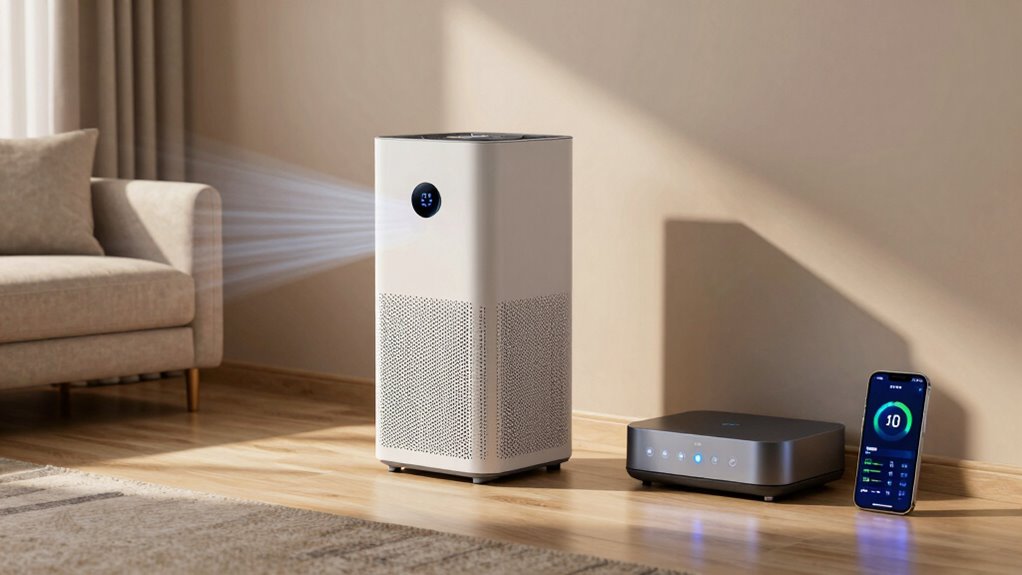

To make your air purifier react to real air data, start by choosing the right air quality sensors that monitor pollutants like PM2.5, VOCs, or humidity. Connect these sensors to your smart home platform via protocols like Zigbee, Z-Wave, or Wi-Fi. Then, set automation rules that trigger the purifier when air quality drops below your preferred threshold. Use apps or voice commands to fine-tune settings, ensuring your system responds efficiently and keeps your indoor air fresh. Keep exploring to learn more about optimizing your setup.

Get home appliances delivered free — and shop member deals
- Fast, free delivery on millions of items
- Access to Prime Big Deal Days deals on October 6–7
- Prime Video, Amazon Music and more included
Key Takeaways
- Use air quality sensors to monitor pollutants like PM2.5 and VOCs in real-time.
- Set automation rules to activate purifiers when air quality exceeds predefined thresholds.
- Integrate sensors with compatible smart home hubs via protocols like Zigbee, Z-Wave, or Wi-Fi.
- Configure triggers to turn purifiers on/off automatically based on live air data.
- Regularly calibrate sensors and maintain devices to ensure accurate, responsive automation.
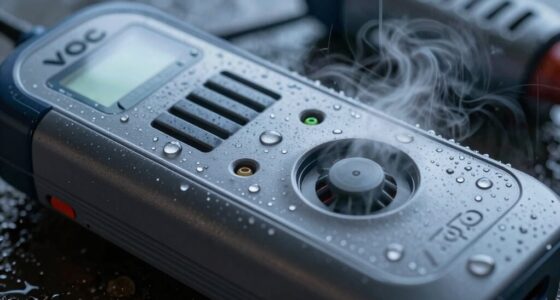
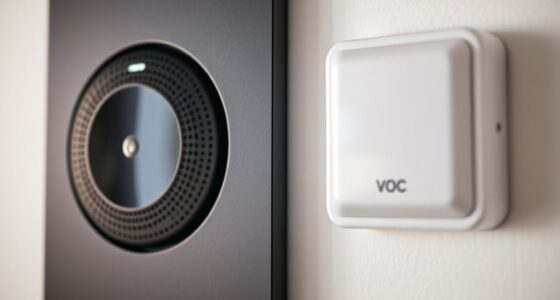
air quality sensor for smart home
As an affiliate, we earn on qualifying purchases.
As an affiliate, we earn on qualifying purchases.
Why Indoor Air Quality Matters and How Automation Helps
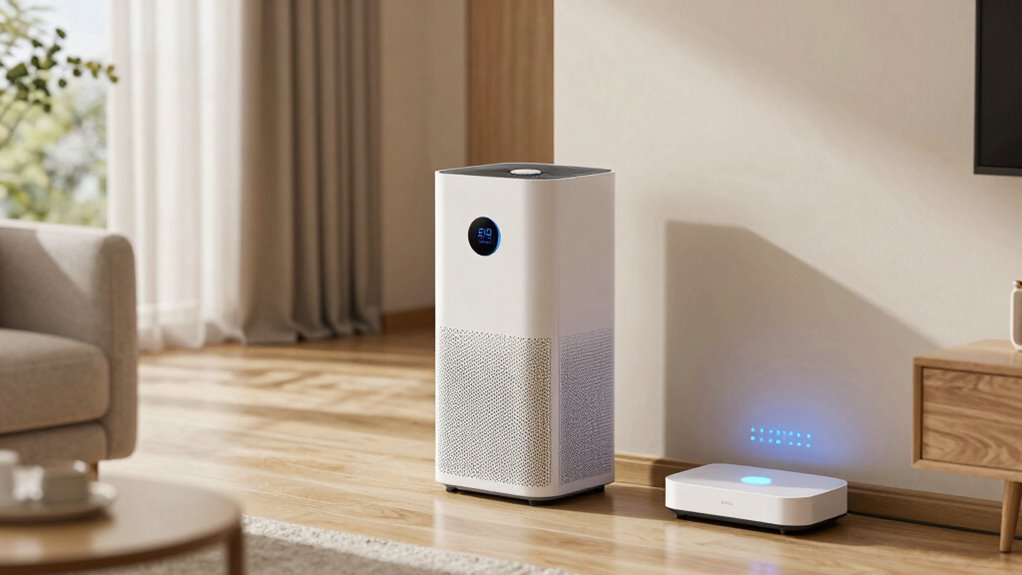
Indoor air quality is essential because it directly impacts your health, comfort, and productivity at home. Many air quality myths suggest that only outdoor pollution matters, but indoor pollution sources like cooking fumes, cleaning products, and mold can be just as harmful. Poor air quality can lead to allergies, respiratory issues, and fatigue. Automation helps you tackle these problems by continuously monitoring air quality and responding instantly. Smart systems can activate air purifiers when pollutant levels rise, ensuring your environment stays safe without manual effort. By understanding indoor pollution sources and leveraging automation, you create a healthier, more comfortable living space. This proactive approach keeps you protected from hidden indoor air hazards, promoting overall well-being. Additionally, monitoring microplastics in dust can help identify less obvious indoor pollutants that may affect your health over time. Employing proper air filtration strategies further enhances indoor air safety and quality, especially when combined with air quality sensors that provide real-time data. Incorporating insights from indoor air quality research can help optimize your automation system for better health outcomes.
Wi-Fi compatible air purifier with automation
As an affiliate, we earn on qualifying purchases.
As an affiliate, we earn on qualifying purchases.
How to Choose the Best Air Quality Sensors for Your Smart Home

When choosing air quality sensors for your smart home, you’ll want to consider the different types and features available to find the best fit. Make sure the sensors are compatible with your existing systems and can easily integrate into your automation setup. Don’t forget to check their accuracy and calibration requirements to ensure reliable readings over time. Additionally, consider sensors designed for Free Floating environments, which can better adapt to varying air conditions indoors. Opting for Vetted sensors that have undergone quality testing can also help ensure dependable performance and data integrity. If you’re interested in energy-efficient options, some sensors are compatible with electric bikes and other renewable energy devices, enhancing your home’s sustainability.
Sensor Types and Features
Choosing the right air quality sensors for your smart home involves understanding the various types and features available. First, consider sensor placement; placing sensors in central locations guarantees accurate readings, while avoiding areas with direct airflow or high humidity. Proper placement can significantly improve data reliability. Second, look at sensor features, such as detection capabilities for pollutants, VOCs, or humidity, to match your needs. Third, factor in sensor maintenance—regular calibration and cleaning keep sensors precise over time. Different sensor types, like electrochemical or photoionization, have unique strengths; select one that fits your air quality goals. Additionally, understanding sensor sensitivity helps ensure your sensors respond accurately to air quality changes. Ensuring sensors have appropriate detection range is crucial for capturing the full spectrum of air quality variations. Moreover, considering sensor durability can extend the lifespan and consistent performance of your devices. To maximize sensor performance, it is also important to evaluate response time, which affects how quickly your purifier reacts to changes in air quality. Regularly monitoring and adjusting sensor placement can further optimize data accuracy and device responsiveness. By understanding these aspects, you ensure your sensors deliver reliable data, helping your purifier respond effectively to real air conditions. Proper placement and maintenance are key to maximizing sensor performance.
Compatibility and Integration
Ensuring your air quality sensors work seamlessly with your smart home system requires careful attention to compatibility and integration. You should verify that the sensors support your smart hub’s wireless protocols, such as Zigbee, Z-Wave, or Wi-Fi, to ensure smooth communication. Additionally, consider data privacy; choose sensors that encrypt data and respect your privacy preferences. The right integration simplifies automation setup and reliable operation. For added security, look for end-to-end encryption features that protect your data during transmission. Selecting sensors with interoperability features can further streamline their inclusion into your existing smart home ecosystem. When choosing sensors, it’s also beneficial to review their security standards to ensure they meet current cybersecurity best practices. Incorporating latest sensor technology can help future-proof your setup and enhance overall system performance.
Accuracy and Calibration
Accurate air quality readings are essential for effective automation and health monitoring in your smart home, so paying close attention to sensor calibration is crucial. To ensure reliability, consider these key points:
- Regular calibration frequency helps prevent sensor drift, which can cause inaccurate readings over time. Sensor drift can significantly impact data accuracy if not properly managed.
- Choose sensors with built-in calibration features or easy manual calibration options for convenience.
- Be aware that high-quality sensors often require less frequent calibration, maintaining accuracy longer.
- Proper placement and protection from environmental factors can also significantly impact sensor performance and longevity.
- Additionally, understanding the environmental factors that influence sensor readings can help you optimize their placement and calibration schedule.
- Using advanced calibration techniques can further enhance sensor accuracy and reliability over extended periods.
- Regularly reviewing sensor data and recalibrating as needed helps maintain sensor accuracy, especially in dynamic home environments.
As an affiliate, we earn on qualifying purchases.
Connecting Sensors to Your Air Purifier: A Step-by-Step Guide
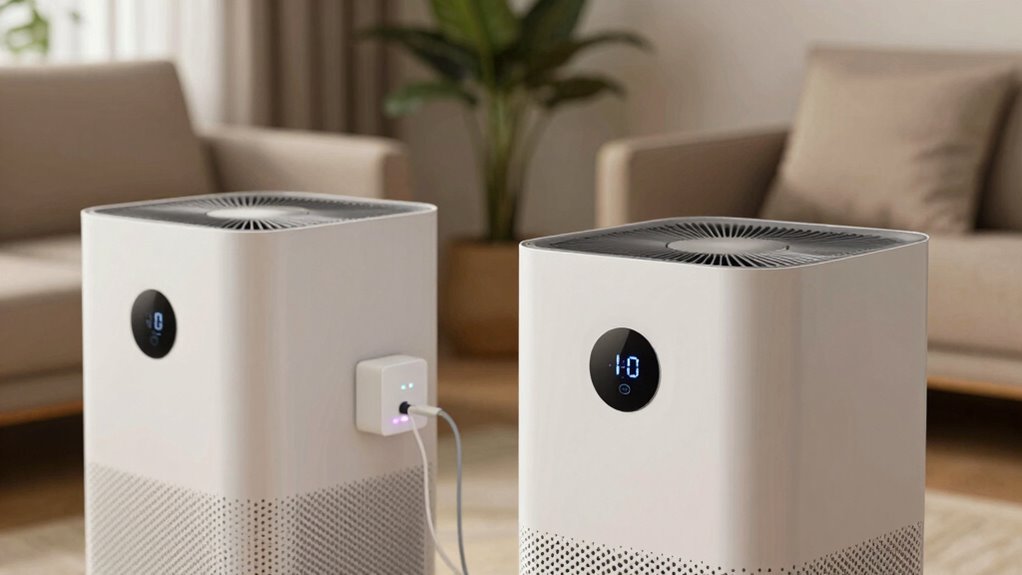
Have you ever wondered how to enhance your air purifier’s efficiency with smart sensors? The first step is proper sensor placement. Position your sensor where it can accurately monitor air quality without obstructions or interference. Avoid placing it near vents, windows, or sources of pollution, which could compromise data accuracy. Mount the sensor at a consistent height, ideally around breathing level, to get reliable readings. Ensure the sensor is securely connected to your purifier or smart hub, following manufacturer instructions. Double-check connections and power sources before testing. Accurate sensor placement directly impacts data quality, which is essential for effective automation. Proper DIY tools can help you mount sensors securely and safely. Once connected correctly, your purifier will respond more precisely to real-time air quality changes, making your smart home truly responsive.
VOC and PM2.5 air quality sensor
As an affiliate, we earn on qualifying purchases.
As an affiliate, we earn on qualifying purchases.
Setting Up Automation Rules Based on Real-Time Air Data

You can set up automation rules that respond instantly to real-time air quality data from your sensors. By defining thresholds and triggers, your system can automatically activate your air purifier when pollution levels rise. This guarantees your home stays comfortable and healthy without you having to manually intervene.
Integrating Air Quality Sensors
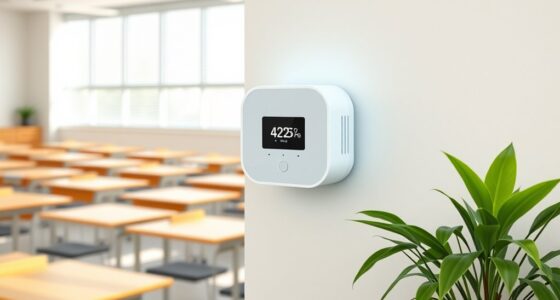
Ever wondered how real-time air quality data can enhance your smart home? Integrating air quality sensors lets you set precise automation rules that respond instantly. First, verify your sensors are placed according to air quality standards, avoiding locations near vents or open windows. Second, select sensors that accurately measure pollutants and particles relevant to your environment. Third, connect these sensors to your smart system to enable real-time data flow. By doing so, your purifier can react swiftly when air quality drops, maintaining a healthier home. Proper sensor placement and quality are key to reliable data, making your automation both effective and responsive. This integration transforms your purifier into a proactive system that keeps your indoor air clean effortlessly.
Defining Thresholds and Triggers
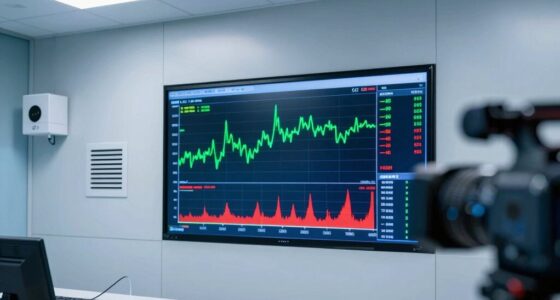
To effectively automate your air quality responses, it is vital to set clear thresholds and triggers based on real-time sensor data. Threshold setting involves determining specific air quality levels—such as particulate matter or VOC concentrations—that will activate your automation rules. You need to decide at what point the air quality becomes unhealthy enough to trigger a response. Trigger conditions specify the exact circumstances under which your purifier should start or stop. For example, you might set a threshold of 50 AQI for PM2.5, with trigger conditions that activate the purifier when levels exceed this point for a certain duration. Clear thresholds and well-defined trigger conditions ensure your automation is responsive, accurate, and prevents unnecessary operation.
Automating Purifier Responses
Setting up automation rules for your air purifier involves creating precise instructions that respond directly to real-time sensor data. To do this effectively, ensure your sensor placement is optimal for accurate readings. Then, follow these steps:
- Connect your air purifier to your smart home system and link it to the sensor data feed.
- Set specific thresholds for air quality metrics like PM2.5 or VOC levels.
- Create automation rules that trigger the purifier to turn on when levels exceed your preset thresholds.
Control Your Purifier With Apps and Voice Assistants
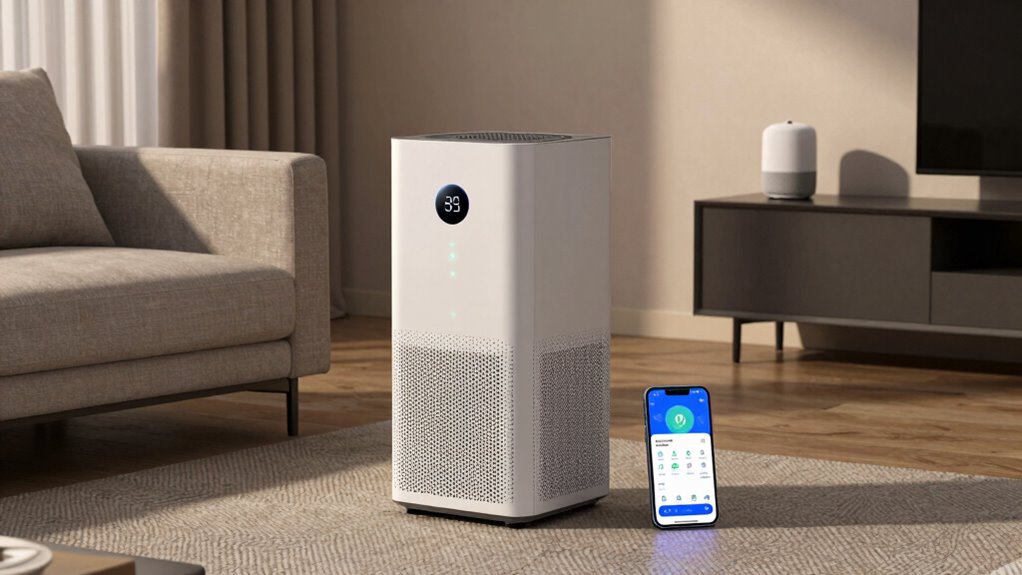
Controlling your purifier with apps and voice assistants makes maintaining clean air more convenient than ever. With a simple tap or voice command, you can adjust settings, check air quality levels, and even schedule operation times. This ease of access helps you avoid common air quality myths, like believing that constant running is unnecessary or that maintenance isn’t essential. Instead, you stay proactive with purifier maintenance, ensuring it functions ideally. Apps often provide real-time data, so you see exactly when filters need replacing or when air quality improves. Voice assistants enable hands-free control, perfect for busy moments or when your hands are full. This seamless integration keeps your air purifiers responsive and your indoor environment healthier without complicating your routine.
Fine-Tuning Automation for Different Air Quality Levels

Once you’ve set up your purifier to respond to app commands and voice prompts, fine-tuning its automation based on air quality levels takes your home’s environment to the next level. Start with proper air quality calibration to guarantee accurate readings. Next, optimize sensor placement by positioning sensors away from drafts, vents, or sources of pollution to get reliable data. Then, adjust automation thresholds so the purifier reacts appropriately: for minor pollution, activate gentle modes; for poor air quality, ramp up to maximum. Regularly review sensor data and calibration settings to maintain accuracy. This careful tuning helps your purifier respond precisely to varying air conditions, creating a healthier, more comfortable home environment.
Troubleshooting Common Problems With Your Smart Air Purifier Setup

Despite careful setup, you might encounter issues with your smart air purifier that prevent it from functioning correctly. One common problem is the purifier not responding to automation commands or air quality data. Check if your air purifier filters are dirty or clogged; replacing filters is often necessary for peak performance. Additionally, verify that your maintenance schedules are up to date, as overdue filters can cause errors or shutdowns. Ensure your device is properly connected to your home Wi-Fi network and that the app settings are correct. Sometimes, restarting the device or resetting the connections can resolve glitches. Regularly monitoring your air purifier’s status and adhering to maintenance schedules helps prevent these issues, guaranteeing smooth operation and effective air quality management.
Comparing Smart Home Platforms for Air Purifier Automation
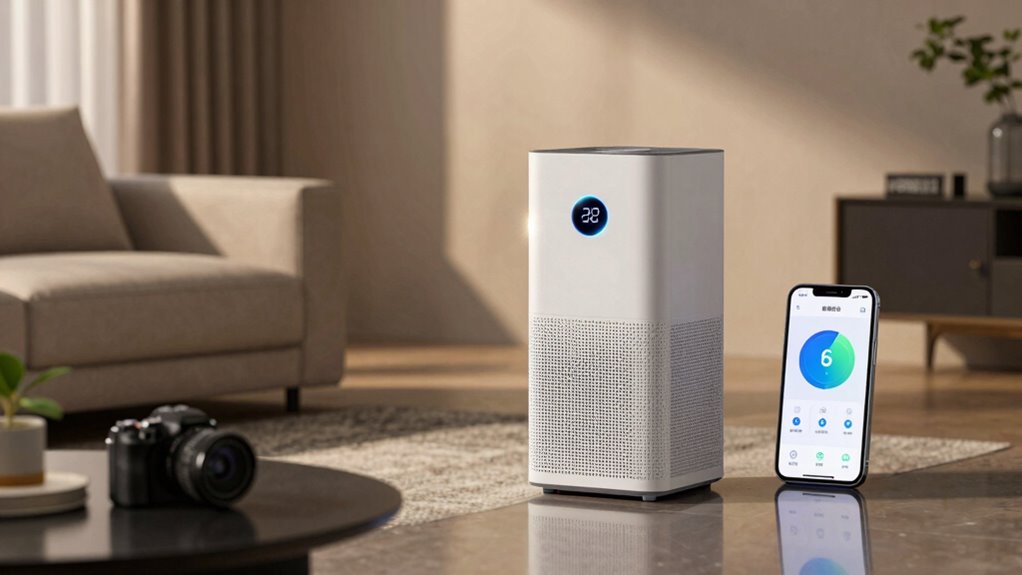
When choosing a smart home platform for your air purifier, you’ll want to evaluate compatibility options to guarantee it works seamlessly with your devices. Ease of integration and flexibility also matter, so you can customize and expand your setup over time. Finally, compare costs and scalability to find a solution that fits your budget and future needs.
Platform Compatibility Options
Choosing the right smart home platform is essential for seamless air purifier automation, as compatibility varies widely among systems. Your top considerations include:
- Hardware compatibility: Make sure your purifier and sensors work with the platform’s supported devices and protocols, like Zigbee, Z-Wave, or Wi-Fi.
- Platform limitations: Some platforms restrict device types or brands, limiting automation options or requiring additional hubs.
- Ecosystem integration: Verify if the platform supports your existing smart devices, simplifying setup and reducing incompatibility issues.
Integration Ease and Flexibility
Integrating your air purifier into a smart home system can be straightforward or complex, depending on the platform’s flexibility. Some platforms offer seamless integration with simple setup processes, allowing you to connect sensors and automate responses easily. Others require more advanced configuration, especially when it comes to sensor placement, which affects data accuracy and responsiveness. Flexibility also involves how well the platform supports third-party devices and custom automations. Keep in mind data privacy; some systems store air quality data locally, while others cloud-sync, which may raise concerns. Choosing a platform that balances ease of integration, adaptable sensor placement, and data privacy ensures your air purifier reacts reliably to real air conditions without compromising your security.
Cost and Scalability
Cost and scalability are key factors to contemplate when selecting a smart home platform for air purifier automation. Budget constraints may limit your options, so choosing a platform that fits your financial plan is essential. Scalability challenges can also influence your decision, especially if you plan to expand your smart home system later. Consider these points:
- Some platforms require high upfront costs, impacting your budget.
- Others offer affordable entry levels but may add costs as you scale.
- Compatibility issues can hinder expansion, increasing long-term expenses.
You need a balance between initial investment and future growth potential. Picking a platform with flexible scalability options helps you avoid costly migrations and keeps your automation seamless as your smart home evolves.
Tips to Save Energy While Automating Your Air Purifier
To save energy while automating your air purifier, start by setting it to run only when necessary. Use real-time air quality data to trigger the purifier efficiently, avoiding continuous operation. This approach maximizes energy conservation without sacrificing user comfort, as the purifier activates only when pollution levels rise. Adjust automation rules to prioritize high-quality air when needed most and turn off during periods of good air quality. Additionally, schedule the purifier to operate during specific times or humidity levels, reducing unnecessary energy use. Installing smart sensors can further optimize performance by providing accurate data. By fine-tuning these settings, you ensure your purifier works smarter, saving energy while maintaining a healthy and comfortable environment.
Future Trends in Air Quality Data and Smart Home Automation

As technology advances, air quality data and smart home automation are expected to become more precise and proactive. You’ll see improvements like enhanced air quality forecasting, giving you accurate predictions before issues arise. Sensor calibration will become more sophisticated, ensuring your devices consistently deliver reliable data. Future trends include:
- Integrating real-time air quality forecasting to optimize your purifier’s response.
- Using advanced sensor calibration techniques to maintain accuracy over time.
- Leveraging machine learning to personalize automation based on your environment and habits.
These developments will make your smart home more responsive, cleaner, and healthier. By embracing these innovations, you’ll stay ahead in maintaining ideal air quality effortlessly and efficiently.
Frequently Asked Questions
Can I Integrate Multiple Air Quality Sensors for Better Accuracy?
Yes, you can integrate multiple air quality sensors for better accuracy. Place sensors strategically in different areas to guarantee thorough coverage, considering factors like airflow and potential pollution sources. Use data aggregation to combine readings, which helps identify patterns and provides a more reliable overall air quality assessment. This approach allows your purifier to react more effectively, improving air quality throughout your space.
How Often Should Air Quality Sensors Be Calibrated?
You should calibrate your air quality sensors regularly, ideally every 3 to 6 months, to guarantee accurate readings. Proper sensor maintenance includes checking calibration frequency, cleaning the sensors, and replacing them when necessary. By staying consistent with calibration and maintenance, you keep your data reliable, your purifier reacting effectively, and your air quality optimized. Don’t forget, regular calibration is key to maintaining sensor accuracy and overall home health.
Are There Privacy Concerns With Real-Time Air Data Collection?
Yes, there are privacy concerns with real-time air data collection. You might worry about how your data is used or shared, so it’s important to check your device’s data security features. Make certain your smart home system encrypts data and limits access. Stay informed about privacy policies and choose devices with transparent data practices to protect your personal information while enjoying the benefits of automated air purification.
What Are the Compatibility Requirements for Connecting Sensors to Various Purifiers?
Imagine you’re connecting a new air quality sensor to your purifier. To guarantee smooth device integration, you need to check sensor compatibility with your purifier’s smart hub or app. Compatibility varies, so look for sensors that support common protocols like Zigbee or Z-Wave. You’ll want to verify your device’s specifications, making sure it can seamlessly communicate with your purifier, creating a unified smart home experience.
How Can I Automate Air Purifier Behavior During Vacations or Absences?
During vacations or absences, you can set your air purifier to vacation mode or create absence automation. Use your smart home app to schedule the purifier to turn off or reduce its activity when you’re away, conserving energy. Alternatively, integrate sensors that detect occupancy or air quality, so the purifier activates only when needed. This ensures your home stays fresh without wasting energy while you’re gone.
Conclusion
By seamlessly integrating your air purifier with smart home automation, you create a healthier, more comfortable environment without even thinking about it. As technology continues to evolve, you’ll find new ways to subtly enhance your space’s air quality effortlessly. Embrace these innovations, and soon, you’ll enjoy a gust of fresh air that’s as natural as a gentle breeze—making your home a true sanctuary where comfort and well-being quietly thrive.
Fall yard work Picks
leaf blowers
As an affiliate, we earn on qualifying purchases.