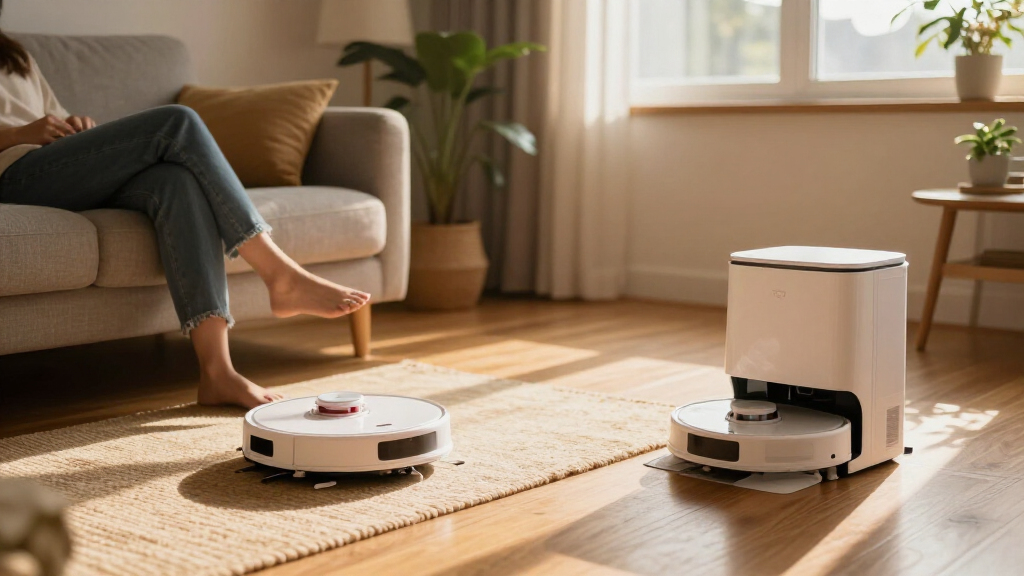
Robot vacuums with self-emptying bases take the last annoying chore out of automated cleaning: instead of emptying a dusty bin after every run, the dock sucks debris into a sealed bag that holds weeks of debris. After comparing 15 current models, the Roborock Q7 M5+ stands out as the best overall pick thanks to LiDAR navigation, a true vacuum-and-mop combo, and a well-designed self-emptying dock. The Shark AI Ultra AV2511AE is the strongest Shark-only alternative with a genuine 60-day capacity, and the Tikom L8000 Plus makes the most sense for buyers who want the combo-plus-dock formula without paying premium-brand prices. The main tradeoffs in this category come down to navigation intelligence versus price, whether you actually need mopping, and how much suction power your floors demand. Keep reading for the full breakdown, including which renewed models are worth the risk and which ones I would skip.

Get home appliances delivered free with Prime
- Fast, free delivery on millions of items
- Prime Video, Amazon Music and more included
- Member-only deals all year
Complete the kit


Key Takeaways
- LiDAR navigation separated the top performers: the two Roborock models mapped and cleaned rooms in organized rows, while camera-based and gyroscope models like the Shark Navigator series wandered more and repeated passes less efficiently.
- Mopping capability varied widely in usefulness — the Roborock Q7 M5+ and Tikom L8000 Plus drag-pad mopping genuinely complements vacuuming, while the Roomba 115 Combo and 105X Combo use swap-in tanks that add friction to daily use.
- Dust bag capacity claims differed sharply: Shark‘s 60-day and 30-day bases held meaningfully more than the Roomba AutoEmpty docks, which fill faster in multi-pet households.
- Renewed units (the Shark RV100AE and UR2360S) cut the entry cost but ship with older, noisier navigation and weaker suction — acceptable for a first robot vacuum, not for a main-floor replacement.
- Suction power mattered most on carpet: the 10,000 Pa Roborock and Shark AI Ultra models pulled embedded pet hair from rugs, while sub-2,000 Pa Navigator models needed repeated passes to match those results.
| Shark Navigator Robot Vacuum with Self-Empty Base, Grey (RV2120AE) |  | Best for Low-Maintenance Hair Pickup | Color: Grey | Model: RV2120AE | Navigation: Spot LiDAR with row-by-row cleaning | VIEW LATEST PRICE | See Our Full Breakdown |
| Shark Navigator Robot Vacuum with 60-Day Self-Emptying Base, White (AV2120) |  | Best Value Self-Emptier | Model: AV2120 | Color: White/Black | Navigation: SmartPath with LiDAR mapping | VIEW LATEST PRICE | See Our Full Breakdown |
| Shark Matrix Plus Robot Vacuum and Mop Combo, AV2610WA |  | Best for Allergy Sufferers | Model: AV2610WA | Type: Robot vacuum and mop combo | Self-emptying capacity: Up to 60 days | VIEW LATEST PRICE | See Our Full Breakdown |
| Roborock Q7 M5+ Robot Vacuum and Mop with Self-Emptying Dock |  | Best Premium Performance | Suction power: 10,000 Pa | Dust bag capacity: 2.7 L | Self-emptying interval: Up to 7–9 weeks | VIEW LATEST PRICE | See Our Full Breakdown |
| Tikom L8000 Plus Robot Vacuum and Mop with Self-Emptying Base |  | Best for Multi-Story Homes | Maximum suction: 6000 Pa | Dustbag capacity: 3 L | Navigation: 360° LiDAR | VIEW LATEST PRICE | See Our Full Breakdown |
| Shark IQ App-Controlled Self-Emptying Robot Vacuum, RV100AE/UR1000SR – Black (Renewed) |  | Best Budget Entry Point | Model: RV100AE/UR1000SR | Condition: Renewed | Navigation: IQ Navigation with Total Home Mapping | VIEW LATEST PRICE | See Our Full Breakdown |
| iRobot Roomba 115 Combo Robot Vacuum and Mop with AutoEmpty Dock |  | Best for Small Homes | Suction Power: 15,000 Pa | Coverage per Charge: Up to 900 sq ft | Navigation: ClearView LiDAR | VIEW LATEST PRICE | See Our Full Breakdown |
| iRobot Roomba 105 Robot Vacuum with AutoEmpty Dock |  | Best Vacuum-Only Value | Navigation: ClearView LiDAR | Cleaning System: 3-stage with multi-surface and edge-sweeping brushes | AutoEmpty Capacity: Up to 75 days | VIEW LATEST PRICE | See Our Full Breakdown |
| iRobot Roomba 105X Combo Robot Vacuum and Mop with AutoEmpty Dock |  | Best Mid-Range Combo | Dock: AutoEmpty Dock | Debris Storage: Up to 75 days | Suction: 70× more power-lifting suction vs. Roomba 600 series | VIEW LATEST PRICE | See Our Full Breakdown |
| iRobot Roomba Plus 415X Robot Vacuum and Mop Combo |  | Best Premium Full-Service Pick | Suction: 2.3× more than Roomba 600 series | Dock Debris Capacity: Up to 90 days | Dock Functions: AutoWash: washes pads, refills water, empties debris | VIEW LATEST PRICE | See Our Full Breakdown |
| Shark AV2501S AI Ultra Robot Vacuum with Self-Empty Base |  | Best for Pet Hair | Model: AV2501S | Navigation: Matrix Clean with 360° LiDAR mapping | Self-empty base capacity: Up to 30 days of debris | VIEW LATEST PRICE | See Our Full Breakdown |
| Shark AI Ultra Robot Vacuum with 60-Day Self-Emptying Base, Black (AV2511AE) |  | Best Set-and-Forget Convenience | Model: AV2511AE | Color: Black | Runtime: Up to 90 minutes | VIEW LATEST PRICE | See Our Full Breakdown |
| Shark UR2360S Ultra Robot Vacuum with Matrix Clean and Self-Empty Base (Renewed) |  | Best Budget Entry Point | Navigation: 360° LiDAR precision mapping with Matrix Clean | Base capacity: Up to 30 days of dirt and debris | Filter type: HEPA | VIEW LATEST PRICE | See Our Full Breakdown |
| Roborock Robot Vacuum and Mop with LiDAR Navigation, 10,000 Pa Suction, and Self-Emptying Dock |  | Best Premium Vacuum-Mop Combo | Suction power: 10,000 Pa | Navigation: PreciSense LiDAR | Dust bag capacity: 2.7 L (advertised 7–9 weeks) | VIEW LATEST PRICE | See Our Full Breakdown |
| Shark Navigator Robot Vacuum with 30-Day Self-Emptying Base, White (AV2110S) |  | Best for First-Time Buyers | Model: AV2110S | Color: White | Navigation: LiDAR with row-by-row cleaning | VIEW LATEST PRICE | See Our Full Breakdown |
| robot vacuums with self-emptying base | Navigation |
|---|---|
| Shark Navigator Robot Vacuum w | Spot LiDAR with row-by-row cleaning |
| Shark Navigator Robot Vacuum w | SmartPath with LiDAR mapping |
| Shark Matrix Plus Robot Vacuum | 360° LiDAR with object detection and avoidance |
| Roborock Q7 M5+ Robot Vacuum a | PreciSense LiDAR |
| Tikom L8000 Plus Robot Vacuum | 360° LiDAR |
| Shark IQ App-Controlled Self-E | IQ Navigation with Total Home Mapping |
| iRobot Roomba 115 Combo Robot | ClearView LiDAR |
| iRobot Roomba 105 Robot Vacuum | ClearView LiDAR |
| iRobot Roomba 105X Combo Robot | — |
| iRobot Roomba Plus 415X Robot | — |
| Shark AV2501S AI Ultra Robot V | Matrix Clean with 360° LiDAR mapping |
| Shark AI Ultra Robot Vacuum wi | 360° LiDAR mapping |
| Shark UR2360S Ultra Robot Vacu | 360° LiDAR precision mapping with Matrix Clean |
| Roborock Robot Vacuum and Mop | PreciSense LiDAR |
| Shark Navigator Robot Vacuum w | LiDAR with row-by-row cleaning |
More Details on Our Top Picks
Shark Navigator Robot Vacuum with Self-Empty Base, Grey (RV2120AE)
This model stands out for one thing above all: hair management without recurring costs. The bagless self-empty base holds up to 60 days of debris, which means no dust bags to buy ever — a real advantage over the Roborock Q7 M5+, whose 2.7 L bag will eventually need replacements. Spot LiDAR mapping and row-by-row cleaning keep coverage orderly rather than random, and the self-cleaning brushroll is built to resist tangles, which matters most in homes with shedding pets or long-haired residents. Compared with the Shark AV2120, this grey model shares the same core cleaning logic but leans harder into the bagless design as its selling point. The tradeoff: it vacuums only. If sealed hard floors need mopping too, the Shark Matrix Plus AV2610WA covers that gap.
Pros:- Bagless base eliminates ongoing dust bag purchases
- Up to 60 days of debris capacity between emptying
- Self-cleaning brushroll resists hair wrap
- LiDAR mapping enables systematic row-by-row coverage
Cons:- No mopping capability despite the premium base
- Suction and coverage claims come from the manufacturer, not independent testing
Best for: Pet owners and long-haired households who want months of hands-off emptying with no bag replacements
Not ideal for: Buyers with mostly hard floors who also want mopping — this is a vacuum-only model
- Color:Grey
- Model:RV2120AE
- Navigation:Spot LiDAR with row-by-row cleaning
- Floor compatibility:Carpets and hard floors
- Base capacity:Up to 60 days of dirt and debris
- Base type:Bagless self-empty base
- Brushroll:Self-cleaning, anti-hair wrap
Our verdict“This pick makes the most sense for hair-heavy homes that want maximum time between touches on the vacuum itself.”
Shark Navigator Robot Vacuum with 60-Day Self-Emptying Base, White (AV2120)
For buyers who want the self-emptying convenience without paying for extras they won’t use, the AV2120 is the sensible entry point in this lineup. It delivers the same 60-day base capacity and SmartPath LiDAR row-by-row navigation as the grey Shark RV2120AE, but its feature set is trimmed to the fundamentals: vacuuming, mapping, object avoidance, and app plus voice control. Compared with the Tikom L8000 Plus, it gives up mopping and multi-floor maps, yet it also avoids that model’s mop-management headaches — there’s no pad to remove before carpet cleaning. The 120-minute lithium-ion battery handles most single-floor homes in one pass, and recharge-and-resume covers the rest. The honest tradeoff is suction: this is a cleaner for maintenance tidying, not deep-carpet restoration.
Pros:- Full 60-day self-emptying base at an accessible price point
- SmartPath LiDAR cleans in orderly rows instead of random passes
- App and voice control included
- Recharge-and-resume finishes large jobs automatically
Cons:- No mopping function at all
- Suction and coverage improvements are manufacturer comparisons, not verified figures
Best for: First-time robot vacuum buyers in apartments or single-story homes who want self-emptying at the lowest complexity
Not ideal for: Homes with thick carpets and heavy debris loads — the suction here is oriented toward everyday upkeep
- Model:AV2120
- Color:White/Black
- Navigation:SmartPath with LiDAR mapping
- Battery life:120 minutes
- Battery type:Lithium-ion, 19 volts
- Capacity:0.52 quarts
- Control:App and voice control
- Included components:Robot vacuum, charging base, 3 side brushes
Our verdict“A straightforward pick for anyone who wants set-and-forget vacuuming without paying for mop hardware they’d never use.”
Shark Matrix Plus Robot Vacuum and Mop Combo, AV2610WA
The AV2610WA earns its place on one differentiator nobody else in this batch matches: true HEPA filtration capturing 99.97% of particles down to 0.3 microns. For households with allergies or asthma, that sealed filtration matters more than raw suction numbers. Add sonic mopping at up to 100 scrubs per minute and the same 60-day bagless base as the Shark RV2120AE, and this model covers both vacuuming and hard-floor mopping in one purchase. Compared with the Roborock Q7 M5+, it trades raw suction power for filtration and a bagless design — a reasonable swap for cleaner air rather than deeper carpet cleaning. The compromises are real, though: mopping works only on hard floors, the included cleaning solution is a 12 oz starter supply, and the sonic mop is a vibrating pad, not a water-fed system.
Pros:- True HEPA filtration traps 99.97% of allergens down to 0.3 microns
- 2-in-1 vacuuming and sonic mopping in a single robot
- Bagless base holds up to 60 days of debris
- Recharge and Resume completes long cleaning sessions
Cons:- Mopping is limited to hard floors
- Only 12 oz of cleaning solution included
- Suction is weaker than the 10,000 Pa Roborock Q7 M5+
Best for: Allergy-sensitive households that want vacuuming, mopping, and HEPA-level air filtration from one machine
Not ideal for: Buyers expecting a full wet-mopping system — the sonic pad damp-mops hard floors only
- Model:AV2610WA
- Type:Robot vacuum and mop combo
- Self-emptying capacity:Up to 60 days
- Mopping speed:Up to 100 scrubs per minute
- Filtration:True HEPA; 99.97% of dust and allergens down to 0.3 microns
- Navigation:360° LiDAR with object detection and avoidance
- Included accessories:XL HEPA self-empty base, 2 reusable microfiber pads, filter, side brush, 12 oz starter solution
- Warranty:1-year limited
Our verdict“The clear choice when air quality matters as much as floor cleanliness and you want mop capability in the same chassis.”
Roborock Q7 M5+ Robot Vacuum and Mop with Self-Emptying Dock
If raw cleaning power is the priority, the Q7 M5+ sits at the top of this batch with 10,000 Pa of suction — well beyond the Tikom L8000 Plus at 6,000 Pa and far ahead of any Shark model here. That translates to genuinely better debris extraction from carpet, especially pet hair ground into rugs. The self-emptying dock uses a 2.7 L dust bag good for 7–9 weeks, edging out the Sharks’ 60-day claim in practical terms, though unlike the bagless Shark bases you’ll eventually repurchase bags. PreciSense LiDAR plus app control with no-go zones gives it the most precise room-level management in this group. Two annoyances hold it back: the app is 2.4 GHz Wi-Fi only, which frustrates modern dual-band routers, and water flow must be manually switched among three settings rather than adapting automatically.
Pros:- Class-leading 10,000 Pa suction for embedded debris and pet hair
- 2.7 L dust bag extends emptying to 7–9 weeks
- Anti-tangle brush design
- App supports scheduling, spot cleaning, and no-go zones
Cons:- 2.4 GHz Wi-Fi only — a hassle on modern routers
- Mop water flow requires manual adjustment among three settings
- Dust bags are a recurring expense unlike Shark’s bagless bases
Best for: Pet owners and carpet-heavy homes who prioritize maximum suction and long dock intervals
Not ideal for: Households on 5 GHz-only networks or those who dislike recurring dust bag costs
- Suction power:10,000 Pa
- Dust bag capacity:2.7 L
- Self-emptying interval:Up to 7–9 weeks
- Navigation:PreciSense LiDAR
- Water flow settings:3
- Connectivity:2.4 GHz Wi-Fi
Our verdict“The strongest cleaner in this lineup, best suited to buyers who’ll accept minor app friction for top-tier suction.”
Tikom L8000 Plus Robot Vacuum and Mop with Self-Emptying Base
What separates the L8000 Plus from everything else here is LiDAR mapping for up to five floors — nobody else in this batch, including the Roborock Q7 M5+, supports that many saved maps. Carry it upstairs, select the saved map, and it cleans with full room zoning intact. The 3 L dustbag is the largest in this group, slightly beating the Roborock’s 2.7 L, and dual-band Wi-Fi support (2.4 and 5 GHz) fixes the exact connectivity complaint that dogs the Roborock. Automatic carpet suction adjustment is a nice touch the Shark AV2120 lacks entirely. The catches: while mopping, you must physically remove the mop holder or set no-go zones to keep it off carpets, and the 150-minute runtime figure applies only to the gentlest suction mode — expect less with real cleaning power.
Pros:- Supports saved maps for up to 5 floors
- Largest dustbag in this lineup at 3 L
- Dual-band Wi-Fi including 5 GHz
- Automatic suction boost on carpets plus Alexa voice control
Cons:- Mop holder must be removed or no-go zones set to protect carpets while mopping
- 150-minute runtime only applies at the gentlest suction setting
Best for: Multi-story homeowners who want one robot to serve every floor with saved maps and zoning
Not ideal for: Mixed carpet-and-hard-floor layouts where mop removal mid-cycle would be a constant chore
- Maximum suction:6000 Pa
- Dustbag capacity:3 L
- Navigation:360° LiDAR
- Saved maps:Up to 5 floors
- Cleaning modes:Sweeping and mopping
- Runtime:Up to 150 minutes (low suction mode)
- Connectivity:2.4 GHz and 5 GHz Wi-Fi
- Voice control:Alexa compatible
Our verdict“The practical pick for anyone carrying a robot between floors who still wants full self-emptying and mapping smarts.”
Shark IQ App-Controlled Self-Emptying Robot Vacuum, RV100AE/UR1000SR – Black (Renewed)
For buyers who want the self-emptying experience without the premium price, this renewed Shark IQ is the cheapest ticket into hands-free cleaning in this lineup. The bagless base is the standout differentiator: unlike the Roomba 105, which needs ongoing replacement bags, this one you simply empty yourself, so there are no consumables to buy. The self-cleaning brush roll also handles long hair better than most budget rivals. The tradeoff is real, though — renewed means renewed, with potential cosmetic wear and a shorter expected lifespan, and its navigation relies on camera-based row mapping rather than the LiDAR found in newer Roombas, so expect occasional missed spots in cluttered rooms.
Pros:- Bagless self-empty base eliminates ongoing bag replacement costs
- Base holds up to 30 days of debris
- Self-cleaning brush roll resists hair wrap from pets and long hair
- App and Alexa voice control with total home mapping for room targeting
Cons:- Renewed condition means possible wear and shorter lifespan than new units
- Cloth filter requires more frequent washing than sealed allergen bags
- Camera-based navigation is less reliable than LiDAR in dark or cluttered rooms
Best for: Budget-conscious buyers who want self-emptying convenience and don’t mind refurbished hardware
Not ideal for: Buyers who want brand-new hardware with a full warranty, or homes with complex layouts that demand LiDAR precision
- Model:RV100AE/UR1000SR
- Condition:Renewed
- Navigation:IQ Navigation with Total Home Mapping
- Self-Empty Base Capacity:Up to 30 days
- Brush Roll:Self-cleaning
- Filter Type:Cloth
- Controls:App, Voice (Alexa)
- Power Source:Battery (Lithium Ion)
Our verdict“A sensible pick if price is your top priority and you accept refurbished-condition risk for bagless self-emptying.”
iRobot Roomba 115 Combo Robot Vacuum and Mop with AutoEmpty Dock
The Roomba 115 Combo earns its spot by pairing vacuuming and mopping in a single pass with a dock bag that seals away debris for up to three months — the longest disposal interval among the mid-range picks here. With 15,000 Pa of suction, it out-pulls the Roomba 105 by a wide margin and handles dried-on messes the 105 can’t touch. Where it falls short is coverage: at 900 sq ft per charge, it’s built for apartments and modest single-story homes, not sprawling layouts. Compared with the Shark IQ above, you gain LiDAR precision and mopping but lose the bagless convenience and take on recurring bag costs plus periodic filter and brush replacements every 3–6 months.
Pros:- Vacuums and mops hard floors in a single pass
- Sealed 2.5 L dock bag traps 99% of pollen and mold for up to 3 months
- ClearView LiDAR mapping enables orderly multi-room navigation
- No Mop Zones keep rugs and carpet dry during mop runs
Cons:- Coverage limited to about 900 sq ft per charge
- Requires 2.4 GHz Wi-Fi for setup and app features
- Filters and brushes need replacement every 3–6 months
Best for: Apartment dwellers and small-home owners who want vacuum-plus-mop in one run with minimal emptying
Not ideal for: Larger homes over 900 sq ft per floor, where battery coverage becomes a bottleneck
- Suction Power:15,000 Pa
- Coverage per Charge:Up to 900 sq ft
- Navigation:ClearView LiDAR
- Dock Bag Capacity:2.5 L
- Bag Filtration:Traps 99% of pollen and mold
- Hands-Free Emptying:Up to 3 months
- Mop Pad:Washable microfiber
- Wi-Fi:2.4 GHz
Our verdict“The strongest fit for compact homes that want serious suction and mopping without frequent dock maintenance.”
iRobot Roomba 105 Robot Vacuum with AutoEmpty Dock
If you don’t need mopping, the Roomba 105 is the cleaner value play in this batch. You get the same ClearView LiDAR mapping and row-by-row cleaning as the Roomba 115 Combo, minus the mop hardware, along with a dock that holds debris for 75 days and traps 99% of allergens down to 0.7 microns — a genuine plus for allergy households that the renewed Shark IQ’s cloth filter can’t match. Custom schedules, keep-out zones, and spot cleaning give it more flexibility than most vacuum-only rivals at this tier. The honest downsides: it’s locked to 2.4 GHz Wi-Fi, and the AutoEmpty system is bag-based, so consumable costs are baked in for the life of the machine.
Pros:- AutoEmpty dock stores debris for up to 75 days
- Sealed bags trap 99% of allergens as small as 0.7 microns
- LiDAR mapping with custom schedules, suction levels, and keep-out zones
- Works with Alexa, Siri, and Google Assistant
Cons:- Requires 2.4 GHz Wi-Fi for setup and operation
- AutoEmpty dock uses replacement bags, adding recurring costs
- No mopping function at all
Best for: Allergy-sensitive buyers who want vacuum-only cleaning with sealed allergen disposal and precise mapping
Not ideal for: Anyone who wants mopping capability, or households with mesh-only 5 GHz Wi-Fi networks
- Navigation:ClearView LiDAR
- Cleaning System:3-stage with multi-surface and edge-sweeping brushes
- AutoEmpty Capacity:Up to 75 days
- Allergen Filtration:Traps 99% of allergens down to 0.7 microns
- Spot Cleaning:Up to 5 minutes
- Wi-Fi:2.4 GHz
- Voice Assistants:Alexa, Siri, Google Assistant
Our verdict“The smart choice for vacuum-only households that prioritize allergen sealing over mop functionality.”
iRobot Roomba 105X Combo Robot Vacuum and Mop with AutoEmpty Dock
The 105X Combo sits neatly between the Roomba 105 and the full-featured Plus 415X: it adds mopping to the 105’s formula while keeping the 75-day AutoEmpty dock and LiDAR mapping, at a lower rung than the 415X’s premium AutoWash system. Its smartest trick is automatic carpet avoidance while mopping — the robot steers rugs dry without you drawing boundaries, something the Roomba 115 handles with manual No Mop Zones instead. Suction is rated at 70× the old Roomba 600 series, which translates to confident pickup on rugs and hard floors alike. Just know that some of the better cleaning features live behind app setup, and like its siblings here, it only speaks 2.4 GHz Wi-Fi.
Pros:- Vacuum, mop, or both in a single run
- AutoEmpty Dock holds debris for up to 75 days
- Automatically avoids rugs while mopping
- LiDAR mapping with keep-out zones and room-based cleaning
Cons:- Wi-Fi operation limited to 2.4 GHz
- Advanced cleaning features require app setup
- Mop pad must be washed by hand, unlike self-washing docks
Best for: Buyers who want vacuum-and-mop flexibility with long dock intervals but don’t need self-washing mop pads
Not ideal for: Hands-off owners who want a dock that washes its own mop pads — that’s the 415X’s job, not this one
- Dock:AutoEmpty Dock
- Debris Storage:Up to 75 days
- Suction:70× more power-lifting suction vs. Roomba 600 series
- Mapping:ClearView LiDAR
- Cleaning Modes:Vacuum, mop, or vacuum and mop together
- Mop Pad:Washable, reusable microfiber
- Wi-Fi:2.4 GHz
- Voice Assistants:Alexa, Siri, Google Assistant
Our verdict“A well-balanced combo for buyers who want mop capability and 75-day emptying without paying for a self-washing dock.”
iRobot Roomba Plus 415X Robot Vacuum and Mop Combo
This is the most complete maintenance story in the batch. Where the Roomba 105X Combo stops at emptying debris, the 415X’s AutoWash Dock also washes and heat-dries the mop pads at 113°F and refills water — meaning no more damp, mildew-prone pads sitting in the dock overnight. Add 90 days of debris storage, the longest interval here, plus a 10 mm mop lift that clears rugs mid-run and tangle-free rubber brushes for pet hair, and it becomes the pick for households that want to genuinely touch the machine as rarely as possible. The caveats are comparative framing rather than flaws: its 2.3× suction claim is measured against the aging Roomba 600 series, so the real-world gap versus the 115 Combo’s 15,000 Pa is murkier than marketing suggests, and the dock is large enough to demand real floor space.
Pros:- Dock washes and heat-dries mop pads automatically
- Debris storage for up to 90 days — the longest in this batch
- Tangle-free rubber brushes handle pet hair without wrapping
- 10 mm mop lift clears rugs without pausing the cleaning run
Cons:- Suction comparison (2.3×) is against the older 600 series, not current rivals
- Full-feature AutoWash dock takes up considerable floor space
- Premium feature set carries a premium price over the 105X and 105
Best for: Pet owners and busy households who want a dock that empties, washes, dries, and refills with minimal intervention
Not ideal for: Buyners with tight budgets or small storage areas who don’t need self-washing mop pads
- Suction:2.3× more than Roomba 600 series
- Dock Debris Capacity:Up to 90 days
- Dock Functions:AutoWash: washes pads, refills water, empties debris
- Mop Pad Drying Temperature:113°F
- Mop Lift:10 mm
- Mapping:LiDAR
- Brushes:Tangle-free rubber
- Controls:App and voice control
Our verdict“The closest thing to fully hands-off floor care here, ideal for pet households that will pay for a dock that does the cleanup after the cleanup.”
Shark AV2501S AI Ultra Robot Vacuum with Self-Empty Base
This model stands out for allergen-focused pet households: the HEPA self-empty base captures 99.97% of dust down to 0.3 microns, which matters when the whole point of a self-emptying base is to stop fine debris from drifting back into your air. Compared with the Shark AV2110S, it adds Matrix Clean navigation — multiple passes in a grid pattern — so pet hair embedded in carpet gets more than one chance to come loose. The tradeoff is capacity: it holds about 30 days of debris, while the AV2511AE doubles that to 60 days for similar effort. Runtime is also capped at 120 minutes, so very large homes will trigger Recharge and Resume mid-session.
Pros:- HEPA self-empty base traps 99.97% of allergens down to 0.3 microns
- Matrix Clean makes multiple grid passes over debris-heavy areas
- Self-cleaning brushroll is built to resist hair wrap
- Recharge and Resume extends coverage across larger homes
Cons:- 30-day base capacity is half what the AV2511AE offers
- 120-minute runtime may require mid-clean recharging in large homes
Best for: Pet owners with allergies who want HEPA-filtered self-emptying and multi-pass pickup on carpet
Not ideal for: Buyers who want the longest stretch between base emptying — the 60-day AV2511AE base beats this one
- Model:AV2501S
- Navigation:Matrix Clean with 360° LiDAR mapping
- Self-empty base capacity:Up to 30 days of debris
- Filtration:HEPA; captures 99.97% of dust and allergens down to 0.3 microns
- Runtime:Up to 120 minutes
- Voice control:Amazon Alexa and Google Assistant
- Included:Robot vacuum, HEPA self-empty base, 2 side brushes
Our verdict“The right pick for allergy-sensitive pet households that prioritize filtered air and multi-pass carpet cleaning over maximum emptying intervals.”
Shark AI Ultra Robot Vacuum with 60-Day Self-Emptying Base, Black (AV2511AE)
If the appeal of a self-emptying base is rarely thinking about your vacuum, this option makes the most sense in the Shark lineup: its XL bagless base holds up to 60 days of debris, double the 30-day capacity of the AV2501S and the renewed UR2360S. You trade some endurance for that convenience — runtime drops to about 90 minutes, so sprawling floor plans will lean harder on recharge-and-resume. Like its siblings, it pairs LiDAR mapping with Matrix Clean grid navigation and a self-cleaning brushroll for pet hair. One caution: product listings conflict on whether this model mops, so buyers wanting a combo machine should look at the Roborock instead.
Pros:- 60-day bagless base capacity is the longest interval in this Shark group
- Strong suction with self-cleaning brushroll handles pet hair on carpet and hard floors
- LiDAR mapping with grid cleaning covers whole floors methodically
- App, Alexa, and Google control with recharge-and-resume
Cons:- 90-minute runtime is the shortest of the new Shark models here
- Conflicting information on mopping capability creates purchase uncertainty
Best for: Busy households that want to empty the base roughly every two months rather than monthly
Not ideal for: Buyers who expect mopping — conflicting product information makes that a gamble here
- Model:AV2511AE
- Color:Black
- Runtime:Up to 90 minutes
- Self-emptying capacity:Up to 60 days of debris
- Navigation:360° LiDAR mapping
- Brushroll:Self-cleaning
- Controls:SharkClean app, Amazon Alexa, Google Assistant
Our verdict“Choose this when stretching time between emptying matters more than maximum runtime or mopping.”
Shark UR2360S Ultra Robot Vacuum with Matrix Clean and Self-Empty Base (Renewed)
For buyers who want the full self-emptying experience at a lower buy-in, this renewed unit delivers the same core formula as the pricier AV2501S: Matrix Clean passes, 360° LiDAR mapping, a self-cleaning brushroll, and a 30-day bagless base with HEPA filtration. The obvious tradeoff is condition — renewed stock varies with the refurbishing process, so cosmetically picky buyers or gift-givers should probably pay up for new. It also runs about 90 minutes per charge, shorter than the AV2501S’s 120, though the 5.7-inch cleaning path and object avoidance keep it competent in tight rooms. Compared with the AV2110S, you’re getting similar capacity in exchange for accepting refurbishment risk.
Pros:- Full feature set — LiDAR, Matrix Clean, self-empty base — at a renewed price point
- Self-cleaning brushroll reduces hair wrap for pet households
- Object detection and corner cleaning improve navigation in cluttered rooms
- Works across carpet, hardwood, tile, and multi-surface floors
Cons:- Renewed condition varies with the refurbishing process
- 90-minute battery life limits large-home coverage per session
Best for: Deal hunters willing to accept refurbished condition for full Shark features at a lower cost
Not ideal for: Gift-givers and buyers who expect pristine condition or full manufacturer warranty coverage
- Navigation:360° LiDAR precision mapping with Matrix Clean
- Base capacity:Up to 30 days of dirt and debris
- Filter type:HEPA
- Battery life:90 minutes
- Cleaning path width:5.7 inches
- Surfaces:Carpet, hardwood, multi-surface, hard floor
- Included:Self-empty base, filter, side brush
Our verdict“A sensible way to test whether a self-emptying robot fits your routine without paying new-retail prices.”
This is the most capable machine in this batch, and it plays a different game than the Sharks. With 10,000 Pa suction, a wide 12.8-inch cleaning path, 150 minutes of runtime, and true mopping with three adjustable water-flow settings, it suits homes where the Sharks are vacuum-only. Its 2.7 L dust bag is advertised to run 7–9 weeks between changes, beating even the 60-day AV2511AE. The tradeoffs: it needs 2.4 GHz Wi-Fi for scheduling and no-go zones, and unlike Shark’s bagless bases, the dust bag is a recurring replacement cost. Compared with the renewed UR2360S, it’s a clear step up in power and versatility — at a corresponding step up in price.
Pros:- 10,000 Pa suction is the strongest pickup power in this lineup
- Vacuum and mop combination with three water-flow settings
- 2.7 L dust bag advertised for 7–9 weeks of hands-free cleaning
- 150-minute runtime and anti-tangle brushes suit large homes and pet hair
Cons:- Connected features require 2.4 GHz Wi-Fi, which excludes some modern routers
- Bagged dock means ongoing replacement costs unlike Shark’s bagless bases
Best for: Owners of hard-floor-heavy homes who want serious suction, mopping, and the longest hands-free interval in one machine
Not ideal for: Households with 5 GHz-only networks or those unwilling to buy replacement dust bags indefinitely
- Suction power:10,000 Pa
- Navigation:PreciSense LiDAR
- Dust bag capacity:2.7 L (advertised 7–9 weeks)
- Battery life:150 minutes
- Cleaning path width:12.8 inches
- Noise level:65 dB
- Surfaces:Wood, tile, marble, carpet
- Connectivity:2.4 GHz Wi-Fi; app, voice, and button control
Our verdict“The pick for buyers who want one high-power machine to vacuum and mop hard floors with minimal attention for weeks at a time.”
Shark Navigator Robot Vacuum with 30-Day Self-Emptying Base, White (AV2110S)
This option makes the most sense for someone buying their first self-emptying robot and wanting the essentials done well without paying for extras. You get LiDAR row-by-row cleaning, a 30-day bagless base, an anti-hair-wrap brushroll, and a straightforward SharkClean app with scheduling, spot cleaning, and no-go zones — the same practical toolkit as the AV2501S, minus Matrix Clean’s extra debris passes and the HEPA-equipped base. That’s a fair simplification for smaller or mostly hard-floor homes. Compared with the AV2511AE, you give up the 60-day capacity, so this suits lighter shedding households. One quibble: only a single side brush is included, so a spare is worth ordering early.
Pros:- Methodical LiDAR row-by-row cleaning keeps coverage predictable
- 30-day bagless base removes the daily bin-emptying chore
- Anti-hair-wrap brushroll suits light pet hair
- Full smart feature set including no-go zones, scheduling, and voice control
Cons:- Lacks the Matrix Clean multi-pass cleaning of higher Shark models
- Only one side brush included, with no spare out of the box
Best for: First-time robot vacuum owners with modest shedding and smaller homes who want simple, reliable automation
Not ideal for: High-shedding pet households that need Matrix Clean multi-pass pickup or a 60-day base
- Model:AV2110S
- Color:White
- Navigation:LiDAR with row-by-row cleaning
- Self-empty base capacity:Up to 30 days
- Brushroll:Self-cleaning with anti-hair wrap
- Smart features:Scheduling, spot cleaning, no-go zones, home mapping, recharge and resume, Alexa and Google Assistant
- Included:Robot vacuum, self-empty base, 1 side brush
Our verdict“A low-complexity entry into self-emptying robots that covers the basics well — just don’t expect flagship pickup power.”

How We Picked
I judged every model through one lens: how well does the self-emptying base actually reduce your workload? That meant looking at dock bag capacity and replacement bag cost, how completely the dock empties the robot’s bin (some leave clumps of pet hair behind), and whether the base requires messy manual cleaning between bag changes. A great robot with a poorly designed dock loses points here, because the whole point of this category is weeks of hands-off operation.
From there, I ranked models on navigation intelligence (LiDAR beat cameras, which beat gyroscopes), suction performance on carpet versus hard floors, mopping usefulness rather than just mopping presence, app control and scheduling quality, and overall value including ongoing consumable costs. Models that combined strong navigation, real suction, and a large-capacity dock ranked highest; cheaper models earned their spots only when their compromises were honest and their price reflected them. Renewed units were held to a stricter standard, since older hardware ages faster against 2026 expectations.
Factors to Consider When Choosing Robot Vacuums With Self-emptying Bases
Before picking a specific model, it helps to understand what actually separates a satisfying self-emptying robot vacuum from an expensive novelty. These are the factors that shaped my rankings — and the ones most buyers get wrong.Dock Capacity and Bag Costs
The headline number — 30, 60, or 75 days — is measured under ideal conditions with fine dust, so real-world capacity is often half of what the box claims, especially with pet hair that clumps. Beyond capacity, look at how the dock handles the debris: fully sealed bags keep allergens contained during disposal, while some designs expose you to a puff of dust at every change. Replacement bags are a recurring cost that adds up over years, and brand-name bags for premium models can cost several times more than third-party options for budget brands — check availability before you buy. Also check whether the dock itself needs periodic cleaning, because hair wrapped around the robot’s bin inlet defeats the purpose of automation. Finally, make sure the dock’s footprint fits your space; some bases need nearly a foot of clearance and an open side wall to work reliably.
Navigation Type Matters More Than Suction Specs
Buyers fixate on Pa numbers, but navigation quality determines whether the robot cleans your whole floor or wanders in circles. LiDAR models map your home with lasers, clean in straight overlapping rows, and let you send the robot to specific rooms — this is why the Roborock models ranked so high. Camera-based AI navigation handles obstacle avoidance well but struggles in dark rooms, and gyroscope-based robots on cheaper Sharks estimate position rather than knowing it, missing patches and repeating others. If your home has lots of furniture legs, pets, or cords on the floor, obstacle avoidance deserves extra weight in your decision. A modest-suction robot with great coverage beats a high-suction robot that never reaches half your rooms.
Do You Actually Need Mopping?
Combo models dominate this roundup, but mopping falls into two very different tiers. Drag-pad mopping (Roborock, Tikom) drags a wet cloth behind the vacuum — fine for daily dust and light footprints on hard floors, useless for dried spills. Swap-tank mopping (Roomba Combo models) requires physically attaching a mopping module before wet runs, which undercuts the hands-off promise of a self-emptying base. Neither type scrubs like a dedicated mop, so set expectations accordingly. If your home is mostly carpet, skip mopping entirely and put the savings into suction power and a better dock — that was my reasoning for ranking the vacuum-only Shark AI Ultra above several combo models.
Suction Power and Floor Type Matching
Suction ratings range from under 2,000 Pa to 10,000 Pa in this lineup, and the gap is real on carpet but nearly irrelevant on hard floors. Hard floors are cleaned by brushes and wheels as much as airflow, so a modest vacuum keeps tile and hardwood spotless. Medium-pile carpet and pet hair are where low-Pa models fall behind, requiring multiple passes to lift embedded debris. If shedding pets and rugs define your home, prioritize models at the top of the suction range along with anti-tangle brush designs. Also consider brushroll type: rubber rollers resist hair tangles far better than bristle brushes, which matters if you’d otherwise be cutting hair off the roller weekly — another manual chore the self-empty base was supposed to eliminate.
The Case For and Against Renewed Models
Two renewed Sharks appear in this roundup, and they make sense only for a specific buyer: someone testing whether a robot vacuum fits their lifestyle at minimum cost. Renewed units typically carry a shorter warranty, cosmetically worn parts, and — more importantly — older navigation and suction hardware that lags current models by several generations. Battery health is the hidden risk, since a degraded battery means shorter runs and more dock interruptions. What you should never do is buy renewed to save money on a model you plan to rely on daily for years; the failure math rarely works out. A better strategy for tight budgets is choosing a new budget model like the Tikom, which delivers current-generation features at a renewed-unit price.
App Quality and Smart Home Fit
The app is how you’ll interact with this machine every day, and quality varies more than spec sheets suggest. Look for room-specific cleaning, no-go zones, suction adjustment per room, and a true schedule system — Roborock’s app delivers all of this; simpler apps on budget models may offer only basic start/stop scheduling. Check compatibility with your ecosystem too: Alexa and Google Assistant support is near-universal here, but HomeKit users have far fewer options. Offline behavior matters as well, since robots that depend heavily on cloud connections become dumb when your Wi-Fi drops. Finally, consider how the robot handles multiple floors — only mapping-capable models store more than one floor plan, a real limitation if you intended to carry it upstairs.
Frequently Asked Questions
How often do I actually need to empty a self-emptying base?
With one pet and mostly hard floors, expect to change the bag every four to eight weeks even on docks rated for 60 days. Pet-heavy households with carpet will empty it closer to every two to three weeks, because hair and carpet fibers bulk up the bag far faster than fine dust. The rating on the box assumes light household dust, so treat it as a ceiling rather than a promise. Most apps notify you when the bag is full, and ignoring the notification eventually causes the dock to stop emptying the robot completely — at which point you’re back to manual bin duty. Buy a multipack of bags up front so a full bag never interrupts your cleaning schedule.
Are combo vacuum-and-mop models worth it, or should I buy a vacuum-only robot?
It depends on your floors. If your home is mostly hard flooring, a combo model with an always-attached mop pad adds genuine daily value for dust and light smudges. If more than a third of your space is carpet, the mopping hardware mostly adds cost, weight, and a pad you have to remove or rinse constantly — and you’d be better served spending that budget on stronger suction and better navigation. Be aware that many combo robots won’t cross carpet while the mop is attached, which can silently block off parts of your home. The strongest setups pair a good vacuum-only robot with an occasional manual mop, which is honest about what robot mopping can achieve.
Do self-emptying docks work with pet hair, or does it clog them?
They work, but with an asterisk. Long pet hair tends to clump, and some docks pull it into the bag incompletely, leaving wads in the robot’s bin that you’ll need to clear by hand every few cycles. Models with stronger dock suction and wider bin inlets handle hair noticeably better — the higher-end Shark AI Ultra and Roborock docks performed best in this lineup for hairy households. Rubber brushrolls also matter here because they feed hair into the bin in manageable pieces instead of delivering tangled mats. If you have multiple shedding dogs, prioritize dock power and anti-tangle brushes over app features; that combination determines whether the base truly runs for weeks without intervention.
Is a renewed robot vacuum with a self-emptying base a smart way to save money?
Only if you accept specific risks. Renewed units usually carry a 90-day warranty instead of a full year, and the battery may already have a year or two of cycle wear, which shortens runtime from day one. The bigger issue is technology drift: a renewed Shark from a few generations back lacks the mapping, suction, and obstacle handling of current budget models that cost about the same. Where renewal makes sense is a low-traffic area like a basement apartment or an office, where occasional coverage matters more than intelligence. For a main living space, a new budget model is almost always the better use of the same money.
LiDAR robots bounce lasers off your walls to build an exact floor plan, letting them clean in neat rows, remember multiple floors, and target individual rooms on command — and they work perfectly in the dark. Camera-based models use AI to recognize and avoid obstacles like shoes and cords, which is genuinely useful, but they can lose their bearings in dim hallways or at night. Gyroscope robots estimate distance traveled rather than seeing the room, so they clean in looser patterns, miss edges, and can’t be sent to specific rooms. In practice, LiDAR delivers the most consistent full-home coverage, which is why the Roborock models top this roundup. If your floors are cluttered with kid or pet items, though, a camera model’s obstacle avoidance may spare you more pre-cleaning pickup than LiDAR’s tidier rows.
Conclusion
Mapping these fifteen models to real buyers: for best overall, the Roborock Q7 M5+ wins on LiDAR mapping, mopping, and a capable dock — and the higher-suction Roborock with 10,000 Pa suction is the best premium step-up for carpeted, pet-heavy homes. The Tikom L8000 Plus takes best value, delivering the combo-plus-dock formula at a price that shames bigger brands. For beginners, the Shark AV2110S is the gentlest entry point: simple controls, a 30-day base, and no features to overwhelm you. If you want strong vacuuming without mopping complexity, the Shark AI Ultra AV2511AE is the pick for pet owners and carpet-heavy homes. Budget-limited experimenters can gamble on the renewed Sharks, but everyone else should buy new — the price gap no longer justifies older hardware. Whatever you choose, buy the bags in bulk up front and let the base do its job.