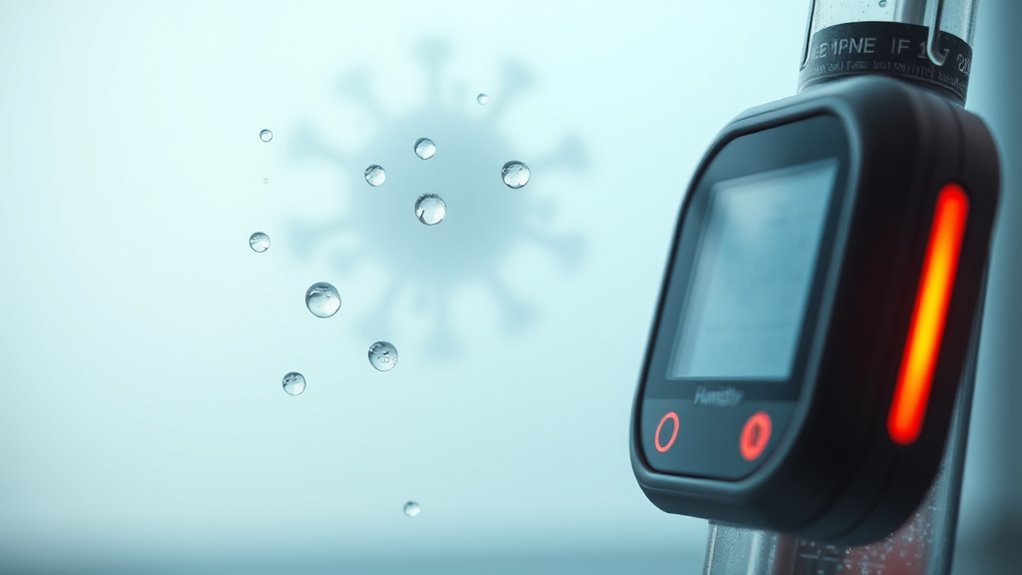
Yes, relative humidity considerably affects virus transmission. When indoor air is dry, droplets from coughs and sneezes evaporate quickly, turning into smaller aerosols that stay airborne longer and increase infection risk. Higher humidity promotes droplet settling, reducing airborne spread. Maintaining indoor humidity between 40-60% can decrease virus survival and boost your immune defenses. To understand how humidity influences virus behavior and transmission dynamics in detail, explore further insights.
Key Takeaways
- Low relative humidity prolongs virus survival and airborne persistence, increasing transmission risk.
- Higher humidity promotes droplet settling, reducing aerosolized virus particles in the air.
- Laboratory studies show viruses survive longer at low humidity, with viability decreasing as humidity rises.
- Maintaining indoor humidity between 40-60% can decrease virus stability and spread.
- Humidity influences droplet dynamics, affecting how far and long viruses remain airborne.
The Basics of Relative Humidity and Virus Survival

Understanding how relative humidity affects virus survival is essential for managing transmission risks. As climate change impacts weather patterns, humidity levels fluctuate more widely, influencing virus stability. Humidity measurement helps determine the moisture content in the air, which directly affects virus particles. When the air is too dry, viruses tend to remain airborne longer, increasing infection chances. Conversely, higher humidity can cause droplets to settle faster, reducing airborne transmission. Recognizing the relationship between climate change and humidity shifts allows you to better anticipate infection risks in different environments. Monitoring humidity levels accurately provides insights into how viruses may behave under changing climate conditions, enabling more effective strategies to limit their spread. Staying aware of these factors helps you make informed decisions about safety and prevention. Additionally, the presence of water features like water parks can influence local humidity levels, potentially affecting virus transmission dynamics in those areas.
How Humidity Influences Droplet Dynamics and Spread

Humidity levels directly influence how respiratory droplets behave once expelled into the air. When humidity is high, droplets retain more moisture, staying larger and settling faster, which can reduce pathogen transmission. Conversely, low humidity causes droplets to evaporate quickly, shrinking into aerosols that remain airborne longer, increasing the chance of inhalation. This droplet evaporation process affects how far and how long viruses can spread, impacting pathogen transmission. In dry conditions, smaller aerosols travel farther and linger in the air, making it easier for viruses to infect others. On the other hand, higher humidity promotes faster droplet settling, limiting airborne spread. Additionally, the storage conditions of respiratory droplets can influence their behavior and infectivity. Understanding these dynamics helps explain how humidity influences virus transmission and highlights the importance of controlling indoor moisture levels.
Evidence From Laboratory Studies on Humidity and Virus Viability

Laboratory studies have provided compelling evidence that humidity levels substantially affect virus viability. Researchers have used humidity sensors to precisely control environmental conditions, revealing how viruses respond to different moisture levels. In controlled settings, viruses tend to survive longer at low humidity, while higher humidity often reduces their viability. These findings highlight the importance of climate control systems in managing indoor environments, especially in healthcare and public spaces. By maintaining specific humidity ranges, you can potentially decrease the lifespan of airborne viruses. Such experiments demonstrate the direct impact of humidity on virus stability, supporting the idea that adjusting indoor moisture levels could be an effective strategy to limit virus transmission. Laboratory evidence underscores the critical role of humidity management in infection control efforts and emphasizes the need for protective measures in various settings.
Real-World Observations During Outbreaks and Seasonal Variations

You’ve probably noticed that respiratory infections tend to spike during certain seasons. Environmental factors, like humidity levels, play a big role in these patterns. Understanding how real-world outbreaks relate to seasonal changes can help you better predict and prevent virus spread. Implementing space organization strategies can also reduce clutter and improve overall hygiene during outbreaks.
Seasonal Infection Patterns
Have you ever noticed how flu seasons seem to peak at specific times of the year? During colder months, increased indoor air circulation often traps viruses, making transmission more likely. Seasonal patterns also relate to surface contamination, as people touch shared surfaces more frequently indoors. These surfaces can harbor viruses longer in low humidity environments, contributing to the spread. As temperatures drop, respiratory droplets linger longer in the air, and ventilation may be reduced, creating ideal conditions for outbreaks. You might observe higher infection rates during winter months when people spend more time indoors with limited airflow. Understanding these seasonal infection patterns helps explain why certain times of the year see more outbreaks and highlights the importance of managing air circulation and surface hygiene. Additionally, relative humidity plays a crucial role in virus viability and transmission efficiency.
Outbreak Environment Factors
During outbreaks, environmental conditions play a crucial role in how viruses spread, often varying with seasonal changes. Humidity effects are a key outbreak factor, influencing virus stability and transmission. Lower humidity levels, typical in winter, can cause respiratory droplets to evaporate quickly, allowing aerosols to remain airborne longer and increasing infection risk. Conversely, higher humidity in summer can cause droplets to settle faster, potentially reducing spread. Real-world observations show virus transmission often spikes during dry, cold months, highlighting the importance of outbreak environment factors. Factors such as indoor heating, ventilation, and humidity levels directly impact how effectively viruses transmit. Understanding these outbreak factors helps in developing strategies to mitigate virus spread, especially during seasonal shifts when humidity effects are most pronounced. Additionally, the impact of ambient conditions on virus survival emphasizes the need for environmental controls in public health strategies.
Mechanisms Linking Humidity to Immune Response and Pathogen Stability

Humidity levels directly influence both the immune system’s ability to respond to pathogens and the stability of viruses outside the body. When humidity is low, your mucous membranes dry out, weakening your immune response and making it easier for pathogens to infect you. Conversely, higher humidity helps maintain mucous membrane moisture, boosting your immune defenses. Additionally, humidity affects pathogen stability; many viruses survive longer in dry conditions, increasing infection risk. High humidity can cause droplets to settle faster, reducing airborne transmission. You can see how humidity creates a balance: it impacts your immune response by maintaining mucous membrane health and influences pathogen stability by affecting how long viruses remain viable outside your body. Both factors play essential roles in virus transmission dynamics. Proper home environment control can help optimize humidity levels and reduce infection risks.
Impacts of Indoor Humidity Levels on Transmission Risks
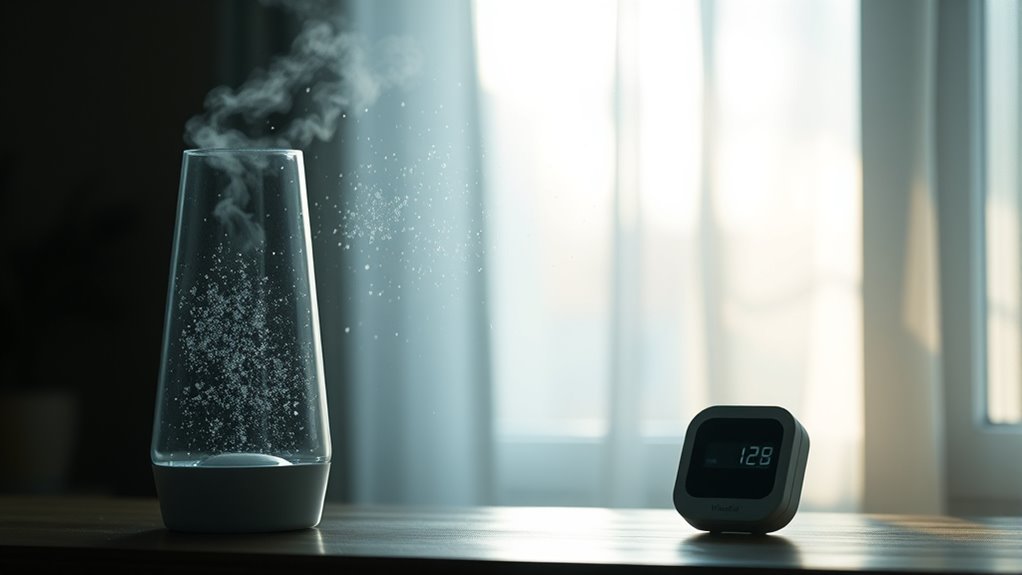
Maintaining indoor humidity within an ideal range can considerably reduce the risk of virus transmission. When humidity levels are too low or too high, it affects how aerosols form and linger in the air. Understanding this balance helps you create safer indoor environments. Proper airless spray painting techniques and equipment maintenance can also help reduce airborne particles and improve air quality indoors.
Optimal Humidity Range
Have you ever wondered how indoor humidity levels influence virus transmission? Maintaining an ideal humidity range, generally between 40-60%, helps improve air quality and reduces the survival of viruses. When humidity is too low, air becomes dry, allowing virus particles to linger longer and increasing transmission risks. Conversely, high humidity can promote mold growth and worsen indoor air quality, which may also affect health. Climate change impacts indoor environments by making humidity control more challenging, especially in poorly insulated buildings. To minimize risks, aim for a balanced indoor humidity level, using humidifiers or dehumidifiers as needed. Keeping within this perfect range helps create a healthier indoor environment and lessens the likelihood of virus spread. Proper ventilation and moisture regulation are essential components of indoor air quality management.
Humidity and Aerosolization
Indoor humidity levels directly influence how virus particles become aerosolized and linger in the air. When humidity is too low, aerosol particles tend to evaporate, creating smaller, lighter particles that stay airborne longer, increasing transmission risk. Conversely, higher humidity can cause particles to grow in size, making them settle faster. Using humidity sensors helps you monitor indoor conditions accurately, allowing you to adjust humidity levels effectively. Understanding aerosol particle size is vital, as smaller particles (<5 micrometers) remain suspended longer, while larger ones settle quickly. Maintaining ideal humidity can reduce the chances of aerosolized virus particles remaining airborne, lowering infection risks indoors. Proper control of indoor humidity can also influence aerosolization dynamics and further mitigate transmission risks. By managing humidity carefully, you can influence aerosolization dynamics, making your environment safer and less conducive to virus transmission.
Public Health Guidelines and Recommendations for Humidity Control

To reduce the risk of virus transmission, public health guidelines emphasize controlling indoor humidity levels within a specific range, typically between 40-60%. You should use humidity sensors to monitor indoor conditions accurately, ensuring levels stay within this ideal window. Maintaining proper humidity helps limit virus survival and reduces aerosol spread. Additionally, air purification systems can enhance indoor air quality by filtering out airborne pathogens. Regularly checking humidity levels allows you to make timely adjustments, avoiding overly dry or humid environments that could facilitate virus transmission. Implementing automation technologies in building management systems can further optimize environmental controls for health safety. Following these guidelines supports a healthier environment and minimizes infection risks. By combining humidity monitoring and air purification, you actively contribute to safer indoor spaces, aligning with public health recommendations for controlling virus spread through humidity management.
Limitations and Confounding Factors in Current Research

Although current studies suggest a link between humidity levels and virus transmission, several limitations complicate understanding these results. Measurement limitations often affect accuracy, as humidity levels are not always precisely tracked or controlled, leading to inconsistent data. Additionally, confounding variables such as temperature, airflow, human behavior, and ventilation can influence virus spread independently of humidity. These factors make it difficult to isolate humidity’s specific effect. Variations in study design and environmental settings further hinder direct comparisons across research. As a result, drawing definitive conclusions about the role of relative humidity remains challenging, emphasizing the need for more rigorous, controlled studies that account for measurement limitations and confounding variables to clarify the true relationship. Understanding environmental factors is crucial for developing effective virus mitigation strategies.
Future Directions and Areas for Further Investigation

Future research should focus on conducting well-controlled studies that isolate the effect of relative humidity on virus transmission. Advancements in technological innovations, such as precise environmental monitoring tools, can help gather more accurate data. These tools enable researchers to better understand how specific humidity levels influence virus spread in different settings. Additionally, exploring these findings can inform policy implications, guiding public health measures and building design standards. Future studies should also examine how humidity interacts with other factors like temperature and airflow. Incorporating advanced detection methods can improve the accuracy of data collection and analysis. By integrating innovative technology and rigorous methodology, you can develop exhaustive strategies to mitigate transmission risks. Ultimately, this research will help policymakers craft evidence-based guidelines that improve indoor air quality and reduce infection rates across various environments.
Frequently Asked Questions
Does Humidity Affect All Types of Viruses Equally?
You might wonder if humidity affects all viruses equally. The answer is no, because viral resistance varies, and humidity variability impacts each differently. Some viruses, like influenza, are more sensitive to humidity changes, reducing their spread in high humidity. Others, like certain coronaviruses, are less affected. So, understanding how humidity influences viral behavior helps you better grasp the complex relationship between environmental factors and virus transmission.
How Quickly Can Indoor Humidity Levels Be Adjusted Effectively?
Adjusting indoor humidity levels quickly depends on your humidification speed and dehumidification efficiency. With modern systems, you can typically raise or lower humidity within 30 minutes to a few hours. Using a humidifier or dehumidifier with high efficiency speeds up the process, allowing you to attain desired levels faster. Properly maintained equipment ensures consistent control, so you can create a comfortable, healthy environment efficiently.
Are There Any Risks Associated With Controlling Indoor Humidity?
Controlling indoor humidity is like walking a tightrope—balance is key. If you don’t, you risk harming air quality and encouraging mold growth, which can impact your health. Too high humidity fosters mold, while too low dries out air and can cause respiratory issues. Stay vigilant, monitor levels carefully, and maintain proper humidity to protect your environment without tipping the scale into health hazards.
What Are the Most Effective Methods to Measure Humidity Accurately?
You should focus on using high-quality relative humidity sensors and regularly calibrate your hygrometers to guarantee accurate readings. Proper hygrometer calibration involves comparing your device with a known humidity standard and adjusting accordingly. Choose digital hygrometers with built-in calibration features for convenience. Regularly check your sensors to maintain precision, especially in environments where exact humidity control is essential. Accurate measurement helps you manage indoor humidity effectively.
Can Humidity Control Alone Prevent Virus Transmission Indoors?
You might think humidity control alone prevents virus transmission, but it’s not enough. While maintaining ideal humidity levels can help create an environment less conducive to viruses, it must be combined with good ventilation, regular cleaning, and mask use. Humidity control supports virus prevention, but relying solely on it leaves gaps. To truly safeguard indoor spaces, you need a thorough approach that includes multiple preventive measures.
Conclusion
You now know that maintaining indoor humidity between 40-60% can markedly reduce virus survival and transmission. Studies show that viruses like influenza and coronaviruses decrease viability by up to 80% at ideal humidity levels. By controlling your environment, you can lower infection risks and support your immune system. So, next time you adjust your humidifier, remember—you’re actively helping protect yourself and those around you. Small changes make a big difference in staying healthier.