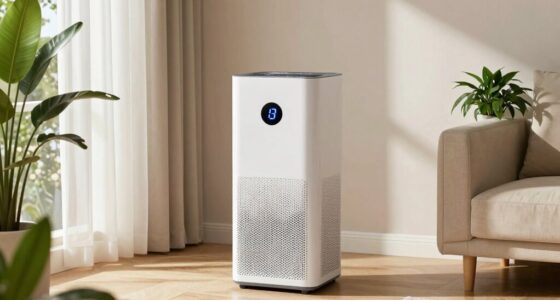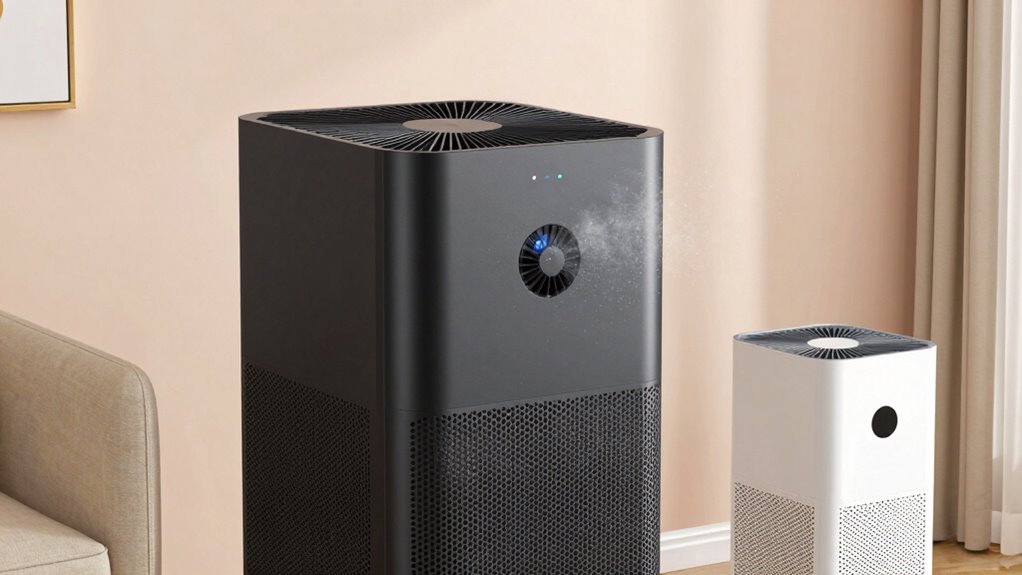

Bigger air purifiers don’t always work better because their size can hinder proper airflow, creating zones where contaminants linger. You might notice uneven purification or dead spots where air stagnates, reducing efficiency. Larger units often consume more energy and are harder to maintain, which can lead to neglect and reduced performance. To get the most out of your purifier, understanding airflow and filter placement is key—if you keep exploring, you’ll discover how to optimize this smarter.
Key Takeaways
- Larger purifiers may create dead zones with stagnant air, reducing overall purification efficiency.
- Ineffective airflow design in big units can lead to uneven pollutant removal.
- Increased size does not guarantee better filtration performance or coverage.
- Larger units often consume more energy, increasing operational costs without improved results.
- Complex maintenance and filter placement challenges can hinder consistent indoor air quality.

Have you noticed that large air purifiers aren’t living up to their promises? It’s frustrating, especially when you’ve invested in a big device hoping it will dramatically improve your indoor air quality. But larger isn’t always better. These hefty machines often fall short of meeting air quality standards, leaving you disappointed. You might assume that a bigger purifier means more power and better filtration, but that’s not necessarily the case. Many large purifiers struggle with effectively circulating air throughout a room, leading to uneven purification. Instead of consistently removing pollutants, they can create zones of clean air and areas where contaminants linger. This means the air quality in your space might not improve as much as you expect, despite the size of the unit.
Another critical factor to evaluate is energy consumption. Large purifiers tend to draw considerably more power than their smaller counterparts. While they may promise rapid purification, they often do so at a high energy cost, which isn’t sustainable or cost-effective over time. If you’re trying to maintain good air quality without skyrocketing your electricity bill, a large purifier might not be the right choice. Over time, the higher energy consumption can outweigh any benefits gained from their size, especially if they don’t perform efficiently. You could be stuck paying more for electricity while still struggling to meet air quality standards. Energy efficiency** plays a significant role in the overall performance and cost-effectiveness of air purifiers. Additionally, proper airflow design** can help mitigate some of these issues by ensuring more uniform circulation.
Large purifiers often consume more energy, making them costly and inefficient over time.
Furthermore, many large purifiers are designed with the assumption that bigger is better, but they overlook the importance of proper airflow design and filter placement. If airflow isn’t optimized, larger units can create dead zones where air stagnates, reducing overall effectiveness. The complexity of these machines often makes maintenance more challenging, too. Replacing filters or cleaning parts can be cumbersome, leading to neglect and decreased performance. When maintenance is neglected, the purifier’s ability to meet air quality standards diminishes even further. Proper airflow design and filter placement are crucial for ensuring pollutants are evenly distributed and removed efficiently. Understanding the air circulation patterns within a space can significantly impact the purifier’s success.
energy efficient air purifier for large rooms
As an affiliate, we earn on qualifying purchases.
As an affiliate, we earn on qualifying purchases.
Frequently Asked Questions
Are Smaller Purifiers More Effective Than Larger Ones?
Smaller purifiers can be more effective than larger ones because their compact design often allows for better air circulation and targeted filtration. With improved airflow, they enhance air quality more efficiently in specific spaces. Purifier design matters—smaller units are easier to place strategically, ensuring better coverage. While larger purifiers cover bigger areas, their performance can diminish if air circulation isn’t optimized, making smaller, well-designed units sometimes the better choice.
How Does Room Size Affect Purifier Performance?
Your room size is the battleground where purifier performance fights for victory. If your space is tiny, a large purifier can overwhelm the room, reducing airflow efficiency and trapping pollutants instead of clearing them. Proper placement is essential; position it centrally to maximize airflow efficiency. For larger rooms, opt for a purifier with appropriate capacity. Ignoring these factors makes your efforts as effective as a leaky faucet—wasting energy and leaving pollutants behind.
Do Large Purifiers Consume More Energy?
Yes, large purifiers generally consume more energy because they have bigger motors and fans to cover larger spaces. However, their efficiency comparison often shows they can purify air faster, saving you energy over time. You might find that, despite higher energy consumption per hour, they’re more efficient overall for big rooms. Always check the energy ratings to guarantee you’re choosing a model that balances power use with performance.
Can Large Purifiers Be Noisier Than Smaller Models?
Yes, large purifiers can be noisier than smaller models. Their bigger fans and more powerful motors often produce higher noise levels, especially if they lack sound insulation. If you’re sensitive to noise, you should check the purifier’s decibel ratings and look for models with sound insulation features. Proper placement can also help minimize noise impact, making your environment more comfortable while still enjoying clean air.
What Maintenance Challenges Do Bigger Purifiers Have?
With larger purifiers, you face maintenance challenges like frequent filter replacement and dust accumulation. Because they process more air, filters tend to clog faster, requiring you to replace them more often to keep performance ideal. Dust buildup can also occur in hard-to-reach areas, making cleaning more time-consuming. Staying on top of these tasks guarantees your purifier remains effective and prolongs its lifespan, despite its size.
air purifier with optimized airflow design
As an affiliate, we earn on qualifying purchases.
As an affiliate, we earn on qualifying purchases.
Conclusion
Remember, bigger isn’t always better when it comes to purifiers. Like a mighty ship that’s too heavy to steer, a bulky purifier can struggle to navigate your space effectively. Size alone doesn’t guarantee clean air — it’s about smart design, proper placement, and tailored features. So, don’t be fooled by the giants. Instead, choose a purifier that fits your needs like a well-cut suit, ensuring you breathe easier without the weight of unnecessary bulk.
large room air purifier with easy filter replacement
As an affiliate, we earn on qualifying purchases.
As an affiliate, we earn on qualifying purchases.
air purifier dead zone reduction
As an affiliate, we earn on qualifying purchases.
As an affiliate, we earn on qualifying purchases.