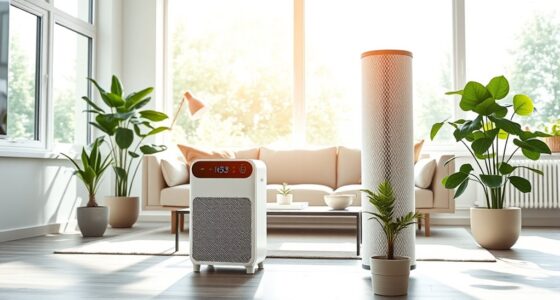
When choosing an air purifier for open-plan living spaces, focus on models with powerful CADR ratings suitable for large areas. Look for units that have easy-to-replace or washable filters, and check for smart features and low noise levels. Energy efficiency is key to keep operating costs low, especially with continuous use. Proper placement near pollution sources enhances effectiveness. To learn how to select the best model for your space, explore the key factors that impact performance and maintenance.
Key Takeaways
- Select models with sufficient CADR to effectively purify large open areas.
- Prioritize units with HEPA and activated carbon filters for comprehensive pollutant removal.
- Ensure the purifier has adjustable fan speeds, timers, and energy-saving modes for efficient operation.
- Choose devices with easy maintenance, washable filters, and filter indicator lights to simplify upkeep.
- Consider noise levels and design to ensure seamless integration into living spaces without disturbance.

Are you overwhelmed by the variety of air purifiers on the market? With so many options available, it can feel daunting to find the right one for your open-plan living space. The key is to focus on models that suit your specific needs while being mindful of long-term maintenance and energy consumption. When choosing an air purifier, consider how easy it is to maintain. Air purifier maintenance includes replacing filters, cleaning pre-filters, and ensuring the unit functions correctly. Some models have indicator lights that tell you when it’s time to change filters, making upkeep straightforward. Opting for an air purifier with easily accessible parts or washable filters can save you time and money. Additionally, look for energy-efficient models that won’t spike your electricity bill. Energy-efficient air purifiers use less power while still providing strong air cleaning performance, which is especially important in open-plan spaces where the unit works harder to circulate air throughout a larger area. These models often come with features like adjustable fan speeds, timers, and energy-saving modes, allowing you to customize operation and reduce power use when full capacity isn’t needed.
In an open-plan living space, air circulation is crucial. Choose an air purifier with a suitable CADR (Clean Air Delivery Rate) that matches the size of your room to guarantee effective air cleaning. A larger space requires a powerful unit that can filter air quickly and efficiently, preventing pollutants from lingering in the open area. When shopping, pay attention to the purifier’s filtration system. HEPA filters are essential for trapping airborne particles like dust, pollen, pet dander, and smoke. For added protection against odors and volatile organic compounds (VOCs), consider models with activated carbon filters. These filters work together to improve air quality thoroughly, which is especially important in open living areas where pollutants can circulate freely.
Furthermore, integrating smart technology into your air purifier can help you monitor air quality remotely and adjust settings for optimal performance. Another factor to keep in mind is noise level. Since open-plan spaces often serve as communal areas, you want a unit that operates quietly, especially if you plan to use it while working, relaxing, or sleeping. Many modern air purifiers are designed to run quietly on lower settings, so check reviews or specifications for noise ratings. Finally, think about the design and placement of your air purifier. It should blend seamlessly into your space without becoming an eyesore or obstructing airflow. Strategically placing the unit near sources of pollution, like pet areas or kitchens, can boost efficiency. By balancing maintenance needs, energy efficiency, filtration power, noise levels, and design, you can select an air purifier that keeps your open-plan living space fresh, healthy, and comfortable.
Frequently Asked Questions
How Do Air Purifiers Affect Energy Consumption in Large Open Spaces?
Air purifiers in large open spaces increase energy consumption because of their higher power usage to cover a bigger area. To maximize energy efficiency, choose models with adjustable fan speeds and energy-saving modes. Keep in mind that running the purifier continuously at high power can spike your energy bills. Opt for a device with good filtration and low power consumption to balance air quality and energy efficiency effectively.
Can Multiple Air Purifiers Work Together Effectively in Open-Plan Areas?
Imagine a gentle breeze sweeping across your open-plan space, with multiple air purifiers working in harmony. Yes, they can work together effectively if you focus on airflow optimization and strategic purifier placement. Position them where airflow converges and avoid obstructions, creating a seamless flow of purified air. This coordination enhances air quality, ensuring your entire space benefits from cleaner, fresher air without overloading any single unit.
What Maintenance Is Required for Air Purifiers in Open Living Spaces?
You need to regularly maintain your air purifiers by replacing filters when they become dirty or after their recommended lifespan, usually every 6 to 12 months. Additionally, clean the filters as needed, following the manufacturer’s instructions, to guarantee peak performance. Regular filter replacement and cleaning help keep the air fresh and allergen-free in your open living space, preventing buildup and maintaining air quality effectively.
Are There Specific Features Suitable for Open-Plan Environments?
In open-plan spaces, look for air purifiers with smart filters and an optimized airflow design. These features guarantee the purifier adapts to your environment, maintains consistent air quality, and covers larger areas efficiently. A smart filter targets pollutants precisely, while a well-designed airflow circulates air evenly. Together, these features help you enjoy cleaner, fresher air throughout your entire living space without dead spots or constant maintenance.
How Do Noise Levels Impact Air Purifier Effectiveness in Open Areas?
Sound levels can considerably impact your air purifier’s effectiveness in open areas. If the noise interference is too high, you might turn the device off, reducing air quality. Look for models with low sound levels, especially during the night, so you can run it continuously without disturbance. Quiet operation ensures consistent air purification, helping you breathe easier without the distraction of loud noise.
Conclusion
Now that you know what to look for, choosing an air purifier becomes like planting a garden in your living space—each one carefully selected helps your home breathe easier. Imagine your open-plan area as a lush forest, where invigorating, clean air flows freely like a gentle breeze through the trees. With the right purifier, you’re cultivating a sanctuary of purity and comfort, turning your home into a gust of fresh air you’ll want to enjoy every day.