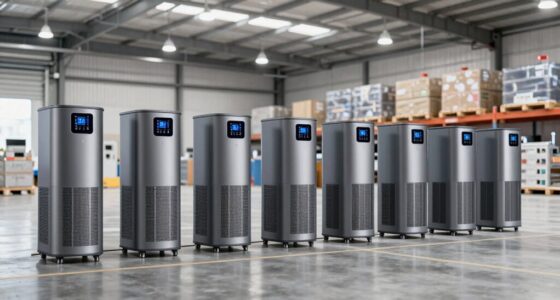
The best whole-house ventilation systems balance fresh-air delivery, energy efficiency, and installation fit rather than maximizing airflow alone. I rank the Panasonic FV-12ESC1 Intelli-Balance Elite Plus as the best overall for its energy-recovery design and manageable 120 CFM capacity; the Aggrfine 6-Inch ERV stands out for higher airflow and PM2.5 filtration, while the Panasonic SelectCycler offers a simpler route to controlled ventilation. The main tradeoff is between balanced ERV systems that exchange heat and moisture, simpler ventilation controls, and room-level units that avoid extensive ductwork but do not serve a whole home in the same way. The right choice depends on your floor plan, climate, existing ducts, and ventilation target. Read on for the full breakdown and guidance on matching a system to your home.

Get home appliances delivered free with Prime
- Fast, free delivery on millions of items
- Prime Video, Amazon Music and more included
- Member-only deals all year
Complete the kit


Key Takeaways
- The Panasonic FV-12ESC1 is the strongest all-around fit for buyers who want an ERV and a more moderate 120 CFM capacity rather than a high-airflow unit.
- Aggrfine and the VENTS-US Frigate ERV 150 target higher airflow, but their 180/250 CFM and 180 CFM figures need to be matched to the home’s ventilation design, not treated as automatic advantages.
- The Panasonic SelectCycler is a different kind of solution: its 4-inch duct setup may suit simpler controlled ventilation needs, but it is not interchangeable with a dedicated ERV.
- Two Panasonic ERVs serve different installation priorities: the BalancedHome Elite’s top-port design can influence duct routing, while the FV-12ESC1 is the more straightforward overall recommendation in this lineup.
- The Weiworld through-wall unit is best treated as a room-level alternative, not a direct substitute for a ducted whole-house system; its HEPA filtration, Wi-Fi, and remote address different needs than balanced whole-home airflow.
| VENTS-US Frigate ERV 150 Whole-House Ventilation System, 180 CFM |  | Best for Cold-Climate Whole-Home Ventilation | Airflow capacity: 180 CFM | Noise level: 1.9 sones | Power: 189 W | VIEW LATEST PRICE | See Our Full Breakdown |
| Panasonic FV-12ESC1 Intelli-Balance Elite Plus Energy Recovery Ventilator, 120 CFM |  | Best for Flexible Airflow and High Filtration | Model: FV-12ESC1 | Airflow range: 30–120 CFM | Motor type: Dual brushless ECM | VIEW LATEST PRICE | See Our Full Breakdown |
| Panasonic SelectCycler Whole-Home Ventilation System, 4-Inch Duct |  | Best for Central-HVAC Integration | Duct size: 4 in | Operating modes: Supply or balanced ventilation | Included control components: Programmable wall controller, 24 VAC motorized supply damper, Fanconnect wall switch | VIEW LATEST PRICE | See Our Full Breakdown |
| Panasonic BalancedHome Elite 120 Energy Recovery Ventilator, Top-Port Design, 30–120 CFM |  | Best for Built-In Controls and Installation Flexibility | Airflow range: 30–120 CFM | Sensible recovery efficiency: Up to 87% SRE | Ports: Four 6-inch top ports | VIEW LATEST PRICE | See Our Full Breakdown |
| Aggrfine 6-Inch ERV Whole-House Ventilation System, 180/250 CFM, with PM2.5 Filtration |  | Best for Higher Airflow and Multi-Stage Filtration | Duct size: 6 in | Airflow settings: 180/250 m³/h (title lists 180/250 CFM) | Filtration: Primary mesh, HEPA filter, activated carbon layer | VIEW LATEST PRICE | See Our Full Breakdown |
| VENTS-US Frigate ERV 120S Energy Recovery Ventilator, 162 CFM |  | Best for Cold-Climate Retrofits | Maximum airflow: 162 CFM | Power consumption: 19 W on LOW; 94 W listed | Voltage: 120 V | VIEW LATEST PRICE | See Our Full Breakdown |
| Weiworld VT501F-WF Through-Wall HEPA Ventilation Fan with Wi-Fi and Remote |  | Best for Room-Level Filtered Ventilation | Model: VT501F-WF | Mounting: Wall mount; through-wall duct | Airflow capacity: 60 m³/h | VIEW LATEST PRICE | See Our Full Breakdown |
| whole house ventilation system | Noise level | Voltage | Mounting | Dimensions |
|---|---|---|---|---|
| VENTS-US Frigate ERV 150 Whole | 1.9 sones | 120 V | Ceiling mount | 31 × 24 × 12 in |
| Panasonic FV-12ESC1 Intelli-Ba | — | 120 V | — | 37.64 × 14.25 × 27.6 in |
| Panasonic SelectCycler Whole-H | — | — | — | 11.49 × 9.09 × 7.71 in |
| Panasonic BalancedHome Elite 1 | — | — | Wall mount | — |
| Aggrfine 6-Inch ERV Whole-Hous | 39–41 dB | 110 V | Wall mount or ceiling-suspended | 35.1 × 9.9 × 32.1 in (D × W × H) |
| VENTS-US Frigate ERV 120S Ener | 1.9 sones | 120 V | — | — |
| Weiworld VT501F-WF Through-Wal | 30 dB | — | Wall mount; through-wall duct | — |
More Details on Our Top Picks
VENTS-US Frigate ERV 150 Whole-House Ventilation System, 180 CFM
The Frigate ERV 150 suits buyers who want a dedicated, balanced ventilation unit with protection against cold-weather frost. Its 180 CFM capacity is higher than the Panasonic FV-12ESC1’s 120 CFM maximum, making it a stronger fit when a home needs more air exchange. The enthalpy core transfers heat and moisture between air streams, while automatic defrost uses warm return air to protect the core in cold conditions. Washable filters keep upkeep straightforward, but MERV 6 filtration is basic compared with the Panasonic’s included MERV 13 filters. This is also a permanent ceiling-mounted system, so it asks for a planned ducted installation rather than the more flexible mounting choices of its Panasonic competitor.
Pros:- 180 CFM capacity exceeds the Panasonic FV-12ESC1’s 120 CFM maximum.
- Enthalpy core transfers both heat and moisture between air streams.
- Automatic electronic defrost helps protect the core in cold conditions.
- Washable MERV 6 filters and corrosion-resistant coated steel housing are included.
Cons:- MERV 6 filtration is more basic than the Panasonic FV-12ESC1’s MERV 13 filters.
- Permanent ceiling-mount installation limits placement flexibility.
- At 31 × 24 × 12 inches, the unit needs dedicated installation clearance.
Best for: Homeowners planning a permanent ducted installation who need up to 180 CFM and automatic frost protection.
Not ideal for: Buyers who need higher-grade included filtration, flexible mounting, or a system that can be installed without ceiling space and ductwork.
- Airflow capacity:180 CFM
- Noise level:1.9 sones
- Power:189 W
- Voltage:120 V
- Core type:Enthalpy
- Filters:Washable MERV 6
- Mounting:Ceiling mount
- Dimensions:31 × 24 × 12 in
- Frost protection:Electronic defrost using warm return air
Our verdict“Choose the Frigate ERV 150 for higher airflow and automatic frost protection if basic filtration and permanent ceiling installation suit your project.”
Panasonic FV-12ESC1 Intelli-Balance Elite Plus Energy Recovery Ventilator, 120 CFM
The FV-12ESC1 is a strong choice when airflow needs to be tuned to a home rather than fixed at one setting. Its 30–120 CFM adjustment range supports balanced, positive, or negative pressure, while dual brushless ECM motors adapt to static pressure to help maintain the selected airflow across duct layouts. The included MERV 13 filters give it a filtration advantage over the VENTS-US Frigate ERV 150, whose washable filters are MERV 6. Its energy-transfer core also handles both heat and moisture. The tradeoff is capacity: homes that need more than 120 CFM may be better matched to the Frigate’s 180 CFM output. At 53 pounds, this Panasonic also calls for sturdy support, and compatible Wi-Fi or wall controls are separate rather than included.
Pros:- Adjustable 30–120 CFM airflow supports balanced, positive, or negative pressure.
- Dual brushless ECM motors adapt to static pressure.
- Dual MERV 13 filters provide finer filtration than the Frigate ERV 150’s MERV 6 filters.
- Supports wall, ceiling, or floor mounting.
Cons:- Maximum airflow is lower than the 180 CFM VENTS-US Frigate ERV 150.
- The 53-pound unit needs substantial support during installation.
- Compatible Wi-Fi, touchscreen, and timer controls are not listed as included.
Best for: Homeowners seeking adjustable ventilation, pressure-control options, and higher-grade included filters for a ducted whole-home system.
Not ideal for: Buyers with ventilation needs above 120 CFM, limited structural support, or a requirement for included Wi-Fi or touchscreen controls.
- Model:FV-12ESC1
- Airflow range:30–120 CFM
- Motor type:Dual brushless ECM
- Speed settings:4
- Filters:Dual MERV 13
- Voltage:120 V
- Mounting options:Wall, ceiling, or floor
- Dimensions:37.64 × 14.25 × 27.6 in
- Weight:53 lb
Our verdict“Pick the FV-12ESC1 when adjustable airflow and MERV 13 filtration matter more than the higher capacity of the Frigate ERV 150.”
Panasonic SelectCycler Whole-Home Ventilation System, 4-Inch Duct
The SelectCycler takes a different route from the dedicated ERVs in this lineup: it coordinates a central HVAC system, dampers, and compatible ventilation fans instead of serving as a self-contained energy-recovery ventilator. That makes it a practical fit for homes where existing equipment can supply the airflow and the goal is to control supply or balanced ventilation. The included programmable wall controller, motorized damper, and Fanconnect switch provide the control pieces, while the Frigate ERV 150 bundles its own ventilation unit, filters, and brackets. The key compromise is that the SelectCycler requires a compatible fan; the kit alone does not deliver ventilation airflow. Its 4-inch duct requirement also narrows retrofit options, though its compact controller hardware takes less space than a complete ERV.
Pros:- Coordinates ventilation with central HVAC equipment, dampers, and compatible fans.
- Supports both supply and balanced ventilation strategies.
- Includes a programmable wall controller, motorized supply damper, and Fanconnect switch.
- Compact, 3-pound control unit and Energy Star certification.
Cons:- Requires a compatible ventilation fan; the kit does not operate as a standalone ventilator.
- Designed for 4-inch ducting, which may limit retrofit compatibility.
- Does not include the energy-recovery core found in the dedicated ERVs in this lineup.
Best for: Homeowners with central HVAC and a compatible ventilation fan who want programmable supply or balanced ventilation control.
Not ideal for: Buyers seeking a standalone ERV with its own motors and energy-recovery core, or homes without compatible 4-inch ducting and fan equipment.
- Duct size:4 in
- Operating modes:Supply or balanced ventilation
- Included control components:Programmable wall controller, 24 VAC motorized supply damper, Fanconnect wall switch
- Speed settings:2
- Wattage:45 W
- Mounting type:Ceiling mount
- Dimensions:11.49 × 9.09 × 7.71 in
- Weight:3 lb
- Warranty:6 years on DC motor; 3 years on parts
Our verdict“Choose the SelectCycler if you already have central HVAC and a compatible fan; choose a dedicated ERV like the Panasonic FV-12ESC1 if you need the ventilation unit itself.”
Panasonic BalancedHome Elite 120 Energy Recovery Ventilator, Top-Port Design, 30–120 CFM
The BalancedHome Elite 120 stands out for pairing a 30–120 CFM adjustable range with an integrated digital control panel. That gives installers access to setup, operating status, and fault information at the unit, unlike the Panasonic FV-12ESC1, which can work with compatible external controls that are not included. Its hygroscopic membrane core transfers heat and moisture, and SmartFlow technology is designed to maintain airflow across varied duct layouts and static pressure. The four top-facing 6-inch ports can help shape a duct plan, but they also require room above the unit and a compatible duct arrangement. The optional touchscreen control is an added accessory, not part of the supplied kit. With a 120 CFM ceiling, it is less suited to homes needing the Frigate ERV 150’s higher 180 CFM capacity.
Pros:- Adjustable 30–120 CFM airflow suits a range of whole-home ventilation needs.
- Integrated digital panel displays setup, system status, and fault information.
- Hygroscopic membrane core transfers moisture and energy between air streams.
- Includes both a power cord and hardwire adaptor kit.
Cons:- Maximum airflow is below the VENTS-US Frigate ERV 150’s 180 CFM.
- Four top ports require a suitable duct layout and overhead clearance.
- FV-SCVE2 touchscreen wall control is optional.
Best for: Homeowners and installers who want adjustable ERV airflow, onboard setup and fault information, and a top-port duct layout.
Not ideal for: Homes requiring more than 120 CFM, installations without clearance for top-facing ducts, or buyers who expect the optional touchscreen control to be included.
- Airflow range:30–120 CFM
- Sensible recovery efficiency:Up to 87% SRE
- Ports:Four 6-inch top ports
- Core:Hygroscopic membrane
- Mounting:Wall mount
- Controls:Integrated digital control panel
- Included accessories:Power cord and hardwire adaptor kit
- Optional control:FV-SCVE2 touchscreen wall control
Our verdict“Choose the BalancedHome Elite 120 for onboard controls and top-port flexibility if its 120 CFM limit fits your home’s ventilation needs.”
Aggrfine 6-Inch ERV Whole-House Ventilation System, 180/250 CFM, with PM2.5 Filtration
Aggrfine is the high-airflow pick for buyers who want an ERV with a more elaborate filter stack than the other dedicated ventilators here. It pairs a washable graphene energy-recovery core with a primary mesh, HEPA filter, and activated carbon layer, giving it a broader filtration setup than the Frigate ERV 150’s washable MERV 6 filters. The listed speed options are 180 and 250 m³/h, so buyers should check that the unit’s airflow format and duct plan match their project rather than assume the CFM figure in the title is directly interchangeable. Wall or ceiling-suspended mounting adds placement choice, but the large 35.1 × 9.9 × 32.1-inch body still needs space. A further catch: the two-speed switch requires hard-wired installation; plug-in operation is factory-set to high speed.
Pros:- Filter stack includes primary mesh, HEPA filtration, and activated carbon.
- Washable graphene core transfers heat and moisture between air streams.
- Two listed airflow settings provide a lower and higher operating option when hard-wired.
- Can be wall-mounted or ceiling-suspended.
Cons:- Plug-in operation is factory-set to high speed; the two-speed switch is for hard-wired installation.
- Large listed dimensions may complicate placement in tight mechanical spaces.
- Airflow is listed as 180/250 m³/h in the specs, so buyers should verify the rating against their duct design.
Best for: Homeowners prioritizing multi-stage filtration and two airflow settings who have room for a larger ducted ERV and can hard-wire it.
Not ideal for: Buyers needing precise plug-in speed control, compact equipment, or clearly specified airflow in a single measurement format.
- Duct size:6 in
- Airflow settings:180/250 m³/h (title lists 180/250 CFM)
- Filtration:Primary mesh, HEPA filter, activated carbon layer
- Core:Washable graphene energy-recovery core
- Noise level:39–41 dB
- Power:150 W
- Voltage:110 V
- Mounting:Wall mount or ceiling-suspended
- Dimensions:35.1 × 9.9 × 32.1 in (D × W × H)
Our verdict“Pick Aggrfine for its HEPA-and-carbon filter stack and mounting choices if you can accommodate its size and hard-wire it for speed selection.”
VENTS-US Frigate ERV 120S Energy Recovery Ventilator, 162 CFM
The Frigate ERV 120S suits homes that need balanced whole-house ventilation with heat and moisture recovery, rather than a simple exhaust fan. Its electronic freeze protection supports operation in colder conditions, while the enthalpy core helps limit the indoor temperature and humidity swings that can come with bringing in outdoor air. At up to 162 CFM, it sits between the 120 CFM Panasonic BalancedHome Elite and the higher-capacity VENTS-US Frigate ERV 150, making it a middle-ground choice for airflow needs. Washable MERV 6 filters keep routine replacement needs down, though they provide less filtration than the Weiworld VT501F-WF’s HEPA-and-carbon setup. The tradeoffs are the required 5-inch duct connections and listed power use of up to 94 W; check duct compatibility and operating requirements before choosing it.
Pros:- Enthalpy core recovers heat and moisture to help moderate incoming-air effects on indoor comfort.
- Electronic freeze protection supports use in cold-weather conditions.
- Washable MERV 6 filters reduce the need to replace disposable filters on a fixed schedule.
- Three control modes and ceiling-mount brackets support flexible installation and operation.
Cons:- Requires 5-inch duct connections, which may complicate retrofit work where existing ducts are smaller.
- Maximum listed power consumption is 94 W, notably higher than its 19 W low setting.
- Washable MERV 6 filtration is less suited to buyers seeking HEPA-level particle capture.
Best for: Homeowners seeking balanced ventilation and heat-and-moisture recovery in a colder climate, with existing or planned 5-inch ductwork.
Not ideal for: Homes with only 4-inch ducting, buyers prioritizing high-efficiency particle filtration, or anyone seeking a very low maximum power draw.
- Maximum airflow:162 CFM
- Power consumption:19 W on LOW; 94 W listed
- Voltage:120 V
- Noise level:1.9 sones
- Core effectiveness:Up to 65% apparent sensible effectiveness
- Filters:Washable MERV 6 supply and exhaust filters
- Duct connection:5-inch diameter
- Mounting and casing:Ceiling mount with brackets; corrosion-resistant steel
- Certification:HVI certified
Our verdict“Choose the Frigate ERV 120S for cold-climate balanced ventilation and heat-and-moisture recovery if your ductwork can accommodate its 5-inch connections.”
Weiworld VT501F-WF Through-Wall HEPA Ventilation Fan with Wi-Fi and Remote
The Weiworld VT501F-WF is the outlier in this whole-house roundup: it ventilates and filters an individual space through a wall, rather than serving a ducted whole-home system like the VENTS-US Frigate ERV 120S. Its pre-filter, HEPA and activated-carbon stages target particles and odors, making it a better fit for a bedroom, office, or other room where localized air treatment matters. The app, remote, and onboard buttons offer more control options than the Frigate’s LOW, MED, and STANDBY modes, while intake, exhaust, and circulation provide several ways to use the unit. The limits are equally clear: airflow is 60 m³/h, installation requires a through-wall opening, and the unit is specified for 230 V. I would not treat it as a substitute for a balanced whole-house ERV.
Pros:- Three-stage pre-filter, HEPA, and activated-carbon filtration targets particles and odors.
- Offers fresh-air intake, exhaust, and circulation modes for room-level use.
- Wi-Fi app, remote, and physical buttons give buyers several control methods.
- Detachable magnetic front panel provides access for cleaning and pre-filter replacement.
Cons:- Through-wall installation makes it unsuitable where exterior-wall penetrations are not possible.
- Its 60 m³/h airflow is room-focused and does not match the whole-house capacity of ducted ERVs such as the Frigate ERV 120S.
- The listed 230 V supply may not suit every home or installation.
Best for: Buyers who want filtered fresh-air intake and exhaust in a specific room and can install a through-wall unit with 230 V power.
Not ideal for: Homeowners seeking one ducted system to ventilate an entire house, or those unable to make a wall opening or provide 230 V power.
- Model:VT501F-WF
- Mounting:Wall mount; through-wall duct
- Airflow capacity:60 m³/h
- Filtration:Pre-filter, HEPA filter, activated-carbon filter
- Motor:Brushless EC
- Noise level:30 dB
- Controls:Wi-Fi app, remote, and buttons
- Modes and speeds:Fresh-air intake, exhaust, and circulation; 3 speeds and 9 power levels
- Electrical and size:230 V; 9 W; 15.4 × 11.4 × 16 in; 6 lb
Our verdict“Pick the Weiworld for app-controlled, HEPA-filtered ventilation in one room, not as a replacement for a ducted whole-house ventilation system.”

How We Picked
I ranked these options by how well their design aligns with whole-house ventilation needs: suitable airflow, balanced supply and exhaust where applicable, energy recovery, filtration, installation flexibility, and the clarity of the use case. I also weighed whether a product’s stated capacity or special feature gives a buyer a practical benefit without encouraging a poor fit for the home’s size, duct layout, or climate. A higher CFM rating alone did not earn a higher position.
The Panasonic FV-12ESC1 leads because it offers an ERV format at a moderate stated capacity, making it the most broadly applicable pick among these seven. Higher-capacity units rank well for homes that need more airflow, while the SelectCycler and through-wall Weiworld sit lower as more specialized solutions. I treated installation type as a major ranking factor: a room-level fan may be useful, but it does not deliver the same whole-house coverage as a properly designed ducted system. Product specifications supplied here do not establish room-by-room performance, so sizing and installation still need to be verified for each home.
| whole house ventilation system | Mounting |
|---|---|
| VENTS-US Frigate ERV 150 Whole | Ceiling mount |
| Panasonic FV-12ESC1 Intelli-Ba | — |
| Panasonic SelectCycler Whole-H | — |
| Panasonic BalancedHome Elite 1 | Wall mount |
| Aggrfine 6-Inch ERV Whole-Hous | Wall mount or ceiling-suspended |
| VENTS-US Frigate ERV 120S Ener | — |
| Weiworld VT501F-WF Through-Wal | Wall mount; through-wall duct |
Factors to Consider When Choosing Best Whole House Ventilation Systems
Before choosing a model, I would start with the home’s ventilation plan, not the product’s headline feature. These systems differ in how they move air, whether they recover heat and moisture, and how much ductwork they need. The factors below help prevent common mismatches that product comparisons alone cannot resolve.
Match Airflow to the Home, Not the Largest Number
CFM describes airflow capacity, but it does not tell you whether a system is correctly sized for your home. A unit with excess capacity can create unnecessary noise, drafts, or pressure imbalance if the system is not designed and controlled appropriately. A lower-capacity model may be a better fit for a smaller or tighter home, while a larger home may need a higher target or more than one ventilation zone. Ask an HVAC professional to calculate the home’s required ventilation rate using its size, occupancy, and applicable local requirements. Treat listed maximum airflow as a capability, not a recommended everyday setting.
Decide Whether Energy Recovery Fits Your Climate
An ERV transfers some heat and moisture between outgoing and incoming air, which can reduce the conditioning burden compared with bringing in untreated outdoor air. That feature is most useful when outdoor conditions would otherwise make fresh-air ventilation harder to manage, though the right choice depends on local humidity and seasonal patterns. A basic ventilation controller may cost less in complexity and can suit a home whose heating and cooling setup already handles outdoor-air loads well. Do not assume every climate benefits equally from the same recovery strategy. Ask a contractor to compare ERV and simpler ventilation options against your climate, indoor humidity goals, and existing equipment.
Check Duct Routes Before Choosing a System
Installation constraints can matter more than a small difference in airflow. A central ERV needs suitable routes for both incoming and exhaust air, plus space for the unit and access for service. Port placement, such as a top-port configuration, can make one layout easier to connect than another, but it may complicate a different attic or mechanical-room arrangement. Small-duct systems can reduce the size of some runs, yet they still need a workable path and thoughtful air distribution. Have the installer review the actual joist bays, mechanical space, exterior terminations, and service clearances before you buy.
Treat Filtration as One Part of Indoor-Air Quality
A filtration feature can help with particles, but it does not replace ventilation or solve every indoor-air concern. Check the filter type, replacement availability, maintenance access, and the system’s airflow with the filter installed. A HEPA-equipped through-wall fan may suit a targeted room, but a single room unit cannot be assumed to ventilate bedrooms, bathrooms, and living areas evenly. For a ducted system, consider where filtered supply air enters and how stale air exits. Buyers with smoke, pollen, or fine-particle concerns should compare filtration performance and filter upkeep alongside the ventilation layout.
Plan for Controls, Balancing, and Maintenance
Controls shape how consistently a system runs, and remote or Wi-Fi features matter only if they make daily operation easier for your household. Ask whether the chosen setup supports the schedules, boost settings, or humidity response you actually need. A ventilation system also needs commissioning: supply and exhaust flows should be measured and adjusted rather than left at assumed settings. Filters, cores, grilles, and outdoor hoods need periodic inspection, with access planned before installation. A model that is easy to reach and maintain may serve you better over time than one chosen for a feature you rarely use.
Compare Total Installation Scope, Not Just the Unit
The unit is only one part of a whole-house ventilation project. Ductwork, exterior penetrations, electrical work, controls, balancing, and repairs to finished surfaces can shape the total scope. A through-wall product may reduce duct installation but offers a different coverage pattern, so it is not a like-for-like shortcut to central ventilation. Conversely, replacing an existing ERV may be simpler if the new unit matches the current ducts and controls. Get a written installation plan that identifies what is included, how airflow will be commissioned, and who will handle follow-up service.
Frequently Asked Questions
Is a 180 CFM ERV automatically better than a 120 CFM model?
No. The home’s required ventilation rate, duct design, and control settings matter more than the maximum capacity by itself. A 180 CFM unit can be useful when the home’s calculated needs and layout support that airflow, but it may be excessive for a smaller home or poorly balanced system. A 120 CFM ERV may be a better match when it meets the design target and offers suitable energy recovery. Have the ventilation rate calculated before choosing between the VENTS-US Frigate ERV 150, Aggrfine, and the Panasonic options.
Can a through-wall ventilation fan replace a whole-house ERV?
Usually not as a direct replacement. A through-wall unit ventilates the room where it is installed, while a ducted ERV is designed to distribute outdoor air and remove stale air across a broader home layout. The Weiworld’s HEPA filter and Wi-Fi controls may appeal when a particular room needs filtered air or duct installation is impractical. Those features do not by themselves provide balanced ventilation throughout bedrooms, bathrooms, and living spaces. For whole-home coverage, verify the airflow path and room-by-room plan before relying on a single wall unit.
When should I choose an ERV instead of a simpler ventilation control system?
An ERV is worth considering when you want incoming and outgoing air to exchange some heat and moisture, particularly where outdoor conditions make ventilation loads a concern. A simpler system such as the Panasonic SelectCycler may fit buyers seeking controlled ventilation without choosing a dedicated energy-recovery ventilator. The right answer depends on climate, indoor humidity, the home’s existing heating and cooling equipment, and installation feasibility. Ask a qualified contractor to explain how each option affects ventilation and conditioning loads in your specific home. Do not choose based on the product label alone.
What should I confirm before ordering an ERV for an existing home?
Confirm that there is enough space for the unit, accessible service clearance, and workable routes for both supply and exhaust ducts. Check whether the existing duct sizes, port locations, electrical setup, and controls are compatible with the replacement or new unit. Also confirm where the exterior hoods will go and whether the installation can avoid drawing in nearby exhaust or contaminants. Ask who will balance the system and provide measured airflow readings after installation. These checks can prevent a promising specification from becoming an expensive fit problem.
Which system makes sense if I mainly want better filtration?
Start by identifying whether the concern is limited to one room or affects the whole home. The Weiworld’s HEPA filtration is a room-level option, while the Aggrfine lists PM2.5 filtration in a higher-airflow ERV format; these serve different installation and coverage needs. Confirm the exact filter specification, replacement process, and airflow impact rather than relying on a filtration label alone. If the concern involves smoke or fine particles throughout the home, ask how filtered air will reach each occupied area. Ventilation and filtration work together, but neither substitutes for a well-planned system.
Conclusion
For most buyers seeking a ducted whole-house ERV, I recommend the Panasonic FV-12ESC1 as the best overall because its 120 CFM capacity and energy-recovery format offer a balanced starting point. The Panasonic SelectCycler is my value-oriented pick for buyers who want a simpler ventilation approach and do not need a dedicated ERV; compare its installation scope before deciding. For a premium-style feature set, choose the Aggrfine 6-Inch ERV when higher airflow and PM2.5 filtration match a professionally sized design, or the Panasonic BalancedHome Elite when its top-port layout suits the duct plan. Beginners should start with the Panasonic FV-12ESC1 and have a contractor confirm sizing and commissioning rather than selecting by CFM alone. For a larger home needing more airflow, compare the Aggrfine with the VENTS-US Frigate ERV 150; for a targeted room with limited duct access, consider the Weiworld, while recognizing it is not equivalent to whole-house coverage.
Black Friday Picks

Sonos One Two-Room Smart Speaker Set with Alexa, Black
As an affiliate, we earn on qualifying purchases.