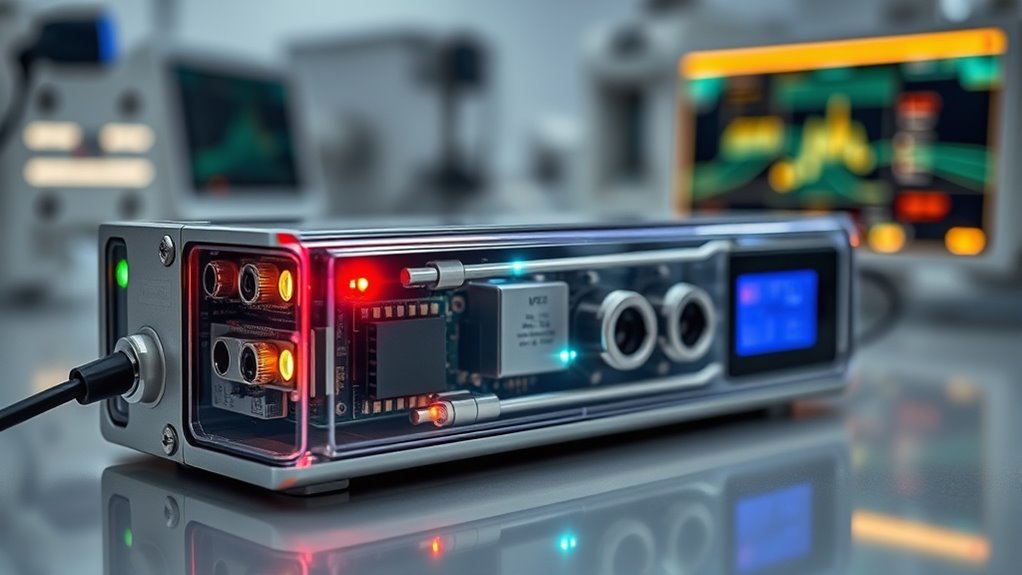

Photoionization detectors (PIDs) use ultraviolet light to ionize VOC molecules in the air. The UV lamp emits specific wavelengths that remove electrons from VOCs with suitable ionization potentials. These ions produce electrical currents proportional to the concentration of VOCs present. The ID’s sealed ionization chamber guarantees only target molecules are detected, providing fast, sensitive, and accurate air quality measurements. Exploring further reveals the detailed science behind how PIDs effectively monitor VOCs in various environments.
Key Takeaways
- Photoionization detectors use UV light to ionize VOC molecules based on their ionization potentials.
- The UV lamp emits specific wavelengths that selectively ionize VOCs with suitable energy levels.
- Ionization chambers contain VOCs and facilitate the creation of charged ions when exposed to UV light.
- The resulting ions generate an electrical current proportional to VOC concentration, enabling detection.
- This process allows for rapid, sensitive, and selective monitoring of VOCs in various environmental conditions.

Have you ever wondered how we detect volatile organic compounds (VOCs) in the environment? It’s a fascinating process that relies on advanced technology like photoionization detectors (PIDs). These devices are essential for monitoring air quality, industrial safety, and environmental health. At the heart of a PID is a UV lamp, which plays a critical role in ionizing VOC molecules. When you activate the detector, the UV lamp emits ultraviolet light with enough energy to remove electrons from VOC molecules passing through the device. This process creates ions, which are charged particles that can be measured. The core component that facilitates this process is the ionization chamber, a sealed space where ionization occurs. As the air sample enters the ionization chamber, the UV lamp bathes the VOC molecules in UV light, causing them to lose electrons and become positively charged ions. These ions generate an electrical current proportional to the concentration of VOCs present. This current is then amplified and processed by the detector’s electronics, providing a real-time reading of the VOC level in the environment. The design of the ionization chamber is critical for accuracy and sensitivity. It’s constructed to ensure that only molecules with ionization potentials below the UV lamp’s energy are ionized. This selectivity allows the PID to distinguish VOCs from other airborne substances, reducing false readings. The UV lamp’s wavelength is carefully chosen to match the ionization potential of target VOCs, making the detection process highly efficient. When the ions are produced within the ionization chamber, they create a measurable current that corresponds directly to the amount of VOCs present. These devices are also capable of detecting a broad range of VOCs at very low concentrations, even in complex environments. The device then converts this signal into a digital readout, so you can quickly assess air quality. Because of this design, PIDs can detect a broad range of VOCs at very low concentrations, even in complex environments.
Frequently Asked Questions
How Do PIDS Compare to Other VOC Detection Methods?
You’ll find that photoionization detectors (PIDs) offer superior comparative accuracy for VOC detection compared to other methods like flame ionization detectors or colorimetric tubes. They provide rapid, real-time readings, making them ideal for continuous monitoring. While PIDs can be more expensive initially, a thorough cost analysis shows they’re cost-effective over time due to their durability and minimal maintenance requirements, ensuring reliable, ongoing VOC detection.
What Are the Limitations of Photoionization Detectors?
Did you know that photoionization detectors (PIDs) are highly sensitive, detecting VOCs at parts-per-billion levels? However, their limitations include detection sensitivity to only certain compounds, meaning they may miss others. Maintenance challenges also pose issues; PIDs require regular calibration and sensor cleaning to guarantee accuracy. Environmental factors like humidity and temperature fluctuations can further affect performance, making consistent upkeep essential for reliable VOC monitoring.
Can PIDS Detect All Types of VOCS Accurately?
No, PIDs can’t detect all VOCs accurately due to VOC specificity and detection limits. They work well for many aromatic and unsaturated hydrocarbons, but some VOCs with high ionization energies or low concentrations may fall below detection thresholds. You’ll find that PIDs are most effective for rapid screening, but for precise identification and quantification of all VOCs, you might need complementary methods like gas chromatography.
How Often Should PIDS Be Calibrated for Optimal Performance?
You should calibrate your PIDs regularly, ideally every 3 to 6 months, depending on your maintenance schedule and usage. Frequent calibration ensures accurate detection of VOCs and maintains peak performance. Follow your device’s specific maintenance schedules and consider more frequent calibration if you work in high-VOC environments or notice inconsistent readings. Staying proactive with calibration helps prevent measurement errors and extends your detector’s lifespan.
Are PIDS Suitable for Use in Explosive or Flammable Environments?
Yes, PIDs can be suitable for use in explosive or flammable environments if they’re designed for explosive safety. Look for PIDs with intrinsic safety certifications, such as ATEX or IECEx, to minimize flammable risk. Always follow safety protocols, guarantee proper calibration, and use appropriate explosion-proof housings. This way, you can reliably monitor VOCs while maintaining safety in potentially hazardous environments.
Conclusion
By understanding how photoionization detectors work, you can effectively monitor VOC levels and guarantee safety. For example, imagine you’re overseeing a paint manufacturing plant; using a PID helps you quickly detect VOC leaks before they reach hazardous levels. This proactive approach not only protects workers but also complies with environmental regulations. Embracing this technology empowers you to maintain safe, healthy environments and respond swiftly to potential VOC hazards.