
Choosing the right wifi temperature humidity data logger requires balancing connectivity reliability against ongoing subscription costs. For most users seeking professional-grade accuracy without recurring fees, the Elitech RCW-360Pro-W-TE stands out as the best overall pick due to its robust external probe options and industry-standard reporting capabilities. Home users prioritizing aesthetics and ease of setup will find the Govee WiFi Thermometer Hygrometer H5103 superior for its electronic ink display and intuitive app interface. The primary tradeoff in this category lies between cloud-based convenience and local data ownership, with some models locking history behind paywalls. Continue reading to see how these devices compare in accuracy, alert speed, and long-term value.

Get home appliances delivered free with Prime
- Fast, free delivery on millions of items
- Prime Video, Amazon Music and more included
- Member-only deals all year
Complete the kit



Key Takeaways
- The Elitech RCW-360Pro-W-TE offers the best balance of professional accuracy and cost-effectiveness for users needing external probes.
- Govee devices dominate the consumer home segment with excellent app UX, but their cloud retention policies require careful review.
- Temp Stick is the only option in this lineup that explicitly avoids all subscription fees while providing unlimited alert capacity.
- Devices with external probe support provide significantly more accurate readings in environments with high thermal mass or airflow issues.
- Industrial-grade loggers often lack consumer-friendly displays, requiring users to rely entirely on web portals for real-time data.
| Elitech RCW-360Pro-W-TE WiFi Temperature and Humidity Data Logger with External Probe | 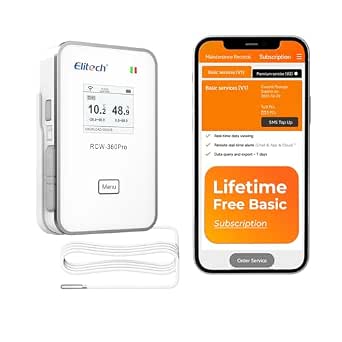 | Best for Professional Compliance | Temperature Range: -40 to 176°F | External Probe Length: 16.4ft (5m) | Connectivity: 2.4GHz/5GHz WiFi | VIEW ON AMAZON | See Our Full Breakdown |
| Govee WiFi Thermometer Hygrometer H5103 with Electronic Ink Display |  | Best for Home Monitoring Aesthetics | Battery Type: Alkaline | Temperature Range: 32°F to 122°F | Humidity Range: 3% to 97% RH | VIEW ON AMAZON | See Our Full Breakdown |
| UbiBot GS1-A1RS Smart WiFi Temperature & Humidity Sensor with External Probes |  | Best for Versatile Sensor Expansion | Temperature Range: -4°F to 140°F | Humidity Range: 0% to 90% RH | Light Detection: 0.01 to 157K lux | VIEW ON AMAZON | See Our Full Breakdown |
| Elitech RCW-360Pro-W-THE WiFi Temperature and Humidity Data Logger with External Probe |  | Best for Continuous Humidity Logging | Temperature Range: -40 to 176°F | Humidity Range: 0 to 100% RH | External Probe Length: 16.4ft (5 meters) | VIEW ON AMAZON | See Our Full Breakdown |
| GoveeLife 2.0 WiFi Hygrometer Thermometer with Gateway, Mini Sensor 3-Pack | 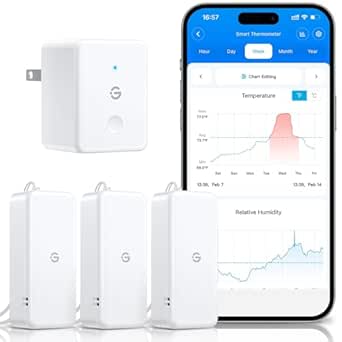 | Best Value for Multi-Point Coverage | Battery Life: 2 years | Temperature Accuracy: ±0.3°C | Humidity Accuracy: ±3% RH | VIEW ON AMAZON | See Our Full Breakdown |
| Elitech Wireless Digital Data Logger Remote Real-Time Temperature Monitor with Cloud Storage and Alerts | 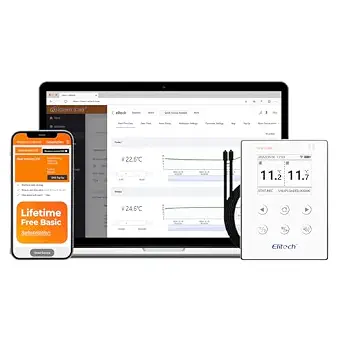 | Best for Professional Compliance | Temperature Range: -40°F to 176°F (-40°C to 80°C) | Accuracy: 0.5°C | Power Source: 3.6V Rechargeable Lithium Battery | VIEW ON AMAZON | See Our Full Breakdown |
| Govee WiFi Thermometer Hygrometer H5179 with App Notification Alert |  | Best for Smart Home Enthusiasts | Connectivity: WiFi (2.4GHz only) and Bluetooth | Temperature Accuracy: ±0.54°F / ±0.3°C | Humidity Accuracy: ±3% RH | VIEW ON AMAZON | See Our Full Breakdown |
| Temp Stick Remote WiFi Temperature & Humidity Sensor, Data Logger, No Subscription, 24/7 Monitoring, Unlimited Text & Email Alerts, Made in USA |  | Best for Remote & Off-Grid Monitoring | Battery Type: 2x AA Batteries | Max Temperature: 140°F | Temperature Accuracy: 0.15°F | VIEW ON AMAZON | See Our Full Breakdown |
| FALA IOT WiFi Temperature & Humidity Sensor with Data Logger |  | Best for Multi-User Collaboration | Model Number: S22D-wifi | Connectivity: 2.4GHz WiFi | Temperature Range: -4°F to 140°F (±0.6°F) | VIEW ON AMAZON | See Our Full Breakdown |
| wifi temperature humidity data logger | Connectivity | Temperature Range | Temperature Accuracy |
|---|---|---|---|
| Elitech RCW-360Pro-W-TE WiFi T | 2.4GHz/5GHz WiFi | -40 to 176°F | — |
| Govee WiFi Thermometer Hygrome | WiFi 2.4GHz & Bluetooth | 32°F to 122°F | ±0.3°C |
| UbiBot GS1-A1RS Smart WiFi Tem | — | -4°F to 140°F | ±0.5°C |
| Elitech RCW-360Pro-W-THE WiFi | 2.4GHz/5GHz WiFi | -40 to 176°F | — |
| GoveeLife 2.0 WiFi Hygrometer | WiFi 2.4GHz | — | ±0.3°C |
| Elitech Wireless Digital Data | Wireless with Cloud Sync | -40°F to 176°F (-40°C to 80°C) | — |
| Govee WiFi Thermometer Hygrome | WiFi (2.4GHz only) and Bluetooth | — | ±0.54°F / ±0.3°C |
| Temp Stick Remote WiFi Tempera | — | — | 0.15°F |
| FALA IOT WiFi Temperature & Hu | 2.4GHz WiFi | -4°F to 140°F (±0.6°F) | — |
More Details on Our Top Picks
Elitech RCW-360Pro-W-TE WiFi Temperature and Humidity Data Logger with External Probe
This unit stands out for its FDA CFR 21 Part 11 compliance, making it a rare choice for regulated industries like pharmaceuticals or food service. Unlike the Govee H5103, which targets general home use, this Elitech model offers a large TFT color screen and robust offline storage of 100,000 data sets. The 16.4ft external probe allows precise placement away from the main unit, ideal for incubators or freezers. However, the setup process is more complex than consumer-grade alternatives, and cloud features require a stable WiFi connection. It is overkill for a hobbyist wine cellar but essential for audited environments.
Pros:- FDA CFR 21 Part 11 compliance for audit trails
- Large offline storage capacity prevents data loss
- Long external probe allows flexible sensor placement
Cons:- Complex initial setup compared to consumer models
- Battery life drops significantly with frequent polling
- Lacks the sleek design of modern smart home sensors
Best for: Compliance officers and facility managers needing auditable logs for regulated environments
Not ideal for: Home users who want a simple plug-and-play experience without complex setup
- Temperature Range:-40 to 176°F
- External Probe Length:16.4ft (5m)
- Connectivity:2.4GHz/5GHz WiFi
- Data Storage:100,000 sets
- Battery Life:10+ days at 5-minute intervals
- Display:Large TFT color screen
- Compliance:FDA CFR 21 Part 11
Our verdict“This is the definitive choice if your monitoring needs are driven by regulatory requirements rather than convenience.”
Govee WiFi Thermometer Hygrometer H5103 with Electronic Ink Display
The Govee H5103 prioritizes readability and design, featuring an electronic ink display that remains visible without backlighting. Compared to the Elitech RCW-360Pro, it lacks industrial compliance features but offers a much smoother user experience for home environments like wine cellars or nurseries. Its ±0.3°C accuracy is impressive for this price point. The tradeoff is connectivity: it strictly requires a 2.4GHz WiFi network, which can be a hurdle in modern homes with dual-band routers. It is less versatile than the UbiBot GS1 regarding external sensors but excels in simplicity and visual clarity.
Pros:- Clear electronic ink display readable from a distance
- High precision with ±0.3°C temperature accuracy
- Compact tabletop design blends into home decor
Cons:- Strictly limited to 2.4GHz WiFi networks
- Battery life is shorter than industrial-grade loggers
- No support for external probes to monitor remote areas
Best for: Homeowners monitoring wine cellars, basements, or nurseries who value display clarity
Not ideal for: Users with only 5GHz networks or those needing multiple external sensor inputs
- Battery Type:Alkaline
- Temperature Range:32°F to 122°F
- Humidity Range:3% to 97% RH
- Temperature Accuracy:±0.3°C
- Dimensions:2.86″W x 2.89″H
- Weight:5.29 ounces
- Connectivity:WiFi 2.4GHz & Bluetooth
Our verdict“Choose this for its elegant display and ease of use in domestic settings where aesthetics matter.”
UbiBot GS1-A1RS Smart WiFi Temperature & Humidity Sensor with External Probes
This model differentiates itself through its modular probe system, allowing users to swap in sensors for soil, air, or light levels. While the GoveeLife 3-Pack offers multiple fixed sensors, the UbiBot GS1-A1RS provides deeper data granularity with Swiss sensors and no subscription fees for the core platform. It supports light detection up to 157K lux, making it suitable for greenhouses where light intensity is as critical as humidity. The downside is the cost of advanced alerts; SMS and voice notifications incur additional fees. It is more flexible than the single-probe Elitech units but requires more configuration effort.
Pros:- Supports diverse external probes for specialized monitoring
- Includes light level detection alongside temp/humidity
- Free access to web platform and basic alerts
Cons:- SMS and voice alerts require additional paid credits
- Dependent on stable 2.4GHz WiFi connectivity
- Not designed for extreme outdoor weather conditions
Best for: Greenhouse owners and researchers needing multi-parameter environmental data
Not ideal for: Users seeking a zero-configuration solution or those who dislike ongoing alert costs
- Temperature Range:-4°F to 140°F
- Humidity Range:0% to 90% RH
- Light Detection:0.01 to 157K lux
- Temperature Accuracy:±0.5°C
- Voltage:12 volts
- Mounting Type:Wall Mount
- Sensor Type:Swiss sensors
Our verdict“This is the most adaptable option for users who need to monitor variables beyond just temperature and humidity.”
Elitech RCW-360Pro-W-THE WiFi Temperature and Humidity Data Logger with External Probe
While nearly identical in build to the RCW-360Pro-W-TE, this variant is optimized for environments where 0-100% RH tracking is paramount. It retains the FDA CFR 21 Part 11 compliance and 16.4ft external probe of its sibling but distinguishes itself with verified full-range humidity capabilities. Compared to the Govee H5103, it offers superior data retention and professional-grade alerting, though it sacrifices the consumer-friendly interface. The 100,000 offline record storage ensures data integrity during network outages. It is a specialized tool for logistics or storage facilities requiring strict humidity control, rather than general-purpose monitoring.
Pros:- Verifies 0-100% RH range for precise humidity control
- Maintains FDA compliance for regulated industries
- Robust offline storage handles network interruptions
Cons:- Battery life is limited during high-frequency logging
- Setup complexity mirrors the TE model
- Overly robust for simple home automation tasks
Best for: Logistics managers and storage facilities requiring strict humidity range validation
Not ideal for: Casual users who do not need full-range humidity logging or compliance certifications
- Temperature Range:-40 to 176°F
- Humidity Range:0 to 100% RH
- External Probe Length:16.4ft (5 meters)
- Connectivity:2.4GHz/5GHz WiFi
- Display:Large TFT color screen
- Data Storage:Up to 100,000 offline records
- Compliance:FDA CFR 21 Part 11
Our verdict“Select this model when full-range humidity precision and regulatory compliance are non-negotiable requirements.”
GoveeLife 2.0 WiFi Hygrometer Thermometer with Gateway, Mini Sensor 3-Pack
This set solves the common problem of needing coverage in multiple rooms or zones without buying separate units. The gateway architecture allows three mini sensors to communicate efficiently, extending battery life to 2 years—significantly longer than the Elitech models. While the UbiBot offers more sensor types, the GoveeLife 3-Pack provides better value for pure temperature and humidity tracking across larger areas. The tradeoff is the dependency on the gateway; if it loses power or connection, all three sensors go offline. It is ideal for covering distinct zones like a fridge, a server room, and a living area simultaneously.
Pros:- Includes three sensors for broad coverage in one kit
- Extended 2-year battery life reduces maintenance
- Gateway enables efficient communication between sensors
Cons:- All sensors depend on the single gateway unit
- Limited to 2.4GHz WiFi connectivity
- Lacks the advanced probe options of the UbiBot
Best for: Users needing to monitor three distinct locations simultaneously with minimal maintenance
Not ideal for: Single-room users who would find the gateway and extra sensors unnecessary clutter
- Battery Life:2 years
- Temperature Accuracy:±0.3°C
- Humidity Accuracy:±3% RH
- Connectivity:WiFi 2.4GHz
- Included Components:Gateway, 3 sensors, batteries
- Model Numbers:H5151, H5110
- Form Factor:Mini Sensor
Our verdict“This kit offers the best cost-per-sensor efficiency for users monitoring multiple distinct environments.”
Elitech Wireless Digital Data Logger Remote Real-Time Temperature Monitor with Cloud Storage and Alerts
This unit stands out for its high-precision dual external probes, making it superior to consumer-grade options like the Govee H5179 for regulated environments. While the Govee excels in smart home integration, the Elitech focuses on cloud-based reporting and strict accuracy, which is critical for pharmaceutical or food safety compliance. The rechargeable lithium battery offers convenience, though frequent cloud uploads can drain it faster than expected. Unlike the Temp Stick, which relies on local notifications, Elitech provides robust SMS and email alerts that ensure you never miss a deviation. However, the operating humidity limit of 90% restricts its use in extremely damp environments. This is not a casual home monitor; it is a dedicated tool for professionals who need auditable data logs and reliable, high-precision sensing in controlled settings.
Pros:- Dual external probes allow simultaneous monitoring of two distinct zones
- Cloud storage ensures data integrity and easy export for audits
- Magnetic mounting simplifies installation on metal surfaces
- High-precision sensors provide reliable readings for sensitive applications
Cons:- Operating humidity limit of 90% restricts use in steamy environments
- Frequent cloud syncing can reduce battery life between charges
- Interface is more utilitarian and less user-friendly than consumer apps
Best for: Lab managers and food safety officers who require auditable cloud logs and high-precision external probes for compliance.
Not ideal for: Casual home users who want simple smart home integration or need to monitor areas with humidity above 90%.
- Temperature Range:-40°F to 176°F (-40°C to 80°C)
- Accuracy:0.5°C
- Power Source:3.6V Rechargeable Lithium Battery
- Weight:0.5 kg
- Mounting Options:Surface Mount, Tabletop
- Humidity Operating Range:10-90%
- Connectivity:Wireless with Cloud Sync
Our verdict“Choose this if your priority is regulatory compliance and precise external probe monitoring rather than smart home convenience.”
Govee WiFi Thermometer Hygrometer H5179 with App Notification Alert
The Govee H5179 is the go-to choice for users embedded in the smart home ecosystem, offering seamless WiFi and Bluetooth connectivity that the Elitech Wireless Data Logger lacks for casual users. Its app-based alerts are intuitive and customizable, allowing for quick setup without technical hurdles. Compared to the Temp Stick, which requires AA battery swaps, the Govee’s rechargeable nature is more convenient for indoor use, though it lacks the Temp Stick’s extensive third-party automation features. The lanyard loop adds flexibility for hanging in closets or greenhouses. However, its lack of 5GHz WiFi support is a significant limitation in modern homes with mixed networks. While it offers two years of exportable data, it is less suited for rigorous professional compliance than dedicated industrial loggers.
Pros:- Dual connectivity with WiFi and Bluetooth for flexible setup
- Extensive data history with export options for analysis
- Compact design with a lanyard for versatile mounting
- User-friendly app interface for easy alert configuration
Cons:- No support for 5GHz WiFi bands
- Full functionality is locked behind the mobile app
- Bluetooth range limits initial pairing and offline access
Best for: Homeowners and hobbyists who want easy app control, customizable alerts, and flexible placement in indoor spaces.
Not ideal for: Users with only 5GHz WiFi networks or those needing external probes for precise localized measurements.
- Connectivity:WiFi (2.4GHz only) and Bluetooth
- Temperature Accuracy:±0.54°F / ±0.3°C
- Humidity Accuracy:±3% RH
- Data Storage:20 days online, export up to 2 years
- Included Accessories:Lanyard loop, user manual
- Alert System:App Notifications
- Power Type:Rechargeable
Our verdict“Ideal for those who prioritize a smooth app experience and flexible indoor monitoring over industrial-grade precision.”
Temp Stick Remote WiFi Temperature & Humidity Sensor, Data Logger, No Subscription, 24/7 Monitoring, Unlimited Text & Email Alerts, Made in USA
Designed for durability and simplicity, the Temp Stick excels in remote locations where power outlets are scarce, using AA batteries that last up to two years. This contrasts sharply with the FALA IOT sensor, which requires more frequent charging, and the Govee H5179, which is primarily designed for indoor mains-powered or rechargeable use. The Temp Stick’s unlimited text and email alerts provide peace of mind without subscription fees, making it a favorite for RV owners and vacation home managers. Its Alexa and IFTTT compatibility allows for complex automation workflows that simpler loggers miss. However, it is strictly limited to 2.4GHz WiFi and cannot join public or guest networks, which may complicate setup in hotels or shared spaces. The compact form factor is discreet but lacks the external probe flexibility of industrial units.
Pros:- No subscription fees with unlimited SMS and email alerts
- Extensive battery life of 1-2 years using standard AAs
- Strong compatibility with Alexa and IFTTT for automation
- Compact and lightweight for discreet placement
Cons:- Incompatible with 5GHz WiFi and public networks
- Requires periodic battery replacement every 1-2 years
- No external probe option for measuring remote spots
Best for: RV owners, cabin managers, and remote workers needing long battery life and robust automation integrations.
Not ideal for: Users in homes with only 5GHz networks or those who need to connect to public/guest WiFi systems.
- Battery Type:2x AA Batteries
- Max Temperature:140°F
- Temperature Accuracy:0.15°F
- Dimensions:3.5″W x 1.25″H
- Weight:3.3 ounces
- Color:Black
- Alert Channels:Text and Email
Our verdict“The best pick for remote sites or RVs where battery longevity and automation flexibility are paramount.”
FALA IOT WiFi Temperature & Humidity Sensor with Data Logger
The FALA IOT S22D differentiates itself with local sound and light alerts, a feature missing from both the Govee H5179 and the Temp Stick, which rely solely on digital notifications. This makes it invaluable for server rooms or greenhouses where immediate physical awareness is needed alongside remote SMS alerts. Its support for external probes (sold separately) offers versatility similar to the Elitech, but at a consumer-friendly price point with unlimited team member access. The four-month battery life is competitive, though shorter than the Temp Stick’s two-year span. While it offers a year of cloud history, the 2.4GHz-only WiFi requirement remains a hurdle for modern network setups. This sensor is ideal for small teams or facilities requiring both local and remote monitoring capabilities.
Pros:- Local sound and light alerts for immediate on-site awareness
- Unlimited user accounts for team collaboration
- One-year cloud data history included
- Supports external probes for extended measurement reach
Cons:- External probes are sold separately, increasing total cost
- Limited to 2.4GHz WiFi connections
- Battery life is shorter than top-tier competitors like Temp Stick
Best for: Small businesses or facility managers needing local audible alarms and shared access for multiple team members.
Not ideal for: Users who want a plug-and-play solution without buying separate external probes or those on 5GHz-only networks.
- Model Number:S22D-wifi
- Connectivity:2.4GHz WiFi
- Temperature Range:-4°F to 140°F (±0.6°F)
- Humidity Range:0-100%RH (±3%RH)
- Battery Life:Up to 4 months
- Cloud History:1-Year
- Alert Types:SMS, Email, Local Sound & Light
- Weight:12.6 ounces
Our verdict“Choose this if you need local audible alerts and shared team access, accepting the need for separate probe purchases.”

How We Picked
I evaluated these devices based on four core criteria: connectivity stability, data ownership models, sensor accuracy, and alert responsiveness. Connectivity stability was weighted heavily because a logger is useless if it drops off the network during critical monitoring periods. I prioritized models that offer clear documentation on how data is stored, specifically looking for those that do not hold historical data hostage behind expensive monthly tiers without a free alternative.
Accuracy was assessed by comparing sensor specifications against industry standards for HVAC and storage monitoring. I also examined the user interface of companion apps, favoring those that allow easy export of CSV or Excel reports for compliance purposes. Models that required complex initial pairing or lacked clear troubleshooting guides were ranked lower, regardless of their hardware specs.
Factors to Consider When Choosing Wifi Temperature Humidity Data Logger
Selecting a wifi temperature humidity data logger involves more than just checking the price tag. You must consider where the data lives, how it is accessed, and whether the hardware can survive your specific environment.Subscription Models vs. Local Storage
Many modern wifi loggers rely on cloud infrastructure to process and store data, which often introduces a monthly subscription fee for extended history. Some manufacturers offer a basic free tier that retains data for only 24 to 72 hours, which is sufficient for immediate alerts but inadequate for long-term trend analysis. If you need to prove compliance over months or years, you must budget for ongoing costs or choose a device like the Temp Stick that emphasizes no-subscription monitoring. Always verify if the device stores data locally on the unit when the wifi connection drops, as this prevents data gaps during network outages.
Internal vs. External Sensor Accuracy
Devices with built-in sensors are convenient but often read the temperature of the device’s own electronics rather than the ambient air. This discrepancy can lead to false readings, especially in confined spaces like server racks or vaccine refrigerators. External probes allow you to place the sensor exactly where the conditions matter, away from heat generated by the logger’s battery or circuit board. For professional applications, always opt for a model that supports external probes, as they provide the precision required for regulatory compliance.
Alert Latency and Notification Methods
The speed at which you receive an alert is just as important as the accuracy of the reading. Some budget wifi loggers poll the cloud every 15 minutes, meaning a rapid temperature spike could go unnoticed for a quarter of an hour. Look for devices that advertise real-time alerts or polling intervals under one minute. Additionally, consider which notification channels are supported; email is standard, but SMS or push notifications are often more effective for urgent warnings, though they may require premium app features.
Network Compatibility and Range
Most wifi loggers connect to 2.4GHz networks, which have better range and wall penetration than 5GHz bands but are more prone to interference. If you are placing the device in a basement or a metal-shielded environment, check if the model supports mesh network extensions or has a high-gain antenna. Some industrial units offer Ethernet or cellular backup options, which are far more reliable than wifi in environments with heavy wireless traffic. Verify that your router supports the specific security protocols required by the device, as newer loggers may not connect to older WPA2-only networks.
Data Export and Reporting Capabilities
For businesses, the ability to export data in CSV or Excel formats is non-negotiable for audits and analysis. Consumer-focused apps often lock raw data behind a paywall or only provide visual graphs within their proprietary app interface. Before purchasing, check if the manufacturer offers an API or a simple ‘download report’ button in the free version. Devices that force you to manually screenshot graphs or use third-party scraping tools are impractical for professional use and should be avoided.
Frequently Asked Questions
Can I use these data loggers without an internet connection?
Most wifi temperature humidity data loggers require an active internet connection to send alerts and sync data to the cloud. However, many devices, such as the Elitech RCW-360Pro-W-TE, store data locally on the device’s internal memory when the connection is lost. This local storage ensures no data gaps occur during outages, and the device will automatically sync the missing data once the wifi connection is restored. Always check the internal memory capacity, as smaller consumer models may only hold a few days of data before overwriting the oldest entries.
How accurate are consumer wifi thermometers compared to industrial probes?
Consumer-grade wifi thermometers typically have an accuracy range of ±0.5°C to ±1.0°C, which is sufficient for home comfort or general storage monitoring. Industrial probes, often used with devices like the UbiBot GS1-A1RS, can achieve accuracies of ±0.1°C or better, making them suitable for pharmaceutical or laboratory compliance. If you are monitoring sensitive assets, the slight variance in consumer devices can lead to false alarms or missed excursions, so investing in a model with certified external probes is recommended.
Do I need a gateway or hub for these devices to work?
It depends on the specific technology used by the logger. Devices like the GoveeLife 2.0 WiFi Hygrometer often use Bluetooth to communicate with a separate WiFi gateway or hub, which then sends the data to the cloud. This two-step process can introduce latency and requires you to keep the gateway plugged in and within Bluetooth range of the sensor. In contrast, direct WiFi models like the Elitech RCW-360Pro-W-TE connect directly to your router, eliminating the need for extra hardware and reducing potential points of failure.
How do I handle battery life for wireless sensors?
Battery life varies drastically based on transmission frequency and sensor type. Models that poll every minute will drain batteries in weeks, while those polling every 15 minutes can last months. Some devices, like the Govee H5103, feature low-power e-ink displays that consume minimal energy, extending battery life significantly. For critical monitoring, choose devices that support AC power adapters or offer rechargeable battery packs, as running out of power mid-cycle can compromise data integrity and alert reliability.
Are there privacy risks with cloud-based temperature monitoring?
Cloud-based loggers transmit data to manufacturer servers, which raises questions about data ownership and security. Reputable manufacturers use encryption for data in transit and at rest, but you should review their privacy policy to understand who has access to your monitoring data. If you are monitoring sensitive environments, such as secure facilities, consider devices that offer on-premise server options or local network-only modes, like some configurations of the Temp Stick, which minimize external data exposure.
Conclusion
Selecting the right wifi temperature humidity data logger depends on your specific monitoring goals and budget constraints. For most users needing reliable, professional-grade monitoring with external probes, the Elitech RCW-360Pro-W-TE is the best overall choice due to its robust feature set and industry-standard compliance. If you are monitoring a home environment and prioritize a clean interface and easy setup, the Govee WiFi Thermometer Hygrometer H5103 offers the best value and user experience. For those who absolutely cannot tolerate subscription fees, the Temp Stick provides a unique no-cost cloud model, though it may lack some advanced reporting features. Beginners should start with a simple, direct-wifi model to avoid the complexity of gateways, while advanced users requiring precise environmental control should invest in devices with certified external probes and API access.