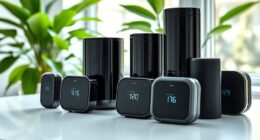
A smart air quality monitor with Alexa can report indoor conditions by voice, send alerts, or help connect readings to a compatible smart-home routine. My best overall pick is the Amazon Smart Air Quality Monitor for shoppers who want a direct fit with Alexa, while the SONOFF SAWF-07P stands out for particle, temperature, and humidity readings plus Matter support. For broader indoor monitoring, the AprilAire ZAWTHCPV offers a five-in-one approach, though buyers should check its ecosystem fit before choosing it. The main tradeoffs are sensor coverage, how well a monitor works with Alexa, and whether one unit can cover the rooms that matter. Read on for the full comparison and advice on choosing the right setup.

Get home appliances delivered free with Prime
- Fast, free delivery on millions of items
- Prime Video, Amazon Music and more included
- Member-only deals all year
Complete the kit


Key Takeaways
- Amazon Smart Air Quality Monitor is the clearest Alexa-first pick in this lineup; choose it when voice access and amazon.com/dp/B08W8KS8D3?tag=pureairadviser-20&ascsubtag=dc-735906″ target=”_blank” rel=”nofollow sponsored noopener”>Amazon smart-home integration matter more than broad sensor coverage.
- SONOFF SAWF-07P and SONOFF SAWF-08P serve different monitoring priorities: the 07P focuses on PM2.5 and PM10, while the 08P centers on CO2, temperature, and humidity.
- The AprilAire ZAWTHCPV is the broader-monitoring option for buyers seeking a five-in-one device, but its added scope makes ecosystem compatibility worth checking before purchase.
- The Kidde and Ring options address specific safety and connected-home needs rather than acting as straightforward substitutes for a general-purpose air monitor.
- The Amazon two-pack favors coverage over a new sensor set: it may suit multi-room monitoring, while the single monitor is the simpler starting point for one location.
| SONOFF SAWF-07P Indoor Air Quality Monitor with PM2.5, PM10, Temperature & Humidity Sensor, 3.73-inch Display, Matter-Compatible, WiFi |  | Best Overall for Matter Smart Homes | Measurements: PM2.5, PM10, temperature, humidity | Display: 3.73 inches | Temperature accuracy: ±0.5 °C | VIEW ON AMAZON | See Our Full Breakdown |
| GoveeLife Smart Air Quality Monitor with PM2.5, LED Display, Wired |  | Best for Govee Appliance Automation | Measurements: PM2.5, temperature, humidity | PM2.5 accuracy: ±15 µg/m³ | Temperature accuracy: ±0.54°F | VIEW ON AMAZON | See Our Full Breakdown |
| SONOFF AirGuard SAWF-08P Indoor Air Quality Monitor, Matter Compatible, WiFi, CO2/Temp/Humidity | 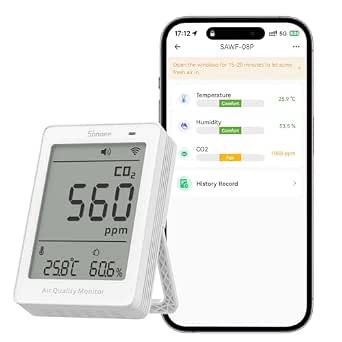 | Best for CO2 and Ventilation Checks | Measurements: CO2, temperature, humidity | CO2 sensor: NDIR | Display: Real-time environmental metrics | VIEW ON AMAZON | See Our Full Breakdown |
| AprilAire ZAWTHCPV Smart Indoor 5-in-1 Wi-Fi Air Quality Monitor |  | Best for Broad Indoor Pollutant Coverage | Measurements: CO2, VOCs, PM2.5, humidity, temperature | Connectivity: Wi-Fi | Companion app: Healthy Air App | VIEW ON AMAZON | See Our Full Breakdown |
| Kidde Smart CO Detector + Indoor Air Quality, Plug-in & AA Battery |  | Best for Carbon Monoxide Safety | Model number: COPDLQW | Detection: Low-level carbon monoxide | Additional monitoring: Indoor air quality, humidity, TVOC | VIEW ON AMAZON | See Our Full Breakdown |
| Amazon Smart Air Quality Monitor |  | Best for Alexa Automation | Measurements: Temperature, humidity, carbon monoxide, PM2.5, and VOCs | Connectivity: 2.4GHz Wi-Fi and Bluetooth Low Energy 4.2 | Dimensions: 65 × 65 × 45 mm | VIEW ON AMAZON | See Our Full Breakdown |
| Ring Air Quality Monitor with CO & PM 2.5 Monitoring |  | Best for Amazon Sidewalk Coverage | Measurements: Temperature, humidity, carbon monoxide, and PM2.5 | Connectivity: Amazon Sidewalk | Dimensions: 1.83 × 2.56 × 2.56 inches | VIEW ON AMAZON | See Our Full Breakdown |
| Amazon Smart Air Quality Monitor (2-pack) | | Best for Monitoring Multiple Rooms | Package quantity: 2 monitors | Measurements: Temperature, humidity, carbon monoxide, PM2.5, and VOCs | Connectivity: Works with Alexa | VIEW ON AMAZON | See Our Full Breakdown |
| smart air quality monitor with alexa | Connectivity | Measurements | Dimensions | Power |
|---|---|---|---|---|
| SONOFF SAWF-07P Indoor Air Qua | 2.4GHz Wi-Fi | PM2.5, PM10, temperature, humidity | 2.36 x 4.72 x 5.51 inches | — |
| GoveeLife Smart Air Quality Mo | 2.4G Wi-Fi and Bluetooth | PM2.5, temperature, humidity | 5.31 x 1.57 x 2.47 inches | Type-C cable; no built-in battery |
| SONOFF AirGuard SAWF-08P Indoo | 2.4GHz Wi-Fi | CO2, temperature, humidity | 2.76 x 4.1 x 1.02 inches | Continuous power supply |
| AprilAire ZAWTHCPV Smart Indoo | Wi-Fi | CO2, VOCs, PM2.5, humidity, temperature | — | — |
| Kidde Smart CO Detector + Indo | 2.4GHz Wi-Fi | — | — | — |
| Amazon Smart Air Quality Monit | 2.4GHz Wi-Fi and Bluetooth Low Energy 4.2 | Temperature, humidity, carbon monoxide, PM2.5, and VOCs | 65 × 65 × 45 mm | 100–240V AC, 5V 1A (5W) |
| Ring Air Quality Monitor with | Amazon Sidewalk | Temperature, humidity, carbon monoxide, and PM2.5 | 1.83 × 2.56 × 2.56 inches | 100–240V AC, 50/60Hz |
| Amazon Smart Air Quality Monit | Works with Alexa | Temperature, humidity, carbon monoxide, PM2.5, and VOCs | — | — |
More Details on Our Top Picks
SONOFF SAWF-07P Indoor Air Quality Monitor with PM2.5, PM10, Temperature & Humidity Sensor, 3.73-inch Display, Matter-Compatible, WiFi
The SONOFF SAWF-07P is the strongest fit here for buyers who want particulate readings alongside basic comfort data and broad smart-home support. It measures PM2.5 and PM10, plus temperature and humidity, and its 3.73-inch display keeps those readings visible without opening an app. Matter compatibility includes Amazon Alexa, so it suits households building voice routines across different platforms. Compared with the SONOFF AirGuard SAWF-08P, this model prioritizes particle monitoring rather than CO2; choose the AirGuard if ventilation awareness is your main concern. The tradeoff is that the supplied details do not specify a PM sensor accuracy figure, and full smart features depend on 2.4GHz Wi-Fi. It is a well-rounded room monitor, not a substitute for a dedicated carbon monoxide alarm.
Pros:- Measures both PM2.5 and PM10, along with temperature and humidity
- Matter compatibility supports Alexa and several other smart-home platforms
- 3.73-inch display presents readings at a glance
- Customizable notifications and data export are listed
Cons:- No specific particulate measurement accuracy is provided in the supplied specifications
- Full connected functionality requires 2.4GHz Wi-Fi
- Does not measure CO2
Best for: Households with Alexa or other Matter-compatible devices that want visible PM2.5 and PM10 readings for a bedroom, nursery, or office.
Not ideal for: Buyers focused on CO2 buildup or those who need a monitor that works without Wi-Fi.
- Measurements:PM2.5, PM10, temperature, humidity
- Display:3.73 inches
- Temperature accuracy:±0.5 °C
- Response time:2 seconds
- Connectivity:2.4GHz Wi-Fi
- Smart-home support:Matter, Apple Home, Amazon Alexa, Google Home, SmartThings, Home Assistant
- Dimensions:2.36 x 4.72 x 5.51 inches
- Weight:0.22 kg
Our verdict“Choose the SAWF-07P for a display-led, Alexa-compatible monitor that tracks particles and comfort conditions, but pick the SAWF-08P if CO2 is your priority.”
GoveeLife Smart Air Quality Monitor with PM2.5, LED Display, Wired
The GoveeLife Smart Air Quality Monitor makes the most sense for people already using Govee appliances and wanting PM2.5 readings to inform automated adjustments. It also tracks temperature and humidity, responds in a stated two seconds, and supports remote viewing and data export for up to two years. That connected record can help buyers spot recurring changes rather than relying on a single reading. Unlike the SONOFF SAWF-07P, it is not described as Matter-compatible and does not measure PM10, so its smart-home appeal is more centered on Govee’s own devices. It is also wired, with no built-in battery; placement needs to account for a Type-C power cable. The provided compatibility information does not confirm Alexa support, so buyers seeking Alexa voice integration should verify it before choosing this model.
Pros:- Tracks PM2.5, temperature, and humidity with a stated two-second response time
- Supports remote monitoring and data export for up to two years
- Can integrate with Govee smart appliances for automated adjustments
- Switchable display and ambient air-quality indicators offer quick visual checks
Cons:- Requires continuous Type-C power and has no built-in battery
- The supplied data does not confirm Alexa or Matter compatibility
- Measures PM2.5 but not PM10
Best for: Govee appliance owners who want PM2.5 monitoring, app-based history, and a powered sensor that can help trigger Govee device adjustments.
Not ideal for: Shoppers who require confirmed Alexa integration, portable monitoring, PM10 readings, or a battery-powered unit.
- Measurements:PM2.5, temperature, humidity
- PM2.5 accuracy:±15 µg/m³
- Temperature accuracy:±0.54°F
- Humidity accuracy:±3%
- Response time:2 seconds
- Connectivity:2.4G Wi-Fi and Bluetooth
- Power:Type-C cable; no built-in battery
- Dimensions:5.31 x 1.57 x 2.47 inches
Our verdict“Pick this Govee model for wired PM2.5 monitoring tied to Govee appliances, but favor the SONOFF SAWF-07P when confirmed Alexa and Matter support matter more.”
SONOFF AirGuard SAWF-08P Indoor Air Quality Monitor, Matter Compatible, WiFi, CO2/Temp/Humidity
If stuffy rooms and ventilation are the concern, the SONOFF AirGuard SAWF-08P is the more relevant choice than the particle-focused SAWF-07P. Its NDIR CO2 sensor tracks carbon dioxide alongside temperature and humidity, giving Alexa-compatible smart-home users a way to monitor room conditions that PM readings alone cannot explain. Matter support also extends across Alexa, Apple Home, Google Home, SmartThings, and Home Assistant, while year-long tracking and export can help reveal patterns over time. The compromise is a narrower sensor set: unlike the AprilAire ZAWTHCPV, it does not list PM2.5 or VOC monitoring. It also needs continuous power and 2.4GHz Wi-Fi for connected functions. Choose it for CO2 awareness, not as an all-in-one detector for every indoor pollutant.
Pros:- NDIR sensor measures CO2 for room ventilation awareness
- Matter compatibility includes Amazon Alexa and several other platforms
- Tracks temperature and humidity alongside CO2
- Year-long data tracking and export are listed
Cons:- Does not list PM2.5 or VOC measurement
- Requires continuous power and 2.4GHz Wi-Fi
- Designed for indoor use only
Best for: Alexa and Matter smart-home users who want to monitor CO2, temperature, and humidity in bedrooms, offices, or other occupied rooms.
Not ideal for: Buyers who need PM2.5, VOC, or other particulate readings, or who need a battery-powered portable monitor.
- Measurements:CO2, temperature, humidity
- CO2 sensor:NDIR
- Display:Real-time environmental metrics
- Connectivity:2.4GHz Wi-Fi
- Smart-home support:Matter, Apple Home, Amazon Alexa, Google Home, SmartThings, Home Assistant
- Data history:Year-long tracking and export
- Power:Continuous power supply
- Dimensions:2.76 x 4.1 x 1.02 inches
- Weight:3.56 ounces
Our verdict“Choose the AirGuard SAWF-08P for Alexa-linked CO2 monitoring, while the AprilAire ZAWTHCPV covers a broader mix of pollutants.”
AprilAire ZAWTHCPV Smart Indoor 5-in-1 Wi-Fi Air Quality Monitor
The AprilAire ZAWTHCPV stands apart by covering five categories: CO2, VOCs, PM2.5, humidity, and temperature. That makes it a broader room-health monitor than either SONOFF option: the SAWF-07P adds PM10 but lacks listed CO2 and VOC sensing, while the SAWF-08P focuses on CO2 and comfort readings. AprilAire pairs its sensor data with the Healthy Air App for alerts and guidance, which may suit buyers who want more than a display of raw measurements. The key limitation for this Alexa-focused roundup is that the supplied details list Wi-Fi and the app but do not confirm Alexa or Matter compatibility. Full integration also depends on an AprilAire Wi-Fi Thermostat, and setup may take more effort than a standalone monitor.
Pros:- Tracks CO2, VOCs, PM2.5, humidity, and temperature
- Healthy Air App provides real-time monitoring, alerts, and guidance
- Three-year warranty is specified
- Broader listed pollutant coverage than either SONOFF monitor
Cons:- The provided product data does not confirm Alexa or Matter support
- Full integration requires an AprilAire Wi-Fi Thermostat
- Setup may be complex, and related ventilation or filtration solutions may require additional purchases
Best for: Homeowners who want PM2.5, VOC, and CO2 readings in one device and already use, or plan to add, AprilAire home systems.
Not ideal for: Buyers who need confirmed Alexa or Matter integration, a simple standalone setup, or a monitor that works without the AprilAire thermostat ecosystem.
- Measurements:CO2, VOCs, PM2.5, humidity, temperature
- Connectivity:Wi-Fi
- Companion app:Healthy Air App
- Warranty:3 years
- Model number:ZAWTHCPV
- Full integration requirement:AprilAire Wi-Fi Thermostat
Our verdict“Choose the AprilAire for broad sensor coverage and app guidance if Alexa integration is not a deciding requirement and its thermostat ecosystem fits your home.”
Kidde Smart CO Detector + Indoor Air Quality, Plug-in & AA Battery
The Kidde Smart CO Detector is the safety-first pick, not a like-for-like alternative to a dedicated air-quality monitor. Its low-level carbon monoxide sensing, 85 dB alarm, plug-in design, and AA battery backup address a risk the SONOFF SAWF-07P and GoveeLife monitor do not cover. Alexa and Google Home connectivity, plus app alerts, add remote awareness; the unit also reports humidity, TVOC, mold risk insights, and thermal comfort analysis. That broader role comes with a tradeoff: advanced home-health insights require a subscription, and the supplied details do not specify particulate or CO2 measurement. Unlike the AprilAire ZAWTHCPV, Kidde’s listed strengths center on CO safety rather than a five-sensor air-quality profile. I would treat it as a smart CO alarm with added air insights, not as a replacement for a multi-pollutant monitor.
Pros:- Low-level CO sensing adds safety coverage absent from the SONOFF and Govee monitors
- Plug-in operation includes AA battery backup
- Alexa and Google Home connectivity with app alerts
- Lists humidity, TVOC, mold-risk insights, and thermal comfort analysis
Cons:- Advanced Home Health insights require a paid subscription
- Does not list PM2.5, PM10, or CO2 measurement
- App notifications depend on 2.4GHz Wi-Fi
Best for: Households seeking Alexa-connected carbon monoxide protection with battery backup and added humidity and TVOC insights.
Not ideal for: Buyers whose main goal is tracking PM2.5, PM10, or CO2, or who want all advanced air-health features without a subscription.
- Model number:COPDLQW
- Detection:Low-level carbon monoxide
- Additional monitoring:Indoor air quality, humidity, TVOC
- Smart-home support:Amazon Alexa, Google Home
- Connectivity:2.4GHz Wi-Fi
- Alarm sound:85 dB
- Power backup:Plug-in with AA batteries included
- Warranty:10-year limited warranty
- Advanced insights subscription:$1.99/month or $19.99/year
Our verdict“Choose Kidde when carbon monoxide detection is the priority and treat its air-quality insights as an added feature, not a substitute for a dedicated particle or CO2 monitor.”
Amazon Smart Air Quality Monitor
I’d choose this monitor when Alexa alerts and routines matter as much as seeing air readings. It tracks temperature, humidity, carbon monoxide, PM2.5, and VOCs, then can use those readings to prompt notifications or trigger compatible climate-control devices. Compared with the Ring Air Quality Monitor, it adds VOC monitoring, while Ring uses Amazon Sidewalk rather than Wi-Fi. It is a compact plug-in unit with app-guided setup, but its strongest features depend on an Alexa-centered home and a 2.4GHz Wi-Fi connection. Its carbon monoxide reading is a monitoring feature, not a substitute for a certified CO alarm. The listed accuracy ranges also leave room for variation, particularly for humidity and PM2.5, so I’d treat readings as guidance rather than laboratory measurements.
Pros:- Tracks five indoor factors, including VOCs and PM2.5
- Alexa notifications and compatible automation can connect readings to smart-home actions
- Compact plug-in setup includes a power adapter
- Uses post-consumer recycled thermoplastic resin
Cons:- Full functionality depends on Alexa and 2.4GHz Wi-Fi
- Indoor-only design does not cover outdoor air
- CO monitoring does not replace a certified CO alarm, and listed accuracy has defined limits
Best for: Alexa households that want VOC, PM2.5, and CO readings linked to notifications or compatible smart-home routines.
Not ideal for: Buyers who need a certified carbon monoxide alarm, outdoor monitoring, or a monitor that works fully without Alexa and Wi-Fi.
- Measurements:Temperature, humidity, carbon monoxide, PM2.5, and VOCs
- Connectivity:2.4GHz Wi-Fi and Bluetooth Low Energy 4.2
- Dimensions:65 × 65 × 45 mm
- Weight:120 g
- Power:100–240V AC, 5V 1A (5W)
- VOC range:0–500 points
- PM2.5 range:0–500 µg/m³
- CO range:0–70 ppm
- Warranty:One-year limited manufacturer’s warranty
Our verdict“Choose this if you want an Alexa-integrated monitor with VOC tracking; skip it if you need independent operation or a certified CO alarm.”
Ring Air Quality Monitor with CO & PM 2.5 Monitoring
I’d favor the Ring Air Quality Monitor for a home where Amazon Sidewalk is a better fit than adding another Wi-Fi device. It reports temperature, humidity, CO, and PM2.5, with smart alerts and suggestions; unlike the Amazon Smart Air Quality Monitor, it does not track VOCs. Sidewalk can offer a different route for connected coverage, though availability depends on location, so I would check that before choosing it. The key safety limit is explicit: this is not a certified CO alarm and does not sound an alarm. It also omits CO2 and radon, so it suits basic indoor trend monitoring, not buyers seeking broader pollutant coverage. Compared with the Amazon two-pack, this is a single monitor, making it a more focused choice for one monitored area.
Pros:- Tracks CO and PM2.5 alongside temperature and humidity
- Uses Amazon Sidewalk connectivity without a separate base station
- Provides smart alerts and suggestions
- Published operating range extends from 0°C to 49°C
Cons:- Not a certified CO alarm and does not sound alarms
- Does not measure CO2, radon, or VOCs
- Sidewalk coverage can vary by location
Best for: Ring and Amazon households with Sidewalk coverage that want temperature, humidity, CO, and PM2.5 monitoring in one room.
Not ideal for: Buyers who need an audible, certified CO alarm, CO2 or radon readings, VOC tracking, or dependable Sidewalk coverage in their area.
- Measurements:Temperature, humidity, carbon monoxide, and PM2.5
- Connectivity:Amazon Sidewalk
- Dimensions:1.83 × 2.56 × 2.56 inches
- Power:100–240V AC, 50/60Hz
- Operating conditions:32°F to 120°F (0°C to 49°C)
- PM2.5 range:0–500 µg/m³
- CO range:0–70 ppm
- Certifications:UL and FCC
- Warranty:One-year limited warranty
Our verdict“Pick Ring if Sidewalk coverage suits your home and basic indoor readings are enough, but rely on a certified detector for CO alarms.”
Amazon Smart Air Quality Monitor (2-pack)
The two-pack’s main advantage is room coverage: I’d place one monitor in a living area and the other in a bedroom or home office to compare conditions across spaces. Each unit tracks temperature, humidity, CO, PM2.5, and VOCs, with readings and notifications delivered through the Alexa app. That makes this a stronger fit for multi-room monitoring than the single Amazon Smart Air Quality Monitor, while the Ring model may suit homes relying on Sidewalk. The supplied data does not specify dimensions, sensor accuracy, or connectivity beyond Alexa, so buyers should not assume the two units offer more precise readings or independent operation. Like the single-unit version, it is indoor-only and depends on the Alexa ecosystem for its full feature set; its CO readings are not a replacement for a certified alarm.
Pros:- Two monitors let buyers track separate indoor spaces
- Each unit measures temperature, humidity, CO, PM2.5, and VOCs
- Alexa app provides readings and real-time notifications
- Plug-in setup is designed to connect through the Alexa app
Cons:- Full functionality depends on the Alexa ecosystem
- Indoor-only monitoring does not measure outdoor conditions
- Provided product data does not state sensor accuracy or detailed connectivity specifications
Best for: Alexa users who want to compare air conditions in two specific rooms, such as a bedroom and a living room.
Not ideal for: People who need outdoor readings, non-Alexa operation, published accuracy specifications, or certified CO alarm protection.
- Package quantity:2 monitors
- Measurements:Temperature, humidity, carbon monoxide, PM2.5, and VOCs
- Connectivity:Works with Alexa
- Setup:Plug in and connect via the Alexa app
- Monitoring location:Indoor air quality
- Alerts:Real-time notifications via the Alexa app
Our verdict“Choose the two-pack if Alexa-based monitoring across two rooms matters more than detailed published accuracy or independent smart-home support.”
How We Picked
I ranked these monitors by how well they answer the specific Alexa use case, not by sensor count alone. The main criteria were the usefulness of the listed measurements, clarity of the display or alert approach, ease of placing the device in a lived-in home, and the stated smart-home connections, including Alexa, Wi-Fi, and Matter. I also weighed whether each product serves general air awareness or a more focused need such as CO detection or coverage across multiple rooms.
The Amazon Smart Air Quality Monitor leads because it is the most direct match for an Alexa-centered buyer. The SONOFF models follow as more measurement-specific alternatives, while AprilAire earns a place for its broader five-in-one scope. Kidde, Ring, GoveeLife, and the Amazon two-pack rank according to their distinct strengths and tradeoffs: safety focus, Ring ecosystem fit, display-led simplicity, and multi-room coverage. Product names and listed features guide this comparison; buyers should confirm current Alexa functions and device compatibility before purchase.
| smart air quality monitor with alexa | Measurements |
|---|---|
| SONOFF SAWF-07P Indoor Air Qua | PM2.5, PM10, temperature, humidity |
| GoveeLife Smart Air Quality Mo | PM2.5, temperature, humidity |
| SONOFF AirGuard SAWF-08P Indoo | CO2, temperature, humidity |
| AprilAire ZAWTHCPV Smart Indoo | CO2, VOCs, PM2.5, humidity, temperature |
| Kidde Smart CO Detector + Indo | — |
| Amazon Smart Air Quality Monit | Temperature, humidity, carbon monoxide, PM2.5, and VOCs |
| Ring Air Quality Monitor with | Temperature, humidity, carbon monoxide, and PM2.5 |
| Amazon Smart Air Quality Monit | Temperature, humidity, carbon monoxide, PM2.5, and VOCs |
Factors to Consider When Choosing Smart Air Quality Monitor With Alexa
Before choosing, decide what you want Alexa to do with the readings. A monitor that reports conditions by voice is not automatically able to trigger every connected device or automate ventilation. The right choice depends on the measurements you need, where the monitor will sit, and whether your household already relies on Amazon, Ring, or Matter-compatible devices.
Choose Measurements That Match Your Concern
Start with the indoor issue you are trying to track rather than the longest sensor list. Particle measurements such as PM2.5 and PM10 answer a different question from CO2, temperature, and humidity. A CO detector adds a safety function, but that does not make it a full substitute for a monitor built to track multiple air-quality indicators. A five-in-one label can also mean little unless the included measurements match your needs. Avoid paying for readings you will not use, but do not mistake one sensor for a complete picture of indoor air. Check the product’s stated measurements and any sensor limitations before deciding.
Separate Alexa Voice Access From Automation
Alexa compatibility can describe several levels of interaction: asking for a reading, receiving a spoken alert, or using data in a routine. Those functions are not interchangeable, and a product listing may not promise all of them. If your goal is to switch on a fan when a reading changes, check whether the monitor exposes that measurement to Alexa routines and whether the fan can be controlled in the same setup. Matter support may help with smart-home interoperability, but it does not guarantee every feature will appear in every app. Buyers who only want quick voice access may be satisfied with a simpler integration. Confirm the specific Alexa functions you plan to use before buying.
Plan Placement Before You Buy One or Two
Air readings describe the area around the monitor, not every room in a home. A unit near a kitchen, window, purifier, or vent may show conditions that differ from a bedroom or nursery. For a single-room concern, one device can be a practical starting point; for a home with distinct activity zones, a two-pack can provide a more useful comparison. Avoid placing a monitor where airflow or a nearby appliance could dominate its readings. Think about outlets and power needs too, since a wired device may limit placement options. Choose room coverage based on where people spend time and where conditions may vary.
Decide Whether a Display or Alerts Matter More
A built-in display is useful when you want to check readings at a glance without opening an app or asking Alexa. App notifications and voice alerts suit buyers who may not be near the device when conditions change. Neither approach replaces a clear plan for what to do with an alert, such as checking the source or improving ventilation. If several people share the home, consider whether the information is easy for everyone to access. A screen can add convenience but does not make sensor readings more complete. Prioritize the way you will actually check information day to day.
Treat Safety Devices and Air Monitors as Different Jobs
A CO detector and an air-quality monitor can overlap in a connected setup, but they serve different purposes. A dedicated safety detector should be selected for its stated alarm and placement requirements, not just because it also reports indoor air information. Likewise, a general air monitor should not be treated as a replacement for required smoke or carbon monoxide alarms. Ring and Kidde options may suit buyers who want monitoring tied to those product lines, while a general-purpose device may make more sense for everyday air readings. Check what each device detects and how it alerts you. Keep required safety equipment in place regardless of which monitor you choose.
Check Ecosystem Fit and Ongoing Setup Needs
Smart-home compatibility affects how useful a monitor feels after setup. A device that fits your existing Alexa, Ring, or Matter arrangement may be easier to manage than one that adds another app and account. Verify Wi-Fi requirements, supported hubs, and whether core features depend on a particular platform. Also check power arrangements, since plug-in or wired placement can affect where readings are most representative. A multi-device kit can simplify room coverage, but only if you are prepared to place and manage each unit. Choose the setup you can maintain, not just the one with the longest feature list.
Frequently Asked Questions
Which monitor in this roundup is the best fit if I mainly want to use Alexa?
The Amazon Smart Air Quality Monitor is the most direct starting point for an Alexa-centered setup. It is the strongest match when voice access and Amazon smart-home use matter more than having the broadest set of measurements. If you need PM2.5 and PM10 readings or Matter support, compare it with the SONOFF SAWF-07P. Before buying, check which Alexa features are supported in your region and whether they cover your intended use, such as voice queries, alerts, or routines.
Can I use an air-quality monitor to turn on a fan or air purifier through Alexa?
Possibly, but Alexa compatibility alone does not confirm that readings can trigger a routine. Check whether the exact monitor exposes the relevant measurement as an Alexa routine condition and whether your fan or purifier is controllable through the same setup. A device may offer voice access or notifications without offering measurement-based automation. Matter support can improve interoperability, but it does not promise every sensor function will be available to every smart-home platform. Confirm the specific routine you want before choosing a monitor.
Should I choose the SONOFF SAWF-07P or the SAWF-08P?
Choose based on which readings answer your question: the SAWF-07P lists PM2.5 and PM10, alongside temperature and humidity, while the SAWF-08P lists CO2, temperature, and humidity. Particle readings and CO2 readings track different aspects of indoor conditions, so neither model is a direct upgrade over the other. If you are unsure, identify the concern you want to monitor and check whether the device’s stated sensors cover it. Both are Matter-compatible Wi-Fi options, but confirm how their functions work with your Alexa setup.
Is the Amazon two-pack a better choice than buying one monitor?
The two-pack makes more sense when you want to compare separate rooms or monitor areas with different uses. Air readings from one room do not represent an entire home, so a second unit can add useful context if you have distinct spaces to track. For a single-room need or a first trial of the category, one monitor keeps placement and app setup simpler. Before choosing the pack, consider whether you have suitable locations and power access for both units. More devices help with coverage, but they do not add new sensor types by themselves.
Can a smart air-quality monitor replace a carbon monoxide detector?
No general air-quality monitor should be treated as a replacement for a required carbon monoxide alarm. The Kidde Smart CO Detector + Indoor Air Quality is the lineup’s safety-focused option, but buyers should still check its alarm functions, certification, and placement instructions. A monitor that tracks other indoor conditions may not detect CO at all. Keep appropriate safety alarms installed and maintained according to their instructions. Use air-monitor readings for indoor-condition awareness, not as a substitute for dedicated life-safety equipment.
Conclusion
For most Alexa-first buyers, I would start with the Amazon Smart Air Quality Monitor as the best overall and best for beginners: its role in this lineup is the clearest fit for an Amazon-centered home. The GoveeLife Smart Air Quality Monitor is the best value-style pick for someone who wants a straightforward display-led monitor, while the AprilAire ZAWTHCPV is my best premium-style choice for buyers seeking broader five-in-one monitoring. Choose the SONOFF SAWF-07P for particle readings and Matter support, or the SAWF-08P when CO2 is the priority. For a CO-focused safety need, look at the Kidde; for Ring-connected households, compare the Ring monitor; and for multiple rooms, choose the Amazon two-pack. The best choice is the one whose measurements and Alexa functions match the job you actually need it to do.
Halloween Picks
halloween
As an affiliate, we earn on qualifying purchases.