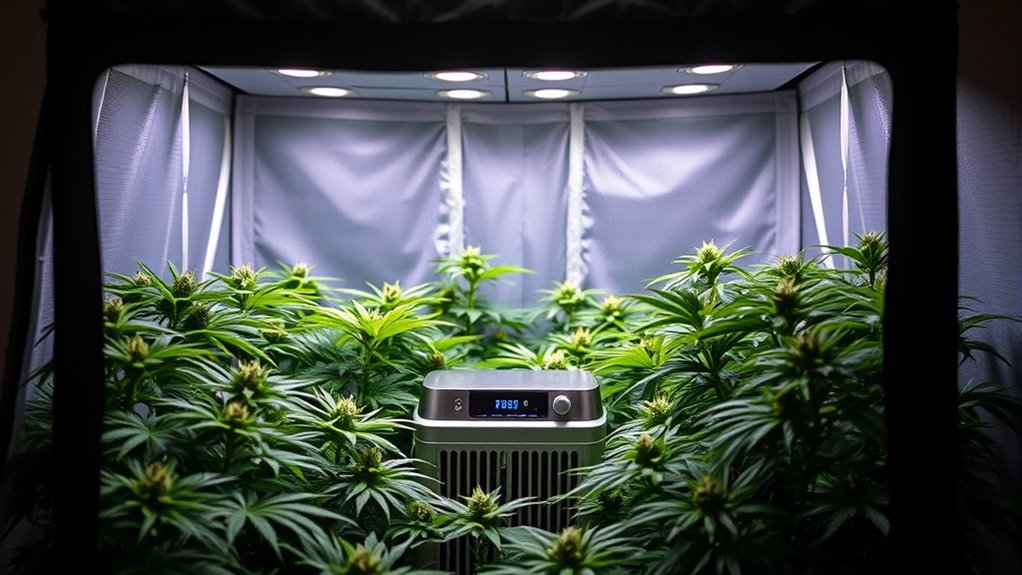
Finding a dehumidifier designed for grow tents is essential for maintaining optimal humidity levels and healthy plant growth. The AC Infinity HYDRONE 7 stands out as the best overall choice thanks to its smart controls and precise humidity targeting. The VIVOSUN AeroDrain D12 is a great budget-friendly option, offering smart features and reliable performance for smaller setups. Growers often face tradeoffs between capacity, control features, noise levels, and price. Continue reading for a detailed breakdown of the best grow tent dehumidifiers and what makes each one unique.
Complete the kit


Key Takeaways
- The top models balance capacity with control features to suit different grow tent sizes.
- Smart sensors and remote control capabilities are common among the best picks, aiding precise humidity management.
- Noise levels and energy efficiency vary significantly; quieter units tend to be more expensive.
- Larger tanks and higher pints per day ratings are best for bigger tents or prolonged operation without frequent emptying.
- Price differences reflect build quality, advanced features, and capacity—more expensive options often provide better control and durability.
| AC Infinity HYDRONE 7 Smart Plant Dehumidifier |  | Best Overall | Recommended plant count: 4-6 plants | Drying levels: 10 | Motor system: PWM-controlled rotary motor | VIEW ON AMAZON | See Our Full Breakdown |
| AC Infinity HYDRONE 5 Precision Plant Dehumidifier |  | Best for Small Tents | Recommended plant count: 2-3 plants | Floor area: 16 square feet | Daily capacity: 2 liters per day | VIEW ON AMAZON | See Our Full Breakdown |
| Small Dehumidifier for Grow Tents, Electric Boxes, Cabinets, and Closets |  | Best for Micro Enclosures | Voltage: 110V/240V | Applications: Grow tents, electrical boxes, storage cabinets, and closets | Claimed humidity change: 80% to 45% RH | VIEW ON AMAZON | See Our Full Breakdown |
| SPIDER FARMER 38 Pints Plant Dehumidifier |  | Best for External Ducting | Title-rated capacity: 38 pints | Stated maximum removal: Up to 32 pints per day at 95°F and 90% RH | Advertised room coverage: Up to 2,000 square feet | VIEW ON AMAZON | See Our Full Breakdown |
| VIVOSUN AeroDrain D12 Smart Environmental Dehumidifier |  | Best Smart Ecosystem Pick | Daily capacity: Up to 12 liters per day, about 25.4 US pints | Tank volume: 2 liters | Recommended tent size: Up to 5×5 feet | VIEW ON AMAZON | See Our Full Breakdown |
| MARS HYDRO 38 Pints Plant Dehumidifier 18L/day for Grow Tent & Home | with Digital Temperature & Humidity Control Display, 2.1L Water Tank, Air Duct, Drain Hose & Washable Filter |  | Best Overall for Grow Tent Dehumidification | Dehumidification Capacity: 38 pints/day | Water Tank Capacity: 2.1 liters | Application Size: Suitable for 3×3 to 4×4 ft tents | VIEW ON AMAZON | See Our Full Breakdown |
| Grow Tent Dehumidifier with Temperature and Humidity Controller |  | Best for Small Enclosed Spaces and Basic Control | Application: Grow tents, cabinets, electrical boxes, closets | Power Voltage: AC/DC 85-265V | Features: Real-time temp & humidity monitoring, auto shut off, external heating interface | VIEW ON AMAZON | See Our Full Breakdown |
More Details on Our Top Picks
AC Infinity HYDRONE 7 Smart Plant Dehumidifier
I rank AC Infinity HYDRONE 7 as Best Overall because its controls match the way a grow tent changes as plants mature, lights cycle, and ambient temperatures shift. The 10 PWM-regulated drying levels offer finer response than the on-off emphasis of the SPIDER FARMER 38 Pints model, while humidity, VPD, and AI targeting reduce manual adjustments across a 4-6-plant cycle. It also operates in hot and extremely cold conditions, a broader climate claim than VIVOSUN provides for the AeroDrain D12. The tradeoff is scale and sizing clarity: this is built around plant count rather than a published pint-per-day rating. I place it first for medium cannabis tents, but high-moisture rooms may be better served by a pint-rated compressor unit.
Pros:- Ten drying levels provide finer moisture control than basic on-off dehumidifiers
- AI-driven humidity and VPD targeting can reduce repeated manual adjustments
- Designed to remain effective in both hot and extremely cold environments
- Exhaust and optional intake ports support external or closed-loop ducting
Cons:- No pint-per-day capacity is provided in the supplied product data
- Four-to-six-plant sizing may be excessive for micro tents and insufficient for full rooms
- A complete closed-loop arrangement may require the optional intake connection
Best for: Cannabis growers managing 4-6 plants who want precise VPD automation across changing temperatures and growth stages
Not ideal for: Growers who need a published pint-per-day capacity for sizing a large room or unusually heavy moisture load
- Recommended plant count:4-6 plants
- Drying levels:10
- Motor system:PWM-controlled rotary motor
- Control metrics:Humidity and VPD
- Automation:Dynamic AI output targeting
- Output response:Instant on-off response with percentage-based adjustment
- Climate range:Hot through extremely cold environments
- Ducting:Exhaust port with optional closed-loop intake port
Our verdict“This is my lead pick for 4-6-plant cannabis tents when precise VPD control matters more than choosing by a headline pint rating.”
AC Infinity HYDRONE 5 Precision Plant Dehumidifier
I give AC Infinity HYDRONE 5 the small-tent precision role because it brings 10-step PWM drying to a clearly defined 2-3-plant setup. Compared with the HYDRONE 7, its 2-liter-per-day capacity and 16-square-foot coverage fit a smaller canopy, so buyers are less likely to pay for unused reach. Dual duct ports support external placement or a closed loop, which can keep equipment heat away from plants. Smart-controller compatibility adds Wi-Fi charts, alerts, humidity automation, and VPD management, but those functions may require extra AC Infinity hardware. Its modest output is a real ceiling during late-flower humidity spikes, and the 2-liter tank can demand regular attention without planned drainage. I rank it below the HYDRONE 7 for versatility, yet its compact-tent precision makes more sense for smaller grows.
Pros:- Ten PWM-controlled levels allow measured drying adjustments
- Capacity and coverage are clearly matched to compact 2-3-plant tents
- Dual duct ports support external placement and closed-loop layouts
- Compatible controllers add Wi-Fi monitoring, charts, alerts, and VPD automation
Cons:- Two-liter daily removal may fall short during major humidity spikes
- The 2-liter tank can require frequent emptying under sustained operation
- App and advanced automation features may require a separate compatible controller
Best for: Growers running 2-3 cannabis plants in a compact tent who want stepped drying and optional VPD automation
Not ideal for: Dense flowering canopies or larger tents where 2 liters of daily removal may not keep pace with moisture production
- Recommended plant count:2-3 plants
- Floor area:16 square feet
- Daily capacity:2 liters per day
- Tank volume:2 liters
- Dimensions:9.52 x 10.23 x 15.66 inches
- Drying levels:10
- Motor system:PWM-controlled rotary motor
- Ducting:Dual duct ports
- Smart compatibility:Compatible with outlet and smart controllers for Wi-Fi functions
Our verdict“This is my precision pick for 2-3-plant cannabis tents that need more control than a basic compact dehumidifier can provide.”
Small Dehumidifier for Grow Tents, Electric Boxes, Cabinets, and Closets
Small Dehumidifier for Grow Tents earns the micro-enclosure role because its compact, mountable form addresses spaces where a wheeled compressor unit will not fit. Its 110V/240V support, temperature-control switch, and AT or continuous MT modes suit electrical boxes, drying cabinets, closets, and very small tents. Against the AC Infinity HYDRONE 5, though, it gives up published daily capacity, app control, VPD automation, and a defined plant count. The claimed 50-minute drop from 80% to 45% humidity sounds fast, but no enclosure volume or test conditions are supplied, so I would not use that figure to size a cannabis tent. Manual wiring and adjustment also make this a better match for hands-on buyers than beginners. I include it as a space-saving specialist, not as a substitute for a full tent dehumidifier.
Pros:- Compact form suits spaces that cannot accommodate a floor-standing compressor unit
- Supports both 110V and 240V electrical systems
- Temperature-control switch adds another layer of enclosure management
- AT and continuous MT modes provide two operating approaches
Cons:- No daily removal capacity or supported tent size is supplied
- Manual wiring and adjustment create a steeper setup burden
- The 50-minute humidity claim lacks enclosure volume and test-condition details
Best for: Hands-on growers controlling humidity in micro tents, drying cabinets, electrical enclosures, or other tightly confined spaces
Not ideal for: Buyers sizing a standard cannabis tent who need a verified daily extraction capacity, automatic VPD control, or app monitoring
- Voltage:110V/240V
- Applications:Grow tents, electrical boxes, storage cabinets, and closets
- Claimed humidity change:80% to 45% RH
- Claimed dehumidification time:50 minutes under unspecified enclosure conditions
- AT mode:Setting-value mode
- MT mode:Continuous operation
- Installation:Multiple mounting options with manual included
- Temperature management:Integrated temperature-control switch
Our verdict“This is my specialist pick for a micro cannabis enclosure or cabinet, but I would skip it for a full-size tent with an active flowering canopy.”
SPIDER FARMER 38 Pints Plant Dehumidifier
I assign SPIDER FARMER 38 Pints the external-ducting role because its air duct and remote sensor let the compressor stay outside a 3×3, 2×4, or 4×4 tent. That arrangement reduces added tent heat while the probe reads conditions near the cannabis canopy. Its stated up-to-32-pints-per-day removal exceeds the VIVOSUN AeroDrain D12’s 12 L/day on the supplied figures, making this the stronger pint-rated cannabis option for heavy moisture loads. It also brings hose drainage, a tank backup, automatic defrost, and a 24-hour timer. The listing creates uncertainty, however: the title says 38 pints while the body states 32 pints at 95°F and 90% RH, conditions much wetter and warmer than many tents. Compared with the HYDRONE 7, its 30%-80% set-point control is less granular than VPD-focused automation.
Pros:- External air duct helps keep compressor heat outside the grow tent
- Remote temperature and humidity probe measures conditions near the plants
- Stated removal capacity suits heavier flowering and drying-stage moisture loads
- Hose drainage, automatic defrost, and tank shutoff support extended operation
Cons:- The 38-pint title conflicts with the 32-pint daily claim in the description
- The 32-pint figure is specified at an unusually hot 95°F and 90% RH
- Humidity set-point control is less refined than the HYDRONE models’ stepped VPD automation
Best for: Cannabis growers with 3×3, 2×4, or 4×4 tents who want the compressor outside the tent and need substantial pint-rated moisture removal
Not ideal for: Buyers who need VPD-based automation or a capacity figure measured under ordinary grow-tent conditions
- Title-rated capacity:38 pints
- Stated maximum removal:Up to 32 pints per day at 95°F and 90% RH
- Advertised room coverage:Up to 2,000 square feet
- Recommended tent sizes:3×3, 2×4, and 4×4 feet
- Humidity setting range:30%-80% RH
- Timer:24 hours
- Drainage:Water tank or continuous drain hose
- Sensor:Remote temperature and humidity probe
- Operating modes:Three selectable modes
Our verdict“This is my pick for cannabis growers who want a pint-rated dehumidifier outside a 3×3 to 4×4 tent, with the probe inside and hose drainage handling heavy flowering moisture.”
VIVOSUN AeroDrain D12 Smart Environmental Dehumidifier
VIVOSUN AeroDrain D12 is my smart-ecosystem pick for growers already using the Vivosun app or Smart Grow System. Its 12 L/day compressor output and recommendation for tents up to 5×5 feet give it more canopy reach than the HYDRONE 5, while the remote probe, app control, and device synchronization simplify whole-tent management. It also supports tank or hose drainage, full-tank shutoff, and restart after a power loss. I place it behind the SPIDER FARMER for buyers comparing pint-rated cannabis dehumidifiers because SPIDER FARMER states up to 32 pints/day, versus roughly 25 pints/day after converting VIVOSUN’s claim. The 2-liter tank is small for that output, and actual results vary with tent size, temperature, and humidity. Buyers outside the Vivosun platform may pay for integration they will barely use.
Pros:- App control enables remote monitoring and humidity adjustments
- Smart Grow System integration can coordinate the dehumidifier with other grow equipment
- Remote sensor probe tracks conditions inside the tent
- Hose drainage, full-tank shutoff, and power-loss restart support unattended operation
Cons:- The 2-liter tank is undersized for sustained operation near the rated output
- Real extraction can vary with temperature, humidity, and tent dimensions
- Its strongest automation benefits depend on using the Vivosun ecosystem
Best for: Vivosun Smart Grow System users managing cannabis tents up to 5×5 feet who want app monitoring and synchronized environmental equipment
Not ideal for: Growers who will not use the Vivosun ecosystem or who plan to rely on the small internal tank rather than continuous drainage
- Daily capacity:Up to 12 liters per day, about 25.4 US pints
- Tank volume:2 liters
- Recommended tent size:Up to 5×5 feet
- Sensor:Remote temperature and humidity probe
- Remote control:Vivosun app
- System integration:Vivosun Smart Grow System
- Drainage:Water tank or drain hose
- Recovery features:Full-tank shutoff and restart after power outages
- Mobility:Built-in handles and caster wheels
Our verdict“This is my choice for Vivosun-based cannabis tents up to 5×5 feet that need app-led control and roughly 25 pints of rated daily removal.”
MARS HYDRO 38 Pints Plant Dehumidifier 18L/day for Grow Tent & Home | with Digital Temperature & Humidity Control Display, 2.1L Water Tank, Air Duct, Drain Hose & Washable Filter
This dehumidifier stands out for its unique design that allows it to sit outside your grow tent, channeling moisture out without adding heat, which is a significant advantage over models like the Grow Tent Dehumidifier with Temperature and Humidity Controller that sit directly inside and may increase ambient temperature. Its high-efficiency compressor removes up to 38 pints daily, making it suitable for medium-sized tents, while the air duct system minimizes disturbance to plant environments. The smart auto mode simplifies operation, automatically maintaining ideal humidity levels, and the washable filter reduces ongoing costs. However, this model requires some setup with the ducting, and the external placement might be less convenient for quick access or small space adjustments. Compared to more compact options like the Grow Tent Dehumidifier with Temperature and Humidity Controller, this unit offers better moisture removal capacity and less heat introduction, though at the expense of slightly more installation effort. It’s perfect for growers wanting robust dehumidification with minimal heat impact, especially in larger tents where internal units might struggle to keep humidity stable.
Pros:- External placement reduces heat added to the grow environment
- High moisture removal capacity (38 pints/day)
- Smart auto mode for effortless humidity control
- Removable washable filter lowers maintenance costs
Cons:- Requires ducting setup, which can be cumbersome
- Larger footprint may be less suitable for very small tents
Best for: Growers with medium-sized tents (3×3 to 4×4 ft) who prioritize efficient moisture removal without heat buildup
Not ideal for: Small growers with very limited space or those who need an ultra-compact unit for tight spots, as this model requires ducting and slightly more setup
- Dehumidification Capacity:38 pints/day
- Water Tank Capacity:2.1 liters
- Application Size:Suitable for 3×3 to 4×4 ft tents
- Control Features:Digital humidity and temperature display, auto mode
- Filter Type:Washable dust filter
- Additional Features:Air duct, drain hose included
Our verdict“This dehumidifier is ideal for growers needing powerful moisture control in medium tents without increasing heat, thanks to its external design.”
Grow Tent Dehumidifier with Temperature and Humidity Controller
This compact dehumidifier excels in tight grow tent environments, offering real-time temperature and humidity monitoring through an easy-to-read LED display, making it a practical choice for small setups like cabinets or electrical boxes. Unlike the AC Infinity HYDRONE 7, which offers more advanced drying levels and AI targeting, this model provides straightforward manual and automatic modes suited for growers who want simple control without extra features. Its compatibility with both AC and DC power expands its flexibility in various setups, but it requires an external heating module for cold environments, which adds complexity. The unit’s limited size makes it less suitable for larger tents or spaces with high humidity loads, where more robust dehumidifiers like the SPIDER FARMER model might be more effective. If your grow tent is small and you prefer a plug-and-play solution with monitoring, this model fits well; otherwise, it may fall short for larger or more demanding grow spaces.
Pros:- Real-time temperature and humidity monitoring
- Easy-to-read LED display simplifies adjustments
- Compatible with both AC and DC power sources
- Compact design fits small spaces perfectly
Cons:- Requires external heating for cold environments, adding setup complexity
- Limited capacity restricts use to small or enclosed spaces
- No built-in heating or cooling functions
Best for: Small-scale growers managing compact tents or cabinets who want straightforward humidity and temperature monitoring
Not ideal for: Growers with larger tents or high humidity loads, as this unit’s capacity and external heating requirement limit its effectiveness
- Application:Grow tents, cabinets, electrical boxes, closets
- Power Voltage:AC/DC 85-265V
- Features:Real-time temp & humidity monitoring, auto shut off, external heating interface
- Included Accessories:5ft power cord, screwdriver
Our verdict“This dehumidifier is a solid choice for small tents needing basic moisture and temperature control with simple monitoring.”

How We Picked
I evaluated each dehumidifier based on performance, control accuracy, build quality, ease of use, and suitability for various grow tent sizes. Priority was given to models that offer precise humidity targeting, reliable operation in different environments, and user-friendly features like remote control or smart sensors. Capacity was a key factor—larger tents need higher pint ratings, but over-specifying can lead to unnecessary expense. Durability and maintenance ease also shaped the rankings, ensuring that each product delivers consistent results over time. The final list reflects a balance of value, functionality, and adaptability for different grower needs.Factors to Consider When Choosing Dehumidifier Designed For Grow Tents
Choosing the right dehumidifier for a grow tent involves understanding several critical factors. It’s not just about capacity but also control features, noise levels, and energy consumption. A good model should match your tent size, humidity requirements, and budget while being easy to operate and maintain. Understanding these factors helps prevent common mistakes, like overbuying capacity or choosing units with complex controls that are hard to use daily.Capacity and Coverage
Capacity, measured in pints per day, is vital for ensuring your dehumidifier can handle the size of your grow tent. Underestimating needs can lead to persistent humidity problems, while overestimating can waste energy and money. Match the unit’s capacity with your tent’s volume and the typical humidity fluctuations to maintain a stable environment. Larger capacities are more suitable for bigger tents or setups with high humidity, but they may also draw more power and be bulkier.
Control Features and Sensors
Precise control over humidity levels is crucial to healthy plant growth. Models with integrated sensors and remote controls allow for real-time adjustments and automation, reducing the need for manual monitoring. Smart features, like app connectivity, can simplify maintaining consistent conditions, especially in larger or multiple tents. However, more advanced controls often come at a higher cost and can introduce complexity for beginners.
Noise and Energy Efficiency
Grow tents are often in shared or quiet spaces, so noise matters. Quieter units tend to use brushless motors or sound-dampening technology but usually cost more. Energy efficiency also impacts ongoing operating costs; look for units with Energy Star ratings or adjustable fan speeds. Balancing noise and efficiency helps create a comfortable environment for both plants and growers, especially if running dehumidifiers continuously.
Tank Size and Drainage Options
A larger water tank reduces the frequency of emptying, which is helpful for larger tents or continuous operation. Some units offer automatic drainage options via hoses, simplifying maintenance. Consider your setup layout—if access to drain points is limited, a bigger tank might be preferable. Conversely, smaller tanks save space but require more frequent attention, which can be inconvenient during busy grow cycles.
Build Quality and Maintenance
Durability and ease of maintenance influence a dehumidifier’s long-term value. Look for units with washable filters, accessible components, and sturdy construction. Regular cleaning prevents mold and ensures optimal performance. Cheaper models may save money upfront but often need more frequent repairs or replacements, so investing in a well-built unit can save money over time and reduce downtime.
Frequently Asked Questions
Can I use a standard home dehumidifier for my grow tent?
While a standard home dehumidifier might seem like a cost-effective solution, it generally lacks the precise humidity control, smart sensors, and compact design tailored for grow tents. Grow tent dehumidifiers are designed to operate efficiently within smaller, enclosed environments, often with features like adjustable humidity targeting and remote control, which are essential for optimal plant health. Using a home unit may lead to over-drying or ineffective humidity regulation, risking plant stress or mold growth.
How often should I empty the water tank in my grow tent dehumidifier?
The frequency depends on the size of your tent, humidity levels, and the dehumidifier’s capacity. Larger tanks—like those with 2+ liters—can run for days without needing attention, especially in moderate humidity. Smaller tanks require more frequent emptying, which can interrupt your grow cycle. Many modern units include drainage hoses or auto-shutoff features that help minimize maintenance, but it’s important to monitor water levels regularly to prevent overflow and maintain consistent humidity control.
Are smart dehumidifiers worth the extra cost for grow tents?
Smart dehumidifiers offer significant advantages like remote monitoring, automatic adjustments, and precise humidity control, which can be especially useful for larger or more complex setups. These features help maintain stable conditions, reducing manual effort and preventing issues like mold or plant stress. However, they tend to come with a higher price tag and potentially more complex operation. If you run a serious or multi-tent operation, investing in smart features can improve consistency and ease of management.
What is the ideal humidity level for a grow tent?
Most grow tents thrive with humidity levels between 40% and 60%, depending on the plant stage. During vegetative growth, maintaining around 50-60% helps prevent dehydration and mold, while flowering stages often require slightly lower levels around 40-50% to avoid bud rot. Using a dehumidifier with precise control ensures you can keep humidity within this range consistently, which is vital for healthy plant development and disease prevention.
Is it better to get a dehumidifier with a higher pint rating than I need?
Opting for a dehumidifier with a higher pint rating than your current needs can provide extra capacity for future expansion or unexpected humidity spikes. It also ensures the unit won’t run continuously, reducing wear and tear. However, larger-capacity models often consume more power and are bulkier, which could be inconvenient in smaller setups. Balancing capacity with your immediate requirements helps avoid unnecessary expense while maintaining effective humidity control.