
For professional vent measurements, I’d start with the Fluke 922/Kit as the best overall pick because its pressure-based approach supports broader HVAC diagnostics than a basic handheld vane meter. The Testo 417 set stands out for measuring airflow at grilles with included funnels, while the Fieldpiece STA2 is a focused choice for in-duct hot-wire readings. The main tradeoff is between quick, simple spot checks and more involved measurements suited to balancing or troubleshooting. Probe reach, measurement method, and data handling can matter as much as the displayed airflow value. Read on for the full comparison and guidance on choosing an airflow meter for vents professional work.

Get home appliances delivered free with Prime
- Fast, free delivery on millions of items
- Prime Video, Amazon Music and more included
- Member-only deals all year
Complete the kit



Key Takeaways
- The Fluke 922/Kit ranks first for versatility: its pressure and airflow capabilities serve broader HVAC diagnostic work than a basic wind-speed meter, though the extra functions may be unnecessary for routine checks.
- The Testo 417 set is the most vent-focused option: its funnels and flow straightener suit grille measurements better than instruments designed mainly for open-air wind readings.
- Probe style changes where you can measure: the Fieldpiece STA2 and hot-wire models suit duct access, while handheld meters with shorter or fixed sensors are less convenient for recessed grilles.
- App and export features solve different workflow problems: the Testo 405i emphasizes Bluetooth-based use, while the BTMETER CFM model offers PC data export; either may help documentation, but neither replaces a suitable measurement setup.
- Basic meters trade diagnostic depth for simplicity: options such as the TopTes TS-301 and BTMETER BT-100 suit straightforward readings, while temperature, humidity, pressure, or flow-capture functions matter more for broader service tasks.
| BTMETER CFM Anemometer Wind Gauge with Data Storage and Export to PC |  | Best for Logged Vent-Balancing Work | Wind speed range: 0.001 to 100 mph | Wind speed accuracy: 3% | Temperature range: 32 to 113°F (0 to 45°C) | VIEW ON AMAZON | See Our Full Breakdown |
| TopTes TS-301 Digital Anemometer with Large Backlit LCD Screen for Wind Speed Measurement |  | Best for Simple, Portable Checks | Display: 2.26-inch backlit LCD | Wind speed units: ft/m, ft/s, mph, knots, km/h, m/s | Temperature range: -4.0°F to 140.0°F | VIEW ON AMAZON | See Our Full Breakdown |
| BTMETER Hot Wire Anemometer – CFM/CMM Air Flow Meter Measuring 0.2-67 Mph |  | Best Hot-Wire Pick for Tight Vents | Air velocity range: 0.2 to 67 mph | Accuracy: ±5% | Airflow volume range: 0 to 999,900 ft³/min | VIEW ON AMAZON | See Our Full Breakdown |
| PM8915 Hot Wire Anemometer Handheld with Telescopic Probe, Digital Wind Speed Meter for HVAC and Duct Airflow |  | Best for Deep or Hard-to-Reach Ducts | Wind speed range: 0 to 67 mph | Wind temperature range: 32 to 113°F (0 to 45°C) | Resolution: 0.01 mph | VIEW ON AMAZON | See Our Full Breakdown |
| Fluke 925 Anemometer Wind Speed Air Flow Velocity Temperature Meter |  | Best for Specified Measurement Accuracy | Wind speed range: 0.40 to 25.00 m/s or 80 to 4,900 ft/min | Wind speed resolution: 0.01 m/s | Wind speed accuracy: ±2% of full scale | VIEW ON AMAZON | See Our Full Breakdown |
| HoldPeak 866B Digital Anemometer, Handheld Wind Speed and Temperature Meter |  | Best for Straightforward Portable Checks | Measurement range: 0.67–67.1 mph | Accuracy: ±2% of readings | Units: m/s, km/h, ft/min, knots, mph, °C, °F | VIEW ON AMAZON | See Our Full Breakdown |
| Fluke 922/Kit Airflow Meter Kit |  | Best for Professional Duct Diagnostics | Measurement functions: Differential pressure, airflow, and velocity | Pressure resolution: Down to 0.001 in H₂O | Duct input: User-defined duct shape and size | VIEW ON AMAZON | See Our Full Breakdown |
| Testo 405i Digital Anemometer with Bluetooth and Telescopic Shaft |  | Best for In-Duct Reach and App Reporting | Velocity range: 0–5,906 fpm / 0–30 m/s | Velocity accuracy: Range-dependent; specified as ±(19.7 fpm + 5% of mv) or ±(0.1 m/s + 5% of mv) at lower ranges, with higher-range tolerances also listed | Temperature range: −4°F to 140°F / −20°C to 60°C | VIEW ON AMAZON | See Our Full Breakdown |
| CPS ABM-200 Airflow and Environmental Meter |  | Best for Phone-Connected Environmental Readings | Model: ABM-200 | Measurement functions: Airflow, temperature, humidity, and pressure | Connectivity: Bluetooth SMART | VIEW ON AMAZON | See Our Full Breakdown |
| UEi Test Instruments Anemometer with Humidity, 99 to 3937 FPM (DAFM3B) |  | Best for Multi-Parameter HVAC Checks | Model: DAFM3B | Air velocity range: 99–3,937 FPM | Measurement functions: Air velocity, volume, air temperature, humidity, dew point, and wet bulb | VIEW ON AMAZON | See Our Full Breakdown |
| Hot Wire Anemometer AM-284 HVAC Airflow Meter |  | Best for Deep-Duct Access | Model: AM-284 | Probe length: Up to 42.1 in (1.07 m) | Measurement units: m/s, km/h, ft/min, knots, mph | VIEW ON AMAZON | See Our Full Breakdown |
| Fieldpiece STA2 In-Duct Hot Wire Anemometer for HVAC Airflow Measurement |  | Best for In-Duct CFM Diagnostics | Model: STA2 | Measurement functions: CFM, air velocity, temperature | Probe: 38-inch telescoping probe | VIEW ON AMAZON | See Our Full Breakdown |
| Testo 417 Anemometer Handheld Set with Funnels and Flow Straightener |  | Best Complete Kit for Documented Airflow Checks | Velocity range: 0.3–3937 fpm / 0.3–20 m/s | Volume-flow range: 0–58,857 CFM / 0–99,999 m³/h | Temperature range: 32 to 122°F / 0 to 50°C | VIEW ON AMAZON | See Our Full Breakdown |
| Extech AN200 CFM/CMM Mini Thermo-Anemometer with Built-in Infrared Thermometer |  | Best for Vent Checks Plus Surface Temperature | Airflow range: 80–5900 FPM | IR temperature limit: Up to 500°F (260°C) | Display: Large LCD with dual readout | VIEW ON AMAZON | See Our Full Breakdown |
| BTMETER BT-100 Handheld Anemometer | 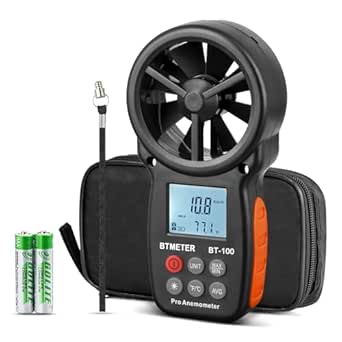 | Best Lightweight Pick for Basic Airflow Checks | Wind-speed range: 0.67–67.1 mph | Wind-speed accuracy: ±2% | Wind-speed resolution: 0.1 m/s | VIEW ON AMAZON | See Our Full Breakdown |
More Details on Our Top Picks
BTMETER CFM Anemometer Wind Gauge with Data Storage and Export to PC
For vent work where readings need to be recorded and reviewed later, I rank this BTMETER ahead of the simpler TopTes TS-301. It measures air velocity, temperature, and CFM/CMM airflow, then stores up to 600 measurement groups for PC export—useful when comparing multiple registers or keeping a service record. Its extendable vane sensor also helps reach vents that are awkward to measure directly, while the backlit screen supports dim mechanical-room work. The tradeoff is a more involved setup: airflow calculations require entering the vent’s cross-sectional area, and the available functions may take time to learn. Compared with the hot-wire BTMETER model, this one favors stored data and a vane sensor over a retractable thermal probe.
Pros:- Measures wind speed, temperature, and airflow in CFM/CMM
- Stores up to 600 measurement groups and supports PC export
- Extendable vane sensor helps reach less accessible vents
- Backlit LCD is easier to read in dim work areas
Cons:- Airflow measurement requires manual entry of the vent area
- Data logging and setup may feel complicated for occasional users
- Frequent logging can put more demand on battery life
Best for: HVAC technicians balancing several vents who want to save readings and review them on a computer
Not ideal for: Users who need a quick, simple wind-speed check or do not want to enter vent dimensions and manage data logging
- Wind speed range:0.001 to 100 mph
- Wind speed accuracy:3%
- Temperature range:32 to 113°F (0 to 45°C)
- Airflow range:0 to 999,900 ft³/min
- Airflow area setting:0.001 to 9,999 ft²
- Data storage:600 groups
- Sensor:Extendable vane sensor
- Display:Backlit LCD
Our verdict“Choose this BTMETER if you need vent readings you can save and analyze; pick the simpler TopTes TS-301 for basic wind measurements instead.”
TopTes TS-301 Digital Anemometer with Large Backlit LCD Screen for Wind Speed Measurement
I’d place the TopTes TS-301 on this list for portability and readability, not for full vent-balancing work. Its 2.26-inch backlit screen and low 135 g weight make quick checks straightforward, and it adds temperature and humidity readings alongside wind speed. That is a more accessible setup than the data-logging BTMETER CFM Anemometer, but the TS-301’s supplied specifications do not list CFM/CMM airflow measurement, so it is less suited to documenting register output. It makes sense for technicians who want a compact meter for preliminary checks or for users who also track outdoor conditions. Allow time for the temperature and humidity sensors to settle; buyers seeking a purpose-built duct airflow tool should choose a model with stated airflow-volume functions instead.
Pros:- Large, backlit 2.26-inch display
- Lightweight at 135 g for carrying between work areas
- Measures wind speed in six listed units
- Includes temperature and humidity readings
Cons:- Product data does not specify CFM/CMM airflow measurement
- Temperature and humidity sensors may need around 30 minutes to calibrate
- Battery life is not specified
Best for: Technicians or field users who want a lightweight meter for quick wind, temperature, and humidity checks
Not ideal for: HVAC professionals who need stated CFM/CMM output, vent-area calculations, or logged airflow readings
- Display:2.26-inch backlit LCD
- Wind speed units:ft/m, ft/s, mph, knots, km/h, m/s
- Temperature range:-4.0°F to 140.0°F
- Humidity range:0.0% to 99.9% RH
- Power:3 AAA batteries
- Weight:135 g
- Material:ABS plastic
Our verdict“Pick the TS-301 for easy-to-carry environmental and wind checks, but choose the BTMETER CFM model if vent airflow volume is the main task.”
BTMETER Hot Wire Anemometer – CFM/CMM Air Flow Meter Measuring 0.2-67 Mph
When a vent or duct opening is hard to access, I favor this BTMETER’s retractable thermal probe over the vane sensor on the BTMETER CFM Anemometer. It measures velocity, airflow volume, and temperature, so it is better aligned with HVAC checks than the TopTes TS-301, whose listed functions center on wind speed and environmental readings. A rechargeable battery and large color LCD also suit repeated work without relying on disposable batteries. The main compromise is its ±5% accuracy, which may be too loose for jobs requiring tighter measurement tolerances; its velocity ceiling is 67 mph as well. Its listed dimensions are relatively large for a handheld meter, so this is a functional access-oriented choice rather than the most compact option in the group.
Pros:- Retractable thermal probe suits confined or recessed measurement points
- Measures air velocity, airflow volume, and temperature
- USB-rechargeable 600mAh Li-Ion battery
- Large color LCD presents multiple readings
Cons:- ±5% stated accuracy may not suit tighter-tolerance work
- Air velocity range tops out at 67 mph
- Larger listed dimensions make it less compact than the TopTes TS-301
Best for: HVAC technicians measuring airflow in recessed vents or confined duct locations who want a rechargeable hot-wire meter
Not ideal for: Users needing tighter stated accuracy than ±5%, measurements above 67 mph, or a particularly compact meter
- Air velocity range:0.2 to 67 mph
- Accuracy:±5%
- Airflow volume range:0 to 999,900 ft³/min
- Temperature range:32 to 113°F
- Battery:600mAh Li-Ion, USB rechargeable
- Display:Large color LCD
- Dimensions:7.2 x 2.2 x 12.28 inches
- Weight:1.2 pounds
Our verdict“Choose this model for hot-wire access to tight vent locations and rechargeable operation, provided its ±5% accuracy meets your work requirements.”
PM8915 Hot Wire Anemometer Handheld with Telescopic Probe, Digital Wind Speed Meter for HVAC and Duct Airflow
The PM8915’s defining advantage is reach: its 42-inch telescopic probe and 66.9-inch cable are better suited to distant or obstructed measurement points than the shorter-reach details supplied for the BTMETER hot-wire model. That makes it a practical specialist for duct testing where the meter body needs to stay outside the opening. It also lists a 0.01 mph resolution and supports max/min and wind-chill functions, giving technicians more detail during spot checks. The tradeoff is that the supplied specifications do not state measurement accuracy, and the product description says calibration is needed for precise readings. Compared with the Fluke 925, this PM8915 prioritizes probe reach and hot-wire access, while the Fluke provides explicit accuracy figures and a defined temperature accuracy.
Pros:- 42-inch telescopic probe reaches deep or obstructed measurement points
- 66.9-inch cable lets the display remain farther from the probe
- 0.01 mph resolution supports fine-grained velocity readings
- Includes carrying case and USB charging cable
Cons:- The supplied data does not state measurement accuracy
- Calibration is needed for precise measurements
- Its extended probe setup is less convenient for quick checks at accessible vents
Best for: HVAC technicians who need to sample airflow deep inside ducts or at vents that are difficult to approach directly
Not ideal for: Buyers who require a stated accuracy specification or need a compact meter for routine, easily reached registers
- Wind speed range:0 to 67 mph
- Wind temperature range:32 to 113°F (0 to 45°C)
- Resolution:0.01 mph
- Airflow range:0 to 999,900 ft/min
- Probe length:42 inches
- Cable length:66.9 inches
- Material:ABS
Our verdict“Choose the PM8915 when probe reach is your main constraint, but prefer the Fluke 925 if published accuracy figures matter more.”
Fluke 925 Anemometer Wind Speed Air Flow Velocity Temperature Meter
I rank the Fluke 925 for buyers who value published accuracy figures over probe reach or data export. Its stated ±2% of full scale accuracy for wind speed and airflow, plus ±0.8°C for temperature, gives technicians a clearer basis for judging whether it fits a measurement task. That contrasts with the PM8915, whose supplied data gives resolution but no accuracy figure, and with the BTMETER hot-wire model’s ±5% specification. The Fluke also weighs 300 g, making it easy to carry between work areas. Its airflow range is narrower than the BTMETER models’ stated range, and the supplied information does not describe an extendable probe or PC logging. It is a focused professional meter, not the best match for users who need long-reach sampling or saved measurement records.
Pros:- Published ±2% of full-scale accuracy for wind speed and airflow
- Temperature accuracy is specified at ±0.8°C
- Measures both wind speed and airflow in metric and imperial units
- Lightweight 300 g body is easy to carry
Cons:- Airflow range is narrower than the listed BTMETER CFM models
- Uses a replaceable 9V battery
- Supplied product data does not list PC logging or an extendable probe
Best for: HVAC and industrial technicians who want stated wind, airflow, and temperature accuracy in a lightweight meter
Not ideal for: Technicians who need a long telescopic probe, PC-exportable logs, or airflow capacity beyond the listed range
- Wind speed range:0.40 to 25.00 m/s or 80 to 4,900 ft/min
- Wind speed resolution:0.01 m/s
- Wind speed accuracy:±2% of full scale
- Airflow range:0.01 to 99.99 m³/s or 1 to 9,999 ft³/min
- Airflow accuracy:±2% of full scale
- Temperature range:0 to 50°C
- Temperature accuracy:±0.8°C
- Weight and power:300 g; one 9V battery
Our verdict“Choose the Fluke 925 for a portable meter with explicit accuracy specifications, but look elsewhere if long-reach access or exported records are essential.”
HoldPeak 866B Digital Anemometer, Handheld Wind Speed and Temperature Meter
The HoldPeak 866B is a practical pick for technicians who want a simple handheld airflow check without relying on a phone app. Its stated range reaches 67.1 mph, and the several velocity units make it easier to use the same meter across different field notes or work settings. Compared with the Testo 405i, it lacks an extending probe and wireless reporting, so it is less suited to reaching into ducts or documenting readings digitally. Its backlight, hand strap, and included pouch favor quick spot checks, while the tripod socket can help keep readings steady when a stand is available. The tradeoff is a more basic workflow: it requires two AAA batteries, and its handheld format can be awkward for prolonged or hard-to-reach vent measurements.
Pros:- Measures wind speed and temperature with a stated ±2% reading accuracy
- Offers six velocity units plus Celsius and Fahrenheit
- Lightweight handheld design includes a carrying pouch and hand strap
- Backlight and tripod socket support varied field conditions
Cons:- No extendable probe for reaching into ducts or recessed vents
- AAA batteries are required and are not included
- Limited onboard features compared with the Fluke 922/Kit’s airflow and pressure functions
Best for: HVAC technicians and maintenance staff who need a lightweight meter for accessible vent and room-air spot checks, with multiple unit choices but no app requirement.
Not ideal for: Technicians who regularly measure inside deep ducts or need wireless logging, since it has no telescopic probe or stated data-transfer function.
- Measurement range:0.67–67.1 mph
- Accuracy:±2% of readings
- Units:m/s, km/h, ft/min, knots, mph, °C, °F
- Power:2 AAA batteries
- Features:Backlight, auto-off, tripod hole, hand strap
- Included accessories:Carrying pouch, screwdriver, user manual
Our verdict“Choose the HoldPeak 866B for portable, direct-access airflow checks; pick the Testo 405i instead when duct reach and app-based records matter.”
Fluke 922/Kit Airflow Meter Kit
For buyers who need more than a velocity reading, the Fluke 922/Kit earns its place with a three-in-one measurement approach: differential pressure, airflow, and velocity. That makes it better suited than the HoldPeak 866B to diagnosing duct conditions where pressure readings can help explain why airflow is uneven. The kit’s user-defined duct shape and size also let technicians account for duct geometry when calculating airflow, rather than treating every opening alike. A NIST-traceable calibration certificate with data adds useful documentation for quality-system work, and the backlit display supports readings in dim mechanical spaces. This professional scope brings a tradeoff: the supplied details do not list measurement ranges, accuracy, power, or included kit components, so buyers comparing exact specifications should verify them before choosing. It is also more specialized than a basic vent meter.
Pros:- Combines differential pressure, airflow, and velocity measurements
- Allows user-defined duct shape and size for airflow calculations
- Includes a NIST-traceable calibration certificate with data
- Backlit display and 0.001 in H₂O resolution support detailed pressure readings
Cons:- Detailed measurement ranges and accuracy figures are not provided in the available product data
- The diagnostic focus may be more than needed for basic vent spot checks
- The supplied information does not specify power source or kit contents
Best for: HVAC service professionals and facility technicians who diagnose duct pressure as well as airflow and need calibration documentation for work records.
Not ideal for: Homeowners or field staff seeking a compact, simple wind-speed meter, since this kit focuses on broader duct diagnostics and its detailed measurement specifications are not provided here.
- Measurement functions:Differential pressure, airflow, and velocity
- Pressure resolution:Down to 0.001 in H₂O
- Duct input:User-defined duct shape and size
- Calibration:Calibrated prior to shipment; NIST-traceable certificate with data
- Display:Bright, backlit display
- Material:Plastic
- Weight:0.64 kg
- Dimensions:13.98 × 43 × 4.41 inches
Our verdict“Choose the Fluke 922/Kit when duct pressure and documented calibration matter as much as airflow, rather than for simple handheld velocity checks.”
Testo 405i Digital Anemometer with Bluetooth and Telescopic Shaft
The Testo 405i is the clearest choice here for technicians who need to reach beyond the vent face: its telescopic shaft extends to 15 inches, making measurements inside ducts and awkward grilles more practical than with the HoldPeak 866B. Bluetooth links readings to the Smart Probe app for storage and reporting, which gives it an edge over the Fluke 922/Kit when a phone-based record is the preferred workflow. The probe measures air velocity and temperature, and the supplied data also describes volume-flow measurement. Its small, light body is easy to carry, but the phone-dependent setup adds friction for crews who want a standalone instrument or work where compatible devices are unavailable. Buyers should also note that the listed velocity accuracy varies by range, rather than being a single simple tolerance.
Pros:- Telescopic shaft extends up to 15 inches for in-duct measurements
- Bluetooth supports remote operation and app-based data storage
- Measures air velocity and temperature, with volume-flow capability described
- Compact 4.22-ounce design is convenient for field carry
Cons:- Requires a compatible smartphone or tablet with Bluetooth 4.0 for app functions
- App setup may add complexity compared with the standalone HoldPeak 866B
- Velocity accuracy varies across the measurement ranges
Best for: HVAC technicians who take readings inside ducts or recessed vents and want to transfer measurements to a compatible phone or tablet for records and reports.
Not ideal for: Workers who need a self-contained meter without a smartphone, or those who prefer a simple single-figure accuracy specification across the full velocity range.
- Velocity range:0–5,906 fpm / 0–30 m/s
- Velocity accuracy:Range-dependent; specified as ±(19.7 fpm + 5% of mv) or ±(0.1 m/s + 5% of mv) at lower ranges, with higher-range tolerances also listed
- Temperature range:−4°F to 140°F / −20°C to 60°C
- Temperature accuracy:±0.9°F / ±0.5°C
- Extendable shaft:Up to 15 inches
- Connectivity:Bluetooth 4.0
- Power:3 AAA batteries
- Dimensions and weight:8 × 1 × 2 inches; 4.22 oz / 119.6 g
Our verdict“Choose the Testo 405i for duct access and phone-based records; choose a standalone meter if you want readings without app setup.”
CPS ABM-200 Airflow and Environmental Meter
The CPS ABM-200 suits technicians who want a wireless environmental measurement tool that can mount on an extension pole for elevated vents or hard-to-reach locations. Its stated functions include airflow, temperature, humidity, and pressure, giving it broader environmental coverage than the HoldPeak 866B, which focuses on wind speed and temperature. Bluetooth SMART connects it to a smartphone or tablet for readings and data recording, but that reliance on a separate device shapes the whole experience: this is not the best fit for crews who want a standalone display. The aluminum housing and 1/4-20 UNC thread support a sturdy, adaptable setup, though the extension pole is an extra and the supplied details omit measurement ranges, accuracy, and battery life. Compared with the Testo 405i, it offers a useful mounting interface but no stated telescopic shaft length.
Pros:- Measures airflow alongside temperature, humidity, and pressure
- Bluetooth SMART supports wireless readings and data recording
- Aluminum construction is suited to regular field handling
- 1/4-20 UNC thread allows attachment to a compatible extension pole
Cons:- Requires a smartphone or tablet for operation
- Extension pole is compatible but not included in the listed components
- Measurement ranges, accuracy, and battery life are not specified in the supplied data
Best for: HVAC technicians who already use a compatible phone or tablet and need wireless environmental readings at elevated vents or locations reached with a separate extension pole.
Not ideal for: Buyers who need a standalone display, published accuracy and range details, or an all-in-one probe-and-pole package.
- Model:ABM-200
- Measurement functions:Airflow, temperature, humidity, and pressure
- Connectivity:Bluetooth SMART
- Material:Aluminum
- Weight:2.4 ounces
- Thread style:1/4-20 UNC
- Extension compatibility:Compatible with an optional extension pole
- Included components:None listed
Our verdict“Choose the ABM-200 if wireless environmental readings and pole mounting fit your workflow, but select the Testo 405i for a specified telescopic probe.”
UEi Test Instruments Anemometer with Humidity, 99 to 3937 FPM (DAFM3B)
The UEi DAFM3B stands apart from the HoldPeak 866B by pairing airflow readings with six HVAC/R measurements: humidity, air temperature, dew point, wet bulb, air velocity, and volume. That range of outputs can help a technician assess air conditions at a vent without carrying separate meters for each parameter. A twist cap protects the built-in sensor between readings, and the included 9V battery and case make the package ready for field use. Compared with the Bluetooth-enabled Testo 405i, the UEi keeps operation in the handheld instrument rather than depending on an app, though the supplied information does not describe wireless logging. Its 99–3,937 FPM velocity range may not suit high-speed applications, and the plastic housing is a less convincing choice for rough handling than the CPS ABM-200’s aluminum body.
Pros:- Combines six HVAC/R parameters in one handheld instrument
- Measures air velocity and volume as well as temperature and humidity-related values
- Twist-cap design protects the built-in sensor between readings
- Includes a 9V alkaline battery and case
Cons:- Velocity range is limited to 99–3,937 FPM
- Plastic housing may be less suited to rough field conditions than the CPS ABM-200’s aluminum construction
- No Bluetooth or app-based reporting is listed
Best for: HVAC/R technicians who want a standalone handheld for airflow, humidity, temperature, dew point, and wet-bulb checks during routine service calls.
Not ideal for: Technicians measuring air speeds above 3,937 FPM or working in harsh environments where a more rugged housing is a priority.
- Model:DAFM3B
- Air velocity range:99–3,937 FPM
- Measurement functions:Air velocity, volume, air temperature, humidity, dew point, and wet bulb
- Power:1 included 9V alkaline battery
- Material:Plastic
- Dimensions:0.5 × 2.9 × 7.1 inches
- Included components:DAFM3B, case, battery
- Warranty:1-year limited warranty
Our verdict“Choose the DAFM3B for broad, standalone HVAC/R readings in routine service work, but look elsewhere for higher velocity capacity or wireless reporting.”
Hot Wire Anemometer AM-284 HVAC Airflow Meter
For HVAC technicians who need to reach well beyond a grille, the AM-284’s telescoping probe extends to 42.1 inches, giving it a clear access advantage over the Fieldpiece STA2’s 38-inch probe. Hot-wire sensing suits duct and exhaust airflow checks where a compact vane-style meter may be awkward to position. Its multiple velocity units, recording functions, and USB connection also support documenting readings for reports rather than relying on notes alone. The tradeoff is a thinner specification picture: the supplied details do not state measurement accuracy, ranges, battery life, or calibration information. Probe placement and extension also matter to reliable readings. I’d favor this model for technicians who prioritize reach and data export, but choose the more feature-documented Testo 417 if stated measurement ranges and app-based documentation matter more.
Pros:- Telescoping probe reaches up to 42.1 inches for access deeper than the Fieldpiece STA2 probe.
- Hot-wire design is suited to airflow checks inside ducts and vents.
- Supports five listed velocity units for flexible reporting.
- Recording functions and USB connectivity support exporting measurement data.
Cons:- Accuracy, measurement range, calibration, and battery-life details are not provided.
- Probe extension and placement require care for dependable readings.
- Multiple functions may feel unnecessarily complex for occasional residential checks.
Best for: HVAC technicians measuring airflow in deep ducts or exhaust runs who need a long probe and USB data export.
Not ideal for: Buyers who need clearly stated accuracy, measurement ranges, or calibration and battery details before choosing a professional meter.
- Model:AM-284
- Probe length:Up to 42.1 in (1.07 m)
- Measurement units:m/s, km/h, ft/min, knots, mph
- Display:Backlit LCD
- Connectivity:USB
- Material:Metal and plastic
- Item weight:160 g
Our verdict“Choose the AM-284 when deep-duct reach and USB reporting matter more than a fully specified measurement range.”
Fieldpiece STA2 In-Duct Hot Wire Anemometer for HVAC Airflow Measurement
The Fieldpiece STA2 is the most directly HVAC-focused choice here for technicians who want air velocity, temperature, and calculated CFM from inside a duct. Its 38-inch telescoping probe reaches into runs that a handheld vane meter such as the Extech AN200 may not suit as well, while the dual display keeps live measurements visible during diagnosis. Stabilizing tools support hands-free positioning, which can help when a reading needs time to settle. Compared with the AM-284, the STA2 makes its CFM and temperature role clearer, but its probe is shorter and the supplied specifications list no measurement ranges or accuracy figures. It also needs a 9V battery. This is a focused service tool, not the simplest pick for occasional household vent checks.
Pros:- Measures air velocity and temperature and calculates CFM directly in ducts.
- 38-inch telescoping probe provides access into deeper ductwork.
- Dual display presents live readings together.
- Stabilizing features support hands-free measurement positioning.
Cons:- Supplied specifications do not state accuracy or measurement ranges.
- Requires a 9V battery, which must be replaced as needed.
- Professional diagnostic functions may be more involved than casual vent checks require.
Best for: HVAC service technicians who need in-duct velocity, temperature, and CFM readings while keeping the probe stable during diagnostics.
Not ideal for: Homeowners or occasional users seeking a simple vent check, or buyers who require published accuracy and measurement-range details.
- Model:STA2
- Measurement functions:CFM, air velocity, temperature
- Probe:38-inch telescoping probe
- Display:Dual display
- Power:1 9V battery required
- Product dimensions:13 x 4 x 11 in
Our verdict“Pick the STA2 for hands-free, in-duct CFM diagnostics; skip it if you mainly need a straightforward room-side airflow check.”
Testo 417 Anemometer Handheld Set with Funnels and Flow Straightener
The Testo 417 stands out as the most measurement-detailed option in this group: its listed ranges cover velocity, volume flow, and temperature, and the set includes funnels and a flow straightener for handling outlet measurements. App compatibility adds a path for storing and documenting results, unlike the AM-284’s USB-centered workflow. That makes the Testo a strong fit for technicians comparing vents and recording findings across a job. Its limits are practical: at 243 g, it is heavier than the 150 g BTMETER BT-100, and its listed temperature and airflow ranges may not suit every application. It also runs on three AA batteries. Choose this kit when repeatable outlet measurements and records matter; look elsewhere if deep-duct reach is the main need, since no telescoping probe is listed.
Pros:- Lists measurement ranges for velocity, volume flow, and temperature.
- Funnels and flow straightener support measurement at air outlets.
- App compatibility supports configuration, data storage, and documentation.
- Specified battery life is 50 hours.
Cons:- At 243 g, it is heavier than the BTMETER BT-100.
- No telescoping probe is listed for reaching deep ducts.
- Requires three AA batteries and has defined operating ranges.
Best for: HVAC technicians measuring vent flow with included funnels who want defined ranges and app-supported documentation.
Not ideal for: Technicians whose main task is probing deep ductwork, or buyers seeking a lighter meter with fewer accessories.
- Velocity range:0.3–3937 fpm / 0.3–20 m/s
- Volume-flow range:0–58,857 CFM / 0–99,999 m³/h
- Temperature range:32 to 122°F / 0 to 50°C
- Weight:9 oz / 243 g
- Dimensions:9 x 4 x 2 in / 236 x 108 x 45 mm
- Protection class:IP40/IP20
- Battery type and life:3 AA; 50 hours
- Included accessories:Funnels, flow straightener, carrying case
Our verdict“Choose the Testo 417 for a documented, accessory-rich vent-measurement workflow rather than deep in-duct access.”
Extech AN200 CFM/CMM Mini Thermo-Anemometer with Built-in Infrared Thermometer
The Extech AN200 pairs airflow readings with a built-in infrared thermometer, making it a useful choice when a vent inspection also calls for checking surface temperature. Its large dual-readout LCD and ergonomic handheld format favor quick checks at accessible grilles, while the 3.9-foot cable gives some separation between the display and the airflow sensor. Compared with the Testo 417, the Extech adds a stated IR temperature capability up to 500°F but provides less detail about data handling and airflow ranges beyond 80–5900 FPM. The infrared reading can also be less dependable at longer distances, so it is not a substitute for close, controlled temperature measurement. I’d select it for mixed airflow and surface-temperature spot checks, not for deep-duct work like the Fieldpiece STA2.
Pros:- Measures airflow from 80 to 5900 FPM.
- Built-in IR thermometer reads temperatures up to 500°F (260°C).
- Large LCD presents two readings at once.
- 3.9-foot cable separates the sensor from the display.
Cons:- Infrared temperature readings may be less precise at longer distances.
- The listed airflow range may not cover every ventilation application.
- Requires a 9V battery.
Best for: HVAC technicians or building-maintenance staff checking accessible vents and nearby surface temperatures with one handheld tool.
Not ideal for: Users who need deep-duct probe access, app-based reporting, or dependable infrared readings from farther away.
- Airflow range:80–5900 FPM
- IR temperature limit:Up to 500°F (260°C)
- Display:Large LCD with dual readout
- Vane diameter:2.83 in (72 mm)
- Cable length:3.9 ft (120 cm)
- Power:9V battery
- Dimensions:2.9 x 1.3 x 7 in
- Weight:0.8 kg
Our verdict“Choose the AN200 for accessible vent checks that also need close-range surface-temperature readings, not deep-duct measurement.”
BTMETER BT-100 Handheld Anemometer
The BTMETER BT-100 is the simplest portable option here for checking air movement at accessible vents, with wind speed, temperature, and wind chill readings in a small handheld body. Its 150 g weight and backlit display make it easier to carry between locations than the 243 g Testo 417, and the tripod mount allows hands-free positioning. But this is a general-purpose wind meter rather than an in-duct HVAC instrument: unlike the Fieldpiece STA2, it has no listed telescoping probe or direct CFM measurement. Its stated ±2% accuracy and 0.67–67.1 mph range offer useful reference points, though the product data does not establish professional-grade performance for duct balancing. I’d choose it for basic, accessible airflow checks and outdoor use, not for formal HVAC diagnostics or deep vents.
Pros:- Lightweight 150 g body is easy to carry between checks.
- Measures wind speed, wind temperature, and wind chill.
- Backlit LCD supports use in dim areas.
- Tripod mount enables hands-free positioning.
Cons:- No telescoping probe is listed for reaching inside ducts.
- No direct CFM measurement function is specified.
- The supplied data does not establish suitability for professional duct balancing.
Best for: Maintenance staff or property owners who want a light meter for accessible vent checks and occasional outdoor wind measurements.
Not ideal for: HVAC professionals needing direct CFM calculations, a probe for deep ducts, or a meter specified for in-duct diagnostics.
- Wind-speed range:0.67–67.1 mph
- Wind-speed accuracy:±2%
- Wind-speed resolution:0.1 m/s
- Wind-temperature range:-10–60°C / 14–113°F
- Temperature resolution:0.2°C
- Power:2 x 1.5V AAA batteries
- Dimensions:6.5 x 3.34 x 1.49 in
- Weight:150 g
- Material and mount:Plastic body; metal thread
Our verdict“Choose the BT-100 for portable, basic airflow checks; select the Fieldpiece STA2 for professional in-duct CFM work.”

How We Picked
I ranked these meters around professional vent work rather than general wind measurement. The main criteria were how well each instrument’s measurement method fits grilles or ducts, whether its probe or accessories can reach the intended location, how useful its airflow and environmental readings are for HVAC decisions, and how clearly it supports repeatable work. I also considered practical handling, data features, and whether the tool’s capabilities justify the added complexity for a typical buyer.
The order favors instruments with a broader or more vent-specific measurement approach. That puts the Fluke 922/Kit first for range of diagnostic tasks and the Testo 417 set high for grille airflow work; the Fieldpiece STA2 earns a distinct place for in-duct readings. General-purpose anemometers remain useful for simpler checks, but they rank lower when their design or stated capabilities offer less support for measuring airflow at installed vents. Product names and listed features guide this comparison; buyers should confirm current specifications and included accessories before purchase.
Factors to Consider When Choosing Airflow Meter For Vents Professional
Choosing a vent airflow meter starts with the measurement job, not the longest feature list. I’d decide where the reading must be taken, how the result will be used, and whether it needs to become part of a service record. These broader checks can prevent buying a capable instrument that is awkward for the actual vent or duct setup.
Match the measurement method to the job
Handheld anemometers estimate airflow from air speed, while pressure-based tools can support a wider diagnostic process, and capture accessories can help quantify flow at a grille. Those methods are not interchangeable in every setup. A reading taken at one point in a grille may not represent the total volume moving through it, especially when airflow is uneven. For balancing work, use a method and procedure suited to the terminal and follow the instrument’s instructions. A common mistake is treating a wind-speed number as a direct, definitive CFM result without accounting for the measurement area or sampling method. Pay for a more involved tool when its method answers the question your service work actually asks.
Check access, probe reach, and vent geometry
Measure the space around the vent before choosing a probe or accessory. Recessed registers, narrow slots, ceiling diffusers, and duct test ports each create different access limits. A telescopic probe may help reach a grille without a ladder position that blocks the airflow, while a funnel or flow straightener may suit some grille shapes better than a bare sensor. These accessories can also add bulk, so check storage and setup needs if you work across many locations. Avoid assuming that a tool marketed for HVAC will fit every vent configuration. If your work spans several grille types, flexible access and compatible accessories can be more useful than extra display functions.
Decide how much measurement detail you need
Air speed alone can be enough for a quick check, but troubleshooting may call for temperature, humidity, or pressure context. Extra readings help distinguish airflow problems from comfort or system issues, though they also add setup steps and interpretation demands. Before choosing a multi-function meter, list the measurements you use routinely rather than buying features for rare tasks. Check units, range, resolution, and stated accuracy against the expected conditions and your reporting needs. Do not compare instruments by range alone: a broad range does not automatically mean better performance at low vent velocities. When readings support commissioning or formal records, follow applicable procedures and instrument guidance rather than relying on a single spot measurement.
Plan for repeatable readings and documentation
Consistency matters when comparing rooms, checking repairs, or returning to a site. Consider whether the meter can store readings, export data, or connect to an app, and whether those functions fit your existing recordkeeping process. A simple log with location, operating mode, and measurement position can make readings more useful than an elaborate export that nobody reviews. Take readings under comparable system conditions; fan settings, open doors, and nearby obstructions can change results. Buyers sometimes focus on wireless features and overlook whether the instrument is easy to operate with gloves or in a ceiling-space position. Choose data features that reduce transcription work without making field use more cumbersome.
Balance build, maintenance, and training
Professional use can involve repeated transport, dusty spaces, and frequent setup, so probe protection and straightforward controls deserve attention. Ask how sensors and accessories are stored, what routine care the manufacturer specifies, and whether replacement parts or service information are available. A complex instrument can offer more diagnostic options but may require training to avoid inconsistent readings. For occasional vent checks, a simpler meter may be easier to use correctly across a team. For commissioning or repeated troubleshooting, a tool that supports a consistent procedure can repay its learning curve. Confirm calibration and maintenance expectations before purchase, especially when results need to support documented decisions.
Frequently Asked Questions
Is a basic handheld anemometer enough for professional vent balancing?
It can be enough for quick airflow checks, but a basic handheld reading may not capture total flow through a grille accurately on its own. Results depend on how the sensor is positioned, how many points are sampled, and how the vent area is handled in the calculation. For balancing, select a method appropriate to the terminal and follow a repeatable procedure. A capture accessory or a more diagnostic instrument may be a better fit when you need defensible airflow totals. The right choice depends on whether you are screening for problems or documenting system performance.
When should I choose a flow hood or funnel set instead of a bare probe?
A hood or funnel set can make sense when you need to measure airflow at a grille and the accessory fits its shape and size. It can help capture flow across an opening rather than relying on isolated velocity points. A bare probe is usually easier to carry and can access places where a hood will not fit, but the reading may require more careful sampling. Check compatibility with your vents before purchase, since a capture accessory that does not seal or sit properly can undermine the measurement. For mixed vent types, compare the accessory’s coverage against your actual site mix.
Do I need pressure measurement for routine vent checks?
Not for every routine check. If the task is limited to comparing airflow at accessible vents, a simpler anemometer may be sufficient when used consistently. Pressure readings become more useful when diagnosing restrictions, checking system behavior, or connecting vent observations to broader HVAC troubleshooting. A pressure-capable meter adds capability but also requires the user to understand what the readings mean and how to take them. Choose it when pressure measurements are part of your regular workflow, not merely because more functions sound better.
Are Bluetooth or PC export features worth choosing over a simpler meter?
They are useful when measurements need to be saved, compared, or included in service records, especially across many vents or visits. Bluetooth can reduce manual transcription, while PC export may suit a workflow built around desktop reports. Neither feature improves the measurement itself, and connectivity can add setup steps or compatibility checks. Think about who will use the records and where they will be stored before paying for data features. If readings are only occasional spot checks, a clear display and easy controls may matter more.
What should I verify before using a meter for formal commissioning records?
Confirm the instrument’s specifications, calibration status, measurement procedure, and suitability for the terminal being measured. Check that the accessories required for the procedure are included or available, and record the system operating conditions alongside each reading. A meter’s displayed CFM or velocity value does not by itself prove that the method matches a commissioning requirement. Follow the applicable project standard and manufacturer instructions, including any rules for sampling or correction. If records need to support acceptance decisions, verify requirements with the responsible engineer or commissioning authority before selecting the tool.
Conclusion
For one instrument to cover varied HVAC diagnostic work, I’d choose the Fluke 922/Kit as best overall; its broader pressure and airflow role sets it apart from simpler meters. The Testo 417 set is my pick for vent-focused measurements, particularly when its included funnels and flow straightener suit the grille types you encounter. For a premium diagnostic choice, the Fluke kit is the clearest fit, while the Fieldpiece STA2 makes more sense for buyers focused on in-duct hot-wire readings. If you want a simpler starting point, the TopTes TS-301 offers an accessible handheld format, and the BTMETER CFM model suits buyers who value stored readings and PC export. Choose the method and accessories around your vents first; that will narrow the field faster than comparing feature lists alone.