Indoor air quality monitors help you track conditions such as carbon dioxide, particulate matter, and humidity, but the right pick depends on which readings you need and how you want to use them. My best overall choice is the BREATHE Airmonitor Plus Gen 2 for buyers seeking a dedicated home monitor, while the Aranet4 stands out for focused CO2 tracking and the Amazon Smart Air Quality Monitor for Alexa-connected households. The main tradeoff is between broad readings on multi-sensor displays and simpler devices that focus on a narrower set of measurements. Connectivity, portability, and the clarity of the screen also shape which monitor is easiest to use day to day. Read on for the full breakdown and help matching a monitor to your home.

Get home appliances delivered free with Prime
- Fast, free delivery on millions of items
- Prime Video, Amazon Music and more included
- Member-only deals all year
Complete the kit


Key Takeaways
- Sensor count alone does not settle the choice: many listed models advertise 10 or 16 measurements, but buyers should check which specific pollutants and conditions matter to them.
- Focused CO2 monitoring has a distinct role: the Aranet4 is the lineup’s dedicated wireless CO2 option, while multi-reading devices aim to show a wider picture of indoor conditions.
- Smart-home fit separates the Amazon models: the Alexa-connected monitor and its two-pack are geared toward households that want linked room monitoring rather than a standalone display-first setup.
- Display size is a practical tradeoff: the 7-inch model favors at-a-glance viewing, while portable and compact options better suit moving a monitor between rooms.
- The lineup contains repeated and similar options: two Zemeollo 10-in-1 listings and several generically named 16-in-1 monitors make verifying exact model specifications especially important before choosing.
| YNAK 16-in-1 Indoor Air Quality Monitor with 5.5-Inch HD Display | 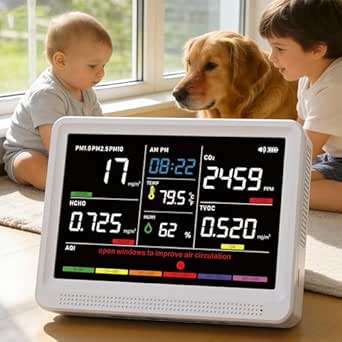 | Best Overall for Portable Multi-Parameter Monitoring | Measurements: CO2, PM2.5, PM1.0, PM10, HCHO, TVOC, temperature, humidity, AQI | Display: 5.5-inch HD LED | Alert functions: 7 AQI alert types | VIEW LATEST PRICE | See Our Full Breakdown |
| 16-in-1 Indoor Air Quality Monitor with 7-Inch Display |  | Best for Large, Real-Time Indoor Monitoring | Display: 7-inch LED | Monitored parameters: CO2, PM2.5, PM1.0, PM10, HCHO, TVOC, temperature, humidity, AQI, and time | AQI alerts: 7 alert functions | VIEW LATEST PRICE | See Our Full Breakdown |
| 16-in-1 Indoor Air Quality Monitor with Color Screen |  | Best for Frequent, Quick Updates in Portable Form | Measurements: PM1.0, PM2.5, PM10, CO2, TVOC, HCHO, temperature, humidity | Update interval: 1.5 seconds | Display: HD color screen with color-coded levels | VIEW LATEST PRICE | See Our Full Breakdown |
| GoveeLife Smart Air Quality Monitor H5106 |  | Best for Remote Monitoring and Automation Integration | Measurements: PM2.5, temperature, humidity | Refresh time: 2 seconds | Connectivity: 2.4 GHz Wi-Fi and Bluetooth | VIEW LATEST PRICE | See Our Full Breakdown |
| 16-in-1 Indoor Air Quality Monitor with Color Display |  | Best for Quick, Visual, Portable Checks | Measurements: PM1.0, PM2.5, PM10, CO2, TVOC, HCHO, temperature, humidity | Sampling interval: 1.5 seconds | Display: HD color screen with color-coded levels | VIEW LATEST PRICE | See Our Full Breakdown |
| 16-in-1 Indoor Air Quality Monitor with HD Color Display |  | Best for Comprehensive Monitoring on the Go | Measurements: PM1.0, PM2.5, PM10, TVOC, HCHO, temperature, humidity | Sampling interval: 1.5 seconds | Battery life: 4–5 hours | VIEW LATEST PRICE | See Our Full Breakdown |
| 10-in-1 Indoor Air Quality Monitor with Color Display |  | Best for Long-Lasting, Broad-Spectrum Monitoring | Measurements: PM0.3, PM2.5, PM10, CO2, CO, HCHO, TVOC, AQI, temperature, humidity | Sampling interval: 1.2 seconds | Battery capacity: 2000mAh | VIEW LATEST PRICE | See Our Full Breakdown |
| Zemeollo 10-in-1 Portable Indoor Air Quality Monitor |  | Best for Visual Alerts and Daily Portable Monitoring | Measurements: CO₂, HCHO, TVOC, benzene, temperature, humidity, AQI, PM1.0, PM2.5, PM10 | Battery capacity: 2000mAh | Battery life: Up to 20 hours | VIEW LATEST PRICE | See Our Full Breakdown |
| Caikieme 10-in-1 Indoor Air Quality Monitor |  | Best for Real-Time Visual Flagging of Air Quality | Measurements: CO₂, TVOC, HCHO, temperature, AQI, PM2.5, PM1.0, PM10 | Battery capacity: 2000mAh | Battery life: Up to 20 hours | VIEW LATEST PRICE | See Our Full Breakdown |
| 16-in-1 Indoor Air Quality Monitor with HD Color Display | | Best for Multi-Parameter Indoor Monitoring in Compact Form | Measurements: PM1.0, PM2.5, PM10, TVOC, HCHO, temperature, humidity | Sampling interval: 1.5 seconds | Battery life: 4–5 hours | VIEW LATEST PRICE | See Our Full Breakdown |
| Amazon Smart Air Quality Monitor with Alexa |  | Best for Alexa Automation | Measurements: Temperature, humidity, carbon monoxide, PM2.5, and VOCs | Connectivity: 2.4 GHz Wi-Fi and Bluetooth LE 4.2 | Compatibility: Echo devices and Alexa app version 2021.16 or later | VIEW LATEST PRICE | See Our Full Breakdown |
| BREATHE Airmonitor Plus Gen 2 Indoor Air Quality Monitor |  | Best for Detailed Air Data | Measurements: CO₂, PM1, PM2.5, PM10, TVOC, formaldehyde (HCHO), temperature, and humidity | CO₂ sensor: NDIR | Particle sensor: Laser | VIEW LATEST PRICE | See Our Full Breakdown |
| Aranet4 Indoor Air Quality Monitor with Wireless CO2 Detector | 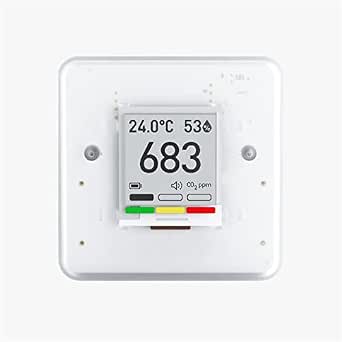 | Best for Long-Term CO₂ Monitoring | Measurements: CO₂, temperature, relative humidity, and atmospheric pressure | Sensor technology: NDIR | Battery life: Up to 4 years | VIEW LATEST PRICE | See Our Full Breakdown |
| Zemeollo 10-in-1 Portable Indoor Air Quality Monitor | 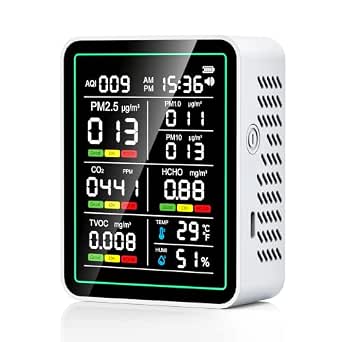 | Best for Cordless Portability | Model: FAS-SA2 | Measurements: CO₂, HCHO, TVOC, benzene, PM1.0, PM2.5, PM10, temperature, and AQI | Battery capacity: 2000 mAh | VIEW LATEST PRICE | See Our Full Breakdown |
| Amazon Smart Air Quality Monitor, 2-Pack | | Best for Monitoring Two Rooms | Pack size: 2 monitors | Measurements: PM2.5, VOCs, carbon monoxide, humidity, and temperature | Connectivity: Amazon Alexa | VIEW LATEST PRICE | See Our Full Breakdown |
| indoor air quality monitor | Measurements | Display | Battery life |
|---|---|---|---|
| YNAK 16-in-1 Indoor Air Qualit | CO2, PM2.5, PM1.0, PM10, HCHO, TVOC, temperature, humidity, AQI | 5.5-inch HD LED | — |
| 16-in-1 Indoor Air Quality Mon | — | 7-inch LED | — |
| 16-in-1 Indoor Air Quality Mon | PM1.0, PM2.5, PM10, CO2, TVOC, HCHO, temperature, humidity | HD color screen with color-coded levels | — |
| GoveeLife Smart Air Quality Mo | PM2.5, temperature, humidity | — | — |
| 16-in-1 Indoor Air Quality Mon | PM1.0, PM2.5, PM10, CO2, TVOC, HCHO, temperature, humidity | HD color screen with color-coded levels | 4–5 hours |
| 16-in-1 Indoor Air Quality Mon | PM1.0, PM2.5, PM10, TVOC, HCHO, temperature, humidity | HD color screen | 4–5 hours |
| 10-in-1 Indoor Air Quality Mon | PM0.3, PM2.5, PM10, CO2, CO, HCHO, TVOC, AQI, temperature, humidity | High-definition color-coded screen | Up to 96 hours |
| Zemeollo 10-in-1 Portable Indo | CO₂, HCHO, TVOC, benzene, temperature, humidity, AQI, PM1.0, PM2.5, PM10 | Color LED screen | Up to 20 hours |
| Caikieme 10-in-1 Indoor Air Qu | CO₂, TVOC, HCHO, temperature, AQI, PM2.5, PM1.0, PM10 | Color screen with alert colors | Up to 20 hours |
| 16-in-1 Indoor Air Quality Mon | PM1.0, PM2.5, PM10, TVOC, HCHO, temperature, humidity | HD color screen | 4–5 hours |
| Amazon Smart Air Quality Monit | Temperature, humidity, carbon monoxide, PM2.5, and VOCs | — | — |
| BREATHE Airmonitor Plus Gen 2 | CO₂, PM1, PM2.5, PM10, TVOC, formaldehyde (HCHO), temperature, and humidity | — | Up to 6 hours |
| Aranet4 Indoor Air Quality Mon | CO₂, temperature, relative humidity, and atmospheric pressure | E-ink | Up to 4 years |
| Zemeollo 10-in-1 Portable Indo | CO₂, HCHO, TVOC, benzene, PM1.0, PM2.5, PM10, temperature, and AQI | HD color screen | Up to 20 hours |
| Amazon Smart Air Quality Monit | PM2.5, VOCs, carbon monoxide, humidity, and temperature | — | — |
More Details on Our Top Picks
YNAK 16-in-1 Indoor Air Quality Monitor with 5.5-Inch HD Display
This monitor stands out for its comprehensive measurement capabilities, including CO2, particulate matter, formaldehyde, TVOC, temperature, humidity, and AQI, all displayed on a large 5.5-inch HD screen with adjustable brightness. Unlike the GoveeLife H5106, which offers remote monitoring but fewer environmental parameters, the YNAK model provides a richer dataset in a portable form factor. Its audible alerts and mute function improve usability in busy or noisy environments, making it ideal for users who want detailed, real-time air quality insights on the go. However, sensor accuracy may be compromised if the device is touched or exposed to strong odors, which is a tradeoff for its portability and multi-measurement features.
Pros:- Monitors a wide range of air quality and environmental parameters
- Large, adjustable brightness display improves readability
- Portable with up to 10 hours of runtime for flexible use
- Includes audible alerts and mute function for convenience
Cons:- Sensor accuracy may be affected by touching or strong odors
- Limited runtime compared to larger stationary monitors
Best for: Individuals seeking a versatile, portable air quality monitor that displays multiple parameters simultaneously, such as homeowners or outdoor inspectors.
Not ideal for: Users who require highly precise measurements for professional or scientific purposes, as sensor accuracy can be affected by handling and environmental factors.
- Measurements:CO2, PM2.5, PM1.0, PM10, HCHO, TVOC, temperature, humidity, AQI
- Display:5.5-inch HD LED
- Alert functions:7 AQI alert types
- Runtime:Up to 10 hours
- Charging:USB-C; AC adapter included
- Temperature accuracy:±1 to ±3 °F
- Humidity accuracy:±2% to ±3% RH
- Included items:Monitor, USB-C cable, AC power adapter, user manual
- Warranty:12 months
Our verdict“This pick is best suited for users who want detailed, portable air quality data with a user-friendly display and alerts.”
16-in-1 Indoor Air Quality Monitor with 7-Inch Display
This monitor offers a spacious 7-inch display with three brightness settings, making it easier to interpret multiple air quality metrics at a glance, especially compared to the more compact YNAK model. It monitors CO2, particulate matter, formaldehyde, TVOC, temperature, humidity, and AQI in real time, with seven alert functions and a mute option, similar to the YNAK but with a larger screen for enhanced visibility. Its 8-hour battery life is slightly less than the portable YNAK, but the larger display and real-time updates make it ideal for home or office environments where constant awareness is needed. The sensor accuracy claim is not independently verified, which could be a concern for precision-critical users.
Pros:- Large, bright display with adjustable brightness
- Real-time monitoring of multiple parameters
- Seven alert functions with mute control
- Supports USB-C charging for convenience
Cons:- Limited to 8 hours of runtime, requiring constant power connection
- Sensor accuracy not independently verified
Best for: Homeowners or office managers who prefer a larger display for easy monitoring of indoor air quality in real time.
Not ideal for: People needing a fully portable device with longer battery life, as this model relies on AC power and has limited runtime.
- Display:7-inch LED
- Monitored parameters:CO2, PM2.5, PM1.0, PM10, HCHO, TVOC, temperature, humidity, AQI, and time
- AQI alerts:7 alert functions
- Display brightness:3 settings
- Sensor accuracy:0.001 units (claimed)
- Battery runtime:Up to 8 hours
- Charging:USB-C
- Included accessories:USB-C cable, AC power adapter, user manual
Our verdict“This monitor is ideal for users who want a larger, real-time display for indoor air quality in fixed locations.”
16-in-1 Indoor Air Quality Monitor with Color Screen
This device features a vibrant color screen updating every 1.5 seconds, providing quick visual cues about particulate matter, CO2, TVOC, formaldehyde, temperature, and humidity. Compared with the smaller YNAK, which offers similar parameters but less frequent updates, the color display makes it easier to interpret changing air quality conditions rapidly. Its portable design and short 4–5 hour battery life suit users who need quick, frequent updates in a compact form. However, the limited runtime and lack of detailed accuracy specifications mean it’s better suited for casual monitoring rather than precise analysis or long-term tracking.
Pros:- Fast updates every 1.5 seconds for quick readings
- Color-coded display enhances clarity
- Portable and easy to use in various settings
- Includes essential charging accessories
Cons:- Limited battery life of 4–5 hours
- Lacks detailed info on sensor calibration and accuracy
Best for: Users who want rapid visual updates on air quality in a portable device, such as travelers or quick-check homeowners.
Not ideal for: Professionals needing long-term or highly accurate measurements, as runtime is short and calibration details are unclear.
- Measurements:PM1.0, PM2.5, PM10, CO2, TVOC, HCHO, temperature, humidity
- Update interval:1.5 seconds
- Display:HD color screen with color-coded levels
- Battery runtime:4–5 hours
- Charging:USB Type-C
- Included accessories:Type-C cable, AC power adapter, user manual
Our verdict“This monitor suits users who prioritize rapid visual feedback over extended measurement durations.”
GoveeLife Smart Air Quality Monitor H5106
Unlike the portable monitors, the GoveeLife H5106 is a wired device designed for continuous, remote monitoring of PM2.5, temperature, and humidity, with updates every two seconds. Its ability to connect via Wi-Fi or Bluetooth and export data over two years makes it ideal for users seeking long-term environmental tracking and integration with smart home systems. While it offers less parameter diversity than the YNAK or the 16-in-1 models, its remote capabilities and automation potential set it apart for homeowners or facility managers. The necessity for a power source and Wi-Fi connection limits its portability and makes it less suitable for on-the-go use.
Pros:- Measures PM2.5, temperature, and humidity accurately
- Remote monitoring via Wi-Fi or Bluetooth
- Supports data export and long-term tracking
- Automates compatible smart devices based on air quality
Cons:- Requires constant wired power, limiting placement flexibility
- Limited parameter set compared to multi-sensor portable monitors
Best for: Homeowners or facility managers who want continuous, remote monitoring with data logging and automation features.
Not ideal for: People needing portable, battery-powered devices for quick checks or outdoor use, as it requires wired power and stable Wi-Fi connection.
- Measurements:PM2.5, temperature, humidity
- Refresh time:2 seconds
- Connectivity:2.4 GHz Wi-Fi and Bluetooth
- Data storage:Up to 2 years of data export
- Power:Wired, Type-C cable
- Dimensions:5.31 x 1.57 x 2.47 inches
- Weight:5.44 ounces
Our verdict“This monitor is best for users seeking detailed remote data and smart home integration over portability.”
16-in-1 Indoor Air Quality Monitor with Color Display
This portable device features a vibrant color display updating every 1.5 seconds, covering parameters like PM1.0, PM2.5, PM10, CO2, TVOC, HCHO, temperature, and humidity. Its quick update rate and color-coded levels make it ideal for users who need immediate visual feedback on air quality, whether at home, in a vehicle, or in small spaces. Compared to the YNAK monitor with a similar parameter set, this model’s shorter 4–5 hour battery life limits long-term use but excels in scenarios requiring rapid, frequent updates. The inconsistency between the ’16-in-1′ claim and the listed parameters suggests it may be more of a marketing choice than a strictly multi-parameter device.
Pros:- Fast updates every 1.5 seconds for real-time feedback
- Color display enhances clarity of air quality levels
- Portable and suitable for multiple environments
- Includes charging accessories
Cons:- Limited battery life of 4–5 hours
- Discrepancy in listed parameters versus marketed features
Best for: Travelers, parents, or anyone needing quick, visual air quality checks in various locations.
Not ideal for: Users requiring long monitoring sessions or highly accurate measurements, given the short battery life and ambiguous parameter listing.
- Measurements:PM1.0, PM2.5, PM10, CO2, TVOC, HCHO, temperature, humidity
- Sampling interval:1.5 seconds
- Display:HD color screen with color-coded levels
- Battery life:4–5 hours
- Charging:USB Type-C
- Included accessories:Type-C cable, AC power adapter, user manual
Our verdict“This device is best for users needing quick, visual updates in portable settings rather than long-term tracking.”
16-in-1 Indoor Air Quality Monitor with HD Color Display
This portable monitor stands out for its ability to track a wide range of air quality indicators, including PM1.0, PM2.5, PM10, TVOC, and HCHO, all updated every 1.5 seconds. Its vibrant HD color display makes real-time readings easy to interpret, and adjustable audio prompts add a layer of convenience. Compared to other models like the Heouakc 10-in-1, this device offers more detailed particulate measurement but is limited by a battery life of only 4–5 hours, which might be restrictive for extended use. Despite listing seven indicators in its 16-in-1 title, the device doesn’t measure gases like CO2 or AQI, which could be confusing. This pick makes the most sense for users needing detailed, portable air quality snapshots during short-term monitoring sessions.
Pros:- Tracks multiple air quality parameters alongside temperature and humidity
- Color display provides clear, real-time visual feedback
- Portable with adjustable audio prompts for alerts
- Includes charging accessories and a 12-month warranty
Cons:- Battery lasts only 4–5 hours per charge, limiting prolonged use
- Lists seven measured indicators despite the 16-in-1 title, causing potential confusion
Best for: Indoor air quality enthusiasts who need quick, detailed readings in various environments
Not ideal for: People seeking long-term, continuous monitoring without frequent recharging
- Measurements:PM1.0, PM2.5, PM10, TVOC, HCHO, temperature, humidity
- Sampling interval:1.5 seconds
- Battery life:4–5 hours
- Charging port:Type-C
- Display:HD color screen
- Warranty:12 months
Our verdict“This device is ideal for users who prioritize detailed, immediate readings in portable formats but need to recharge frequently during extended monitoring.”
10-in-1 Indoor Air Quality Monitor with Color Display
This monitor offers a broad spectrum of measurements, including PM0.3, PM2.5, PM10, CO2, CO, HCHO, TVOC, AQI, temperature, and humidity, making it more comprehensive than the Zemeollo 10-in-1. Its real-time updates every 1.2 seconds ensure users stay aware of fluctuating air conditions, and the color-coded display simplifies interpretation. However, the device’s 4–5 hour battery life is similar to the MORPTRA 16-in-1, which may limit its use for extended periods without recharging. The device’s focus on a wide range of gases and particulate indicators makes it well-suited for users concerned about diverse indoor pollutants, especially in smaller spaces where quick alerts matter most.
Pros:- Measures diverse particles, gases, and environmental conditions
- Color-coded readings with audible alerts simplify understanding
- Portable with a rechargeable battery lasting several hours
- No app or wireless connection needed for operation
Cons:- Limited battery runtime of only a few hours, restricting extended use
- No independent accuracy validation details provided
Best for: Homeowners or small office users needing detailed, multi-parameter air quality insights with long battery life
Not ideal for: Users requiring continuous monitoring over days without recharging, due to its short runtime
- Measurements:PM0.3, PM2.5, PM10, CO2, CO, HCHO, TVOC, AQI, temperature, humidity
- Sampling interval:1.2 seconds
- Battery capacity:2000mAh
- Battery life:Up to 96 hours
- Display:High-definition color-coded screen
- Connectivity:No Wi-Fi, Bluetooth, or app
Our verdict“This monitor suits users who want a detailed, portable device with broad measurement capabilities for short-term indoor assessments.”
Zemeollo 10-in-1 Portable Indoor Air Quality Monitor
The Zemeollo 10-in-1 combines a range of measurements including CO₂, formaldehyde, TVOC, benzene, particulate matter, and more, with a color LED screen that highlights alerts clearly. Its 20-hour rechargeable battery enhances portability compared to shorter-life models like the AirWhisper 16-in-1, making it suitable for daily use in different rooms or small spaces. However, temperature defaults to Celsius and requires a manual switch to Fahrenheit, which could be inconvenient. This device is especially beneficial for users prioritizing quick visual cues on air quality and chemical levels, but it may fall short for those needing detailed long-term trend data or app integration.
Pros:- Measures multiple gases, particulates, and environmental factors
- Color LED screen highlights readings exceeding safe thresholds
- Longer battery life of up to 20 hours supports daily portability
- Simple one-button operation for ease of use
Cons:- Temperature defaults to Celsius and needs manual adjustment
- Lacks detailed data logging or app connectivity
Best for: Individuals needing straightforward, visual air quality alerts in daily environments
Not ideal for: Advanced users looking for extensive data logging or app-based monitoring
- Measurements:CO₂, HCHO, TVOC, benzene, temperature, humidity, AQI, PM1.0, PM2.5, PM10
- Battery capacity:2000mAh
- Battery life:Up to 20 hours
- Display:Color LED screen
- Charging:USB charging cable
- Model:ZLJC2
Our verdict“This monitor is best for users who want quick, visual alerts for common indoor pollutants without complex setup or long-term data needs.”
Caikieme 10-in-1 Indoor Air Quality Monitor
The Caikieme 10-in-1 provides real-time monitoring of gases, particulates, and environmental conditions with a color change alert system when readings surpass safety thresholds. Its compact size and 20-hour rechargeable battery make it a versatile choice for quick checks around the home or office. Compared with the Heouakc 10-in-1, its emphasis on visual cues through screen color changes simplifies understanding without requiring interpretation of complex numbers. However, the device defaults to Celsius for temperature readings, needing a manual toggle for Fahrenheit, and lacks details about accuracy validation. This model is well-suited for users who want an easy-to-understand, quick snapshot of air safety levels.
Pros:- Monitors multiple gases and particulate matter
- Real-time color change alerts simplify understanding
- Long-lasting, portable battery supports frequent use
- Includes comprehensive accessories in the package
Cons:- Temperature defaults to Celsius, requiring manual switch
- No detailed accuracy validation info available
Best for: Homeowners or casual users who need immediate, visual indicators of air quality status
Not ideal for: Technical users requiring detailed data analysis or app integration
- Measurements:CO₂, TVOC, HCHO, temperature, AQI, PM2.5, PM1.0, PM10
- Battery capacity:2000mAh
- Battery life:Up to 20 hours
- Display:Color screen with alert colors
- Charging connector:USB-C
Our verdict“This device is ideal for users who prefer quick, visual cues and straightforward operation for everyday indoor air checking.”
16-in-1 Indoor Air Quality Monitor with HD Color Display
This monitor combines multiple measurements, including PM1.0, PM2.5, PM10, TVOC, and HCHO, with updates every 1.5 seconds, providing a comprehensive snapshot of indoor air. Its HD color display makes it easy to interpret conditions at a glance, and its portability supports use in various environments. While similar to the AirWhisper 16-in-1, it is limited to a 4–5 hour battery life, which may be restrictive for all-day monitoring. Despite the confusing title, it focuses mainly on particulate and some gaseous pollutants, making it suitable for users needing quick, detailed snapshots rather than long-term tracking.
Pros:- Tracks multiple air quality indicators simultaneously
- Color display enhances real-time readability
- Portable with included charging accessories
- Provides frequent updates for dynamic environments
Cons:- Limited battery life of 4–5 hours restricts all-day use
- Title may be misleading regarding the number of indicators measured
Best for: Indoor air quality enthusiasts needing portable, multi-indicator readings for short-term assessments
Not ideal for: Long-term monitoring users or those requiring all-in-one gas and particulate tracking over days
- Measurements:PM1.0, PM2.5, PM10, TVOC, HCHO, temperature, humidity
- Sampling interval:1.5 seconds
- Battery life:4–5 hours
- Charging port:Type-C
- Display:HD color screen
- Warranty:12 months
Our verdict“This device suits those who want detailed, portable air quality snapshots during short-term use but not prolonged monitoring.”
Amazon Smart Air Quality Monitor with Alexa
The Amazon Smart Air Quality Monitor is a practical pick for households already using Alexa: it tracks temperature, humidity, carbon monoxide, PM2.5, and VOCs, then surfaces a color-coded score and alerts in the Alexa app. Its standout advantage over the Aranet4 is broader pollutant coverage, including particles and VOCs; unlike that battery-powered monitor, this one needs a nearby outlet. Alexa routines can also link readings to compatible devices, making a change in air quality actionable rather than just visible. The tradeoff is ecosystem dependence: app alerts and automations rely on Alexa, and the monitor does not provide the longer historical data and export tools offered by the BREATHE Airmonitor Plus Gen 2. Choose it for convenient, connected monitoring, not for a standalone display or detailed data analysis.
Pros:- Tracks five air and comfort factors, including PM2.5, VOCs, and carbon monoxide
- Shows a color-coded air quality score and readings in the Alexa app
- Can send alerts and trigger compatible Alexa routines
- Compact design and app-based setup
Cons:- Smart features depend on the Alexa app and compatible Alexa devices
- Requires continuous USB power rather than offering battery operation
- Does not list historical graphs or data export
Best for: Alexa households that want alerts and routine-based responses to changes in PM2.5, VOCs, or comfort conditions.
Not ideal for: Buyers who want a screen-based monitor, extensive historical graphs, or operation without Alexa and a power outlet.
- Measurements:Temperature, humidity, carbon monoxide, PM2.5, and VOCs
- Connectivity:2.4 GHz Wi-Fi and Bluetooth LE 4.2
- Compatibility:Echo devices and Alexa app version 2021.16 or later
- Power:5 V, 1 A (5 W)
- Dimensions:65 × 65 × 45 mm
- Weight:120 g without cable or adapter
- Operating conditions:0°C to 40°C; 0% to 80% humidity
- Included:Micro-USB cable, power adapter, and Quick Start Guide
- Warranty:One-year limited manufacturer’s warranty
Our verdict“Pick this monitor if you want broad everyday sensing tied to Alexa alerts and automations, and skip it if you need a standalone display or independent data tools.”
BREATHE Airmonitor Plus Gen 2 Indoor Air Quality Monitor
The BREATHE Airmonitor Plus Gen 2 is the data-focused option here, measuring eight readings that span CO₂, several particle sizes, TVOC, formaldehyde, temperature, and humidity. That breadth gives it an advantage over the Aranet4, which concentrates on CO₂ and basic environmental conditions, and it adds app graphs, up to 90 days of history, and data export for people who want to track patterns. A color display keeps readings visible on the device, while USB-C power supports continuous use; the battery allows up to six hours away from an outlet, less than the Zemeollo 10-in-1 claims. The tradeoff is that app connectivity requires 2.4 GHz Wi-Fi, and its short portable runtime makes it less suited to all-day cordless monitoring. I’d choose it for breadth and reviewable records, not maximum mobility.
Pros:- Measures CO₂, PM1, PM2.5, PM10, TVOC, formaldehyde, temperature, and humidity
- Provides app alerts, graphs, up to 90 days of history, and data export
- Color display shows readings on the device
- Supports continuous USB-C operation as well as portable use
Cons:- Portable battery use is limited to up to six hours
- App connectivity requires 2.4 GHz Wi-Fi
- The wide range of readings and app tools may be more than casual users need
Best for: Homeowners or indoor-environment enthusiasts who want a broad set of readings, app history, and data export for tracking changes over time.
Not ideal for: People who need a monitor to run cordless for a full day or who cannot connect it to a 2.4 GHz Wi-Fi network.
- Measurements:CO₂, PM1, PM2.5, PM10, TVOC, formaldehyde (HCHO), temperature, and humidity
- CO₂ sensor:NDIR
- Particle sensor:Laser
- Connectivity:2.4 GHz Wi-Fi
- Battery life:Up to 6 hours
- App history:Up to 90 days
- Power:Rechargeable battery or USB-C
- Display and features:Color display, configurable CO₂ and PM2.5 alerts, and data export
Our verdict“Choose the BREATHE if you want varied measurements and exportable history; choose the Aranet4 instead for simpler, long-running CO₂ monitoring.”
Aranet4 Indoor Air Quality Monitor with Wireless CO2 Detector
The Aranet4 is the focused choice for people primarily concerned with CO₂ and ventilation. Its NDIR sensor tracks CO₂ alongside temperature, relative humidity, and atmospheric pressure, while the e-ink display and color-coded alerts make readings easy to check without opening an app. Its standout distinction from the BREATHE Airmonitor Plus Gen 2 is up to four years of battery life, which suits a fixed room where low-maintenance, cable-free monitoring matters more than measuring particles or formaldehyde. The companion app adds up to 90 days of history, and an optional buzzer can make alerts more noticeable. The tradeoff is narrower pollutant coverage: it does not measure PM2.5, VOCs, or formaldehyde. I’d pick it for ventilation awareness, not as a single monitor for every air-quality concern.
Pros:- NDIR sensor measures CO₂ in real time
- Up to four years of battery life supports long-term wireless placement
- E-ink display and color-coded alerts make readings easy to check
- Companion app stores up to 90 days of historical data
Cons:- Does not measure PM1, PM2.5, PM10, VOCs, or formaldehyde
- Uses two AA batteries, which may eventually need replacement
- App history is limited to 90 days
Best for: People monitoring ventilation in bedrooms, classrooms, or home offices who want an always-on CO₂ reading without a power cable.
Not ideal for: Buyers who want particulate, VOC, or formaldehyde readings alongside CO₂ in one device.
- Measurements:CO₂, temperature, relative humidity, and atmospheric pressure
- Sensor technology:NDIR
- Battery life:Up to 4 years
- Display:E-ink
- App history:Up to 90 days
- Power:Two included AA batteries
- Dimensions:2.76 × 2.76 × 0.94 inches
- Weight:3.67 ounces
- Manufacturer and model:SAF Tehnika; TDSPC003.001
Our verdict“Choose the Aranet4 for long-running, cable-free CO₂ and ventilation checks, but pick the BREATHE if you need broader pollutant measurements.”
Zemeollo 10-in-1 Portable Indoor Air Quality Monitor
The Zemeollo 10-in-1 is aimed at buyers who want to carry a monitor between rooms rather than keep it tethered to one spot. Its stated measurements cover CO₂, formaldehyde, TVOC, benzene, PM1.0, PM2.5, PM10, temperature, and an AQI indicator, all shown on an HD color screen. A rechargeable 2000 mAh battery is rated for up to 20 hours, making it more convenient to move around than the plug-in Amazon Smart Air Quality Monitor and longer-running on a charge than the BREATHE’s stated portable window. The compromise is the available detail: the product information does not specify measurement ranges, so buyers have less information for judging readings. Battery runtime is also stated as a maximum and may vary. It suits spot checks and room-to-room use better than buyers seeking detailed app history.
Pros:- Covers gases, multiple particle sizes, temperature, and an AQI indicator
- Color screen displays readings directly on the device
- Rechargeable 2000 mAh battery is rated for up to 20 hours
- Automatic detection starts when the monitor is powered on
Cons:- Product details do not specify measurement ranges
- Up to 20-hour battery life may vary in actual use
- No app history or data-export features are listed
Best for: Renters and homeowners who want to carry a screen-equipped monitor between rooms for cordless spot checks.
Not ideal for: Buyers who need published measurement ranges, app-based historical graphs, or a monitor with a clearly documented measurement profile.
- Model:FAS-SA2
- Measurements:CO₂, HCHO, TVOC, benzene, PM1.0, PM2.5, PM10, temperature, and AQI
- Battery capacity:2000 mAh
- Battery life:Up to 20 hours
- Display:HD color screen
- Charging:USB charging cable included
- Temperature units:Celsius and Fahrenheit
- Color:White
Our verdict“Pick the Zemeollo for a portable, on-device overview across rooms, but favor the BREATHE if app history and published sensor details matter more.”
Amazon Smart Air Quality Monitor, 2-Pack
This two-pack makes the most sense when one monitor would leave important rooms unchecked. Each unit tracks PM2.5, VOCs, carbon monoxide, humidity, and temperature, with app air-quality scores, phone notifications, Echo announcements, and Alexa Routines for compatible devices. Compared with the single Amazon Smart Air Quality Monitor, the clear benefit is coverage: buyers can place a unit in two locations instead of moving one monitor around. It shares that model’s Alexa dependence, though, and the provided product details do not specify battery operation or a display beyond a color-coded LED. The BREATHE Airmonitor Plus Gen 2 is a better fit for users who want detailed historical graphs and data export; this pair is about convenient, connected alerts in separate spaces. Choose it for multi-room Alexa monitoring, not standalone analysis.
Pros:- Two monitors can cover separate rooms at the same time
- Each unit tracks PM2.5, VOCs, carbon monoxide, humidity, and temperature
- Alexa app offers air-quality scores, phone notifications, and Echo announcements
- Compatible Alexa Routines can respond to changing readings
Cons:- Smart features require the Alexa app and compatible Alexa devices
- A color-coded LED is listed, but no full reading display is specified
- Historical graphs and data export are not listed
Best for: Alexa households that want to monitor two rooms at once, such as a bedroom and a living area, with app alerts or automated routines.
Not ideal for: Buyers who do not use Alexa, need detailed historical records, or want a monitor with a full on-device display.
- Pack size:2 monitors
- Measurements:PM2.5, VOCs, carbon monoxide, humidity, and temperature
- Connectivity:Amazon Alexa
- Alerts:Phone notifications and Echo announcements
- Indicator:Color-coded LED
- Setup:Plug in and configure with the Alexa app
- Automation:Alexa Routines for compatible devices
Our verdict“Choose the two-pack to extend Alexa-linked monitoring across two rooms, but choose the BREATHE if data history and export matter more than coverage.”
How We Picked
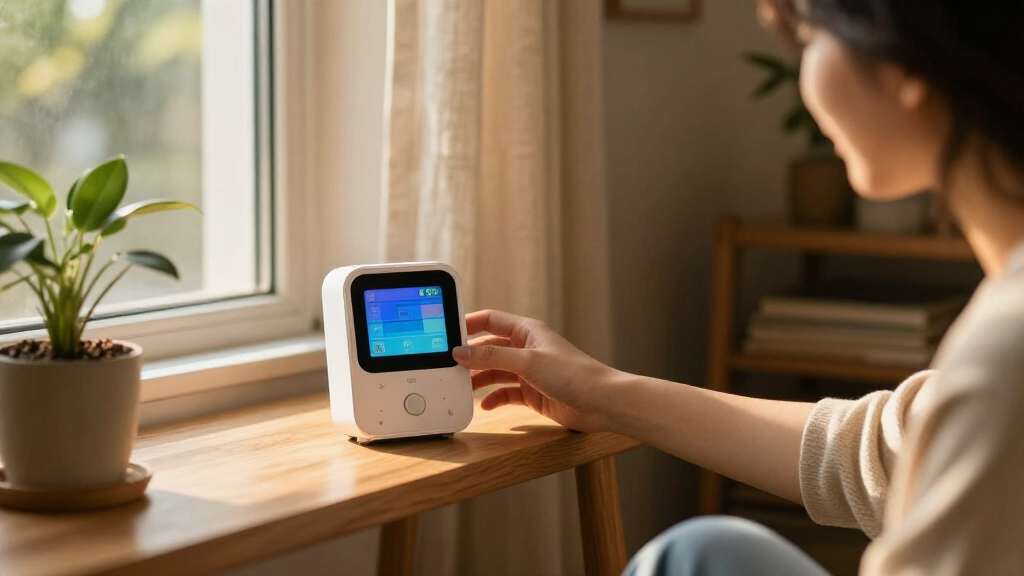
I ranked these indoor air quality monitors by how clearly they serve a real monitoring need, not by advertised sensor count alone. I weighed the type and breadth of measurements, how easily a buyer can read and interpret results, and whether the format suits a fixed room, several rooms, or portable use. I also considered connectivity and ecosystem fit, since app and smart-home features help some households while adding little for buyers who want local readings.
The higher positions go to options with a clearer role in a home-monitoring setup, including dedicated CO2 tracking, smart-home integration, or a defined display and sensor scope. Broadly named 10-in-1 and 16-in-1 units remain useful contenders, but similar product names and repeated listings make exact sensor specifications harder to distinguish from the supplied product information. I treat that uncertainty as a buying drawback: check the precise model and its stated measurements before relying on any monitor for a particular concern.
Factors to Consider When Choosing Indoor Air Quality Monitors
Before choosing among these indoor air quality monitors, decide what action you want the readings to support. A monitor is most useful when its measurements answer a specific household question and its display or app makes that information easy to interpret.
Match the sensor to the question you need answered
Start with the issue you want to track, such as ventilation, particles, or general room conditions. A larger list of advertised measurements can sound reassuring, but it does not mean every reading is equally relevant to your home. Check the exact sensor names and measurement units rather than relying on labels such as 10-in-1 or 16-in-1. If your main concern is CO2, a focused CO2 monitor may be easier to interpret than a device presenting many unrelated values. For broader monitoring, confirm that the specific pollutants you care about are actually listed. Avoid treating a monitor’s reading as a diagnosis or as a substitute for a dedicated safety alarm.
Choose between a screen, an app, or both
A built-in display lets household members check readings without opening a phone, which can matter in shared spaces. Larger screens can make readings easier to see from across a room, though they may take up more surface area. App-connected monitors can support remote checks and longer-term viewing, but those benefits depend on a reliable connection and an app you are willing to use. Before buying, check whether the device can show its core measurements without an account or network connection. A screen-first model suits people who want quick local feedback; app-first models are a better fit when remote access or smart-home routines are part of the plan.
Plan where the monitor will sit
Room placement affects how useful a reading is: a monitor placed beside a window, cooking area, vent, or humidifier may reflect a local condition rather than the room as a whole. Think about whether you need one fixed reference point or want to move a unit between bedrooms, living areas, or a home office. Portable designs make room-to-room checks easier, but repeated movement can make comparisons less consistent. For several frequently used rooms, one device may not answer every question at once. A two-device setup can provide simultaneous readings, while a single portable monitor keeps the setup simpler. Follow the maker’s placement guidance and allow readings to settle after moving the unit.
Decide whether smart-home integration earns its place
Connectivity is useful when it changes what you can do with a reading, such as checking air conditions remotely or using a compatible smart-home routine. It adds less value if you only plan to glance at a device’s screen. Buyers already using Alexa may find an Alexa-compatible monitor easier to fit into an established setup, while others may prefer a standalone option that does not depend on a voice assistant. Check which readings and alerts are available through the app or ecosystem; integration does not guarantee that every sensor value is exposed. Also account for Wi-Fi availability, account setup, and any dependence on cloud services. Choose connected features for a clear purpose, not just because they appear on a product page.
Understand what a reading can and cannot tell you
Indoor monitors provide measurements at one location and point in time, not a complete assessment of every room or exposure. A change in a reading can help you notice a pattern, but it may not identify the source or the right remedy. Check product documentation for measurement ranges, stated accuracy, calibration guidance, and sensor upkeep. These details help you judge whether small changes are meaningful and how much maintenance the device may need. Keep a dedicated smoke or carbon monoxide alarm for life-safety alerts; a general air monitor is not a replacement unless it is specifically certified and designed for that function. When a persistent concern remains, use the monitor as one clue alongside appropriate professional advice.
Compare the full ownership setup, not just the feature list
Consider how the monitor is powered, whether it needs an outlet, and how often a portable unit may need recharging. A device that is easy to leave in place may suit a living room, while a wireless model can be more convenient for checking different spaces. Think about who will read the display and whether the interface is clear enough for everyone in the household. App permissions, software support, and the availability of replacement or calibration guidance also shape long-term usability. If two products seem similar, favor the one with clearer documentation and a more defined sensor list. That practical clarity can matter more than another advertised measurement.
Frequently Asked Questions
Should I choose a 10-in-1 or 16-in-1 indoor air quality monitor?
Choose by the measurements you will use, not the number in the name. A 16-in-1 label does not by itself confirm which sensors are included or how clearly the monitor reports them. Compare the exact measurement list, units, stated accuracy, and maintenance instructions for each model. A simpler monitor can be a better fit if it gives clear readings for your main concern. When listings use similar names, verify the model details before ordering.
Is a CO2 monitor enough to judge whether a room has good air quality?
No single reading describes every aspect of indoor air quality. CO2 can help you observe ventilation patterns, but it does not directly report all pollutants, particles, or humidity conditions. If ventilation is your main concern, a focused CO2 device such as the Aranet4 has a clear role in this lineup. If you are tracking multiple kinds of conditions, look for a monitor whose listed sensors match those concerns. Keep using dedicated safety alarms for hazards they are designed to detect.
Do I need one monitor for every room?
Not always; the right number depends on whether you need simultaneous readings or just occasional room checks. One portable monitor can help compare spaces over time, but moving it means you cannot see conditions in both rooms at once. Separate units are more useful when bedrooms, work areas, or other spaces need ongoing monitoring. Place each device consistently and away from localized sources that could skew readings. If you are unsure, begin by identifying which rooms matter most rather than buying several units by default.
Can an indoor air quality monitor replace a carbon monoxide or smoke alarm?
No, a general-purpose air quality monitor should not be treated as a replacement for a dedicated smoke or carbon monoxide alarm. The listed monitors serve different purposes, and a broad sensor count does not establish that a device is certified for life-safety detection. Keep properly installed alarms designed for those hazards, and follow their testing and replacement instructions. If a monitor listing claims a safety function, verify the exact certification and device requirements directly. Use an air monitor for the readings its manufacturer specifies.
When is a smart or multi-room monitor worth choosing over a standalone unit?
A connected monitor makes more sense when you will use remote checks, app history, alerts, or a compatible smart-home setup. If you only want to read conditions from a nearby screen, those features may add setup without improving your routine. A multi-room approach is useful when comparing rooms at the same time matters, while a portable standalone unit can be moved when needed. Check whether your preferred readings are available in the app and whether the device requires Wi-Fi or an account. Choose the setup that supports a habit you will actually maintain.
Conclusion
For a broad home-monitoring setup, my best overall recommendation is the BREATHE Airmonitor Plus Gen 2; its dedicated monitor positioning makes it a strong starting point among this varied lineup. For best value, compare the listed 10-in-1 and 16-in-1 options by exact sensor list and display needs rather than paying extra for a higher count. The Aranet4 is my best focused pick for buyers who mainly want wireless CO2 tracking, while the Amazon Smart Air Quality Monitor is the more natural beginner choice for an Alexa household seeking connected monitoring. Choose the Amazon two-pack when you want readings from two rooms at once, or a Zemeollo portable model if moving one monitor between spaces matters more. Before deciding, confirm the precise model specifications—especially for the similarly named multi-sensor displays—so the device’s readings match your reason for buying it.