

The best home dehumidifiers balance moisture removal, room coverage, energy use, and the effort needed to empty or drain them. From this lineup, the AEOCKY 5500 Sq. Ft. ENERGY STAR Most Efficient model stands out as the best overall for large, damp spaces, while the Waykar 34-pint model suits many basements and homes without needing a high-capacity unit. For smaller rooms, compact options such as the ToLife 1000 sq. ft. model trade compressor-scale moisture removal for a smaller footprint and simple shutoff features. The main tradeoffs are capacity versus size and energy demand, plus convenience features versus ongoing tank emptying. Read on for the full breakdown, selection criteria, and advice on matching a unit to your space.

Get home appliances delivered free — and shop member deals
- Fast, free delivery on millions of items
- Access to Prime Big Deal Days deals on October 6–7
- Prime Video, Amazon Music and more included
Complete the kit


Key Takeaways
- Large-area compressor models lead for damp basements: the AEOCKY, KNKA, Quilt, and 4500–5500-square-foot options prioritize higher moisture removal and broad coverage, but may be more machine than a small bedroom needs.
- Coverage claims are not a substitute for capacity: the 21-, 26-, 32-, and 34-pint models offer a middle ground, while buyers should match output to actual dampness rather than choosing by square footage alone.
- Continuous drainage matters most during long runs: several compressor models include drain hoses, reducing the need to empty a tank; a hose still needs a suitable drain and a reliable downhill route.
- Small-room models emphasize convenience over heavy-duty drying: the 1000-square-foot options with auto shutoff, sleep modes, or ambient lighting may suit lighter moisture loads, but are not interchangeable with high-capacity basement units.
- The strongest choice depends on the job, not the longest feature list: compare rated moisture removal, intended room size, drainage, noise expectations, and maintenance before treating smart controls or lighting as deciding factors.
| Quilt 4500 Sq. Ft. Compressor Dehumidifier with Drain Hose |  | Best for Large Basements | Coverage area: Up to 4,500 sq. ft. | Dehumidification capacity: 45–80 pints per day | Water tank: 1.72 gallons | VIEW LATEST PRICE | See Our Full Breakdown |
| Waykar 34 Pints 2025 Energy Star Dehumidifier for Home & Basement, Ideal for Spaces up to 2,000 sq. ft., with Auto or Manual Drainage and 0.62-Gallon Water Tank | 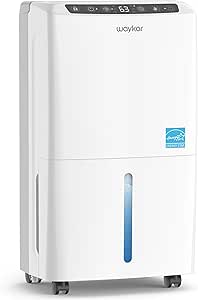 | Best Mid-Size Compressor Pick | Coverage area: Up to 2,000 sq. ft. | Dehumidification capacity: 34 pints per day | Water tank: 0.62 gallons | VIEW LATEST PRICE | See Our Full Breakdown |
| Dehumidifier for Home with Auto Shutoff Sleep Mode, 1000 sq ft |  | Best for Quiet Small Rooms | Stated coverage area: Up to 1,000 sq. ft. | Dehumidification capacity: 1 L per day | Tank capacity: 95 fl. oz. | VIEW LATEST PRICE | See Our Full Breakdown |
| ToLife Dehumidifier for Home Bedroom 1000 sq.ft with Auto Shut-Off, White |  | Best Simple Bedroom Option | Stated floor area: Up to 1,000 sq. ft. | Tank volume: 95 fl. oz. | Technology: Semiconductor condensation | VIEW LATEST PRICE | See Our Full Breakdown |
| NineSky 1000 Sq. Ft. Portable Dehumidifier with 95oz Tank, 7-Color Ambient Light, and Auto Shut-Off |  | Best Portable Pick | Stated coverage area: Up to 1,000 sq. ft. | Dehumidification rate: Up to 34 oz per day at 86°F and 80% RH | Water tank: 95 oz | VIEW LATEST PRICE | See Our Full Breakdown |
| 4500 Sq. Ft. Dehumidifier with Drain Hose, Smart Humidity Control, and Auto Shut-off |  | Best for Quiet, Flexible Whole-Home Use | Coverage area: Up to 4,500 sq. ft. | Dehumidification capacity: Adjustable 45–80 pints | Noise level: 40 dB | VIEW LATEST PRICE | See Our Full Breakdown |
| AEOCKY 5500 Sq.Ft ENERGY STAR Most Efficient 2025 Dehumidifier Max 80 Pint/D |  | Best for Maximum Coverage and Efficiency | Model: RHEA-001 | Dehumidification capacity: 80 pints per day | Coverage area: Up to 5,500 sq. ft. | VIEW LATEST PRICE | See Our Full Breakdown |
| 26-Pint Dehumidifier for Basement and Home with Drain Hose, Covers 2600 sq ft |  | Best Compact Pick for Moderate Moisture | Coverage area: Up to 2,600 sq. ft. | Dehumidification capacity: 26 pints per day | Tank volume: 0.52 gallons | VIEW LATEST PRICE | See Our Full Breakdown |
| Waykar 80 Pints Energy Star Dehumidifier for Large Spaces |  | Best for Easy Mobility and Everyday Controls | Dehumidification capacity: 80 pints per day | Coverage area: Up to 5,000 sq. ft. | Water tank capacity: 3.5 L (0.92 gal.) | VIEW LATEST PRICE | See Our Full Breakdown |
| BEDRED 95OZ Dehumidifier for Home, Quiet with Auto Shut Off & 7 Color Ambient Light, Suitable for 1000 sq ft |  | Best for Bedrooms and Small Personal Spaces | Collection capacity: 95 oz. | Coverage area: Up to 1,000 sq. ft. | Cooling method: Thermoelectric | VIEW LATEST PRICE | See Our Full Breakdown |
| Waykar 80 Pints Dehumidifier for Large Spaces up to 5,000 Sq. Ft, Energy Star Certified |  | Best for Large Homes | Capacity: 80 pints per day | Coverage area: Up to 5,000 sq. ft. | Humidity range: 30%–80% | VIEW LATEST PRICE | See Our Full Breakdown |
| 32-Pint Dehumidifier for Basement and Home, 2600 Sq Ft Coverage with Drain Hose |  | Best for Mid-Size Basements | Capacity: 32 pints per day | Coverage area: 2,600 sq. ft. | Tank size: 2 L | VIEW LATEST PRICE | See Our Full Breakdown |
| KNKA Energy Star 5500 Sq.Ft Dehumidifier for Basement, Max 80 Pint/Day |  | Best for Wide Coverage | Coverage area: 5,500 sq. ft. | Dehumidification capacity: Up to 80 pints per day | Tank capacity: 1.45 gal | VIEW LATEST PRICE | See Our Full Breakdown |
| 21-Pint Dehumidifier for Basement with Drain Hose, 1600 sq ft, White |  | Best Compact Option | Floor area: Up to 1,600 sq. ft. | Capacity: 21 pints per day | Tank volume: 0.52 gal | VIEW LATEST PRICE | See Our Full Breakdown |
| 1600 Sq.Ft Compressor Dehumidifier for Basement, Max 21 Pint/Day |  | Best for Flexible Controls | Floor area: Up to 1,600 sq. ft. | Capacity: Up to 21 pints per day | Tank volume: 2.3 L | VIEW LATEST PRICE | See Our Full Breakdown |
| home dehumidifier | Coverage area | Dimensions | Dehumidification capacity | Noise level |
|---|---|---|---|---|
| Quilt 4500 Sq. Ft. Compressor | Up to 4,500 sq. ft. | 8.6 × 14.6 × 23.8 in. | 45–80 pints per day | 40 dB |
| Waykar 34 Pints 2025 Energy St | Up to 2,000 sq. ft. | 10.87 × 8.39 × 19.3 in. | 34 pints per day | 38 dB |
| Dehumidifier for Home with Aut | — | 7.8 × 4.9 × 13 in. | 1 L per day | — |
| ToLife Dehumidifier for Home B | — | 14 × 6 × 9 in. | — | — |
| NineSky 1000 Sq. Ft. Portable | — | 8.3 × 5.7 × 14 in. | — | — |
| 4500 Sq. Ft. Dehumidifier with | Up to 4,500 sq. ft. | — | Adjustable 45–80 pints | 40 dB |
| AEOCKY 5500 Sq.Ft ENERGY STAR | Up to 5,500 sq. ft. | 14.45 in. D × 8.66 in. W × 24.09 in. H | 80 pints per day | 44 dB at lowest fan speed |
| 26-Pint Dehumidifier for Basem | Up to 2,600 sq. ft. | 6.89 in. D × 10.13 in. W × 16.1 in. H | 26 pints per day | — |
| Waykar 80 Pints Energy Star De | Up to 5,000 sq. ft. | — | 80 pints per day | — |
| BEDRED 95OZ Dehumidifier for H | Up to 1,000 sq. ft. | — | — | — |
| Waykar 80 Pints Dehumidifier f | Up to 5,000 sq. ft. | — | — | 42 dB |
| 32-Pint Dehumidifier for Basem | 2,600 sq. ft. | — | — | 39–42 dB |
| KNKA Energy Star 5500 Sq.Ft De | 5,500 sq. ft. | — | Up to 80 pints per day | 40–45 dB |
| 21-Pint Dehumidifier for Basem | — | 6.89 in D × 9.65 in W × 15.94 in H | — | — |
| 1600 Sq.Ft Compressor Dehumidi | — | 7.2 in D × 13.2 in W × 17.1 in H | — | 40 dB |
More Details on Our Top Picks
Quilt 4500 Sq. Ft. Compressor Dehumidifier with Drain Hose
I’d choose the Quilt 4500 when the main job is controlling moisture across a large basement, garage, or open-plan home. Its stated 45–80-pint daily capacity and coverage up to 4,500 square feet give it a different purpose from the smaller Waykar 34 Pints, which is aimed at spaces up to 2,000 square feet. A continuous drain hose can reduce tank-emptying chores near a floor drain, while the 1.72-gallon tank offers a backup when hose drainage is inconvenient. At 40 dB, it is specified to run quietly for a compressor model, and Energy Star certification is a useful efficiency marker. The tradeoffs are its plastic construction and substantial 23.8-inch height; I’d skip it for a cramped room or for anyone seeking a compact bedside unit.
Pros:- Rated for spaces up to 4,500 square feet, with a stated capacity of up to 80 pints per day.
- Tank and included drain hose offer both portable and continuous drainage.
- 40 dB operating-noise specification and sleep mode suit areas where noise matters.
- Energy Star certification and auto-defrost and overload protections.
Cons:- Plastic construction may feel less robust than a metal-bodied appliance.
- Its 23.8-inch height and broad footprint can be awkward in tight spaces.
- The 1.72-gallon tank still needs emptying when continuous drainage is not used.
Best for: Homeowners managing dampness across a large basement, garage, or multi-room area who can use hose drainage.
Not ideal for: People with tight placement space or small bedrooms; its large body and high-capacity compressor design are more than those settings need.
- Coverage area:Up to 4,500 sq. ft.
- Dehumidification capacity:45–80 pints per day
- Water tank:1.72 gallons
- Noise level:40 dB
- Dimensions:8.6 × 14.6 × 23.8 in.
- Weight:10 lb
- Humidity range:30%–80%
- Certification:Energy Star
Our verdict“Choose the Quilt for broad-area moisture control and hose drainage, but pick a smaller unit if easy placement matters more than capacity.”
Waykar 34 Pints 2025 Energy Star Dehumidifier for Home & Basement, Ideal for Spaces up to 2,000 sq. ft., with Auto or Manual Drainage and 0.62-Gallon Water Tank
The Waykar 34 Pints fills the middle ground between compact room units and the Quilt 4500, which is designed for much larger spaces. Its 2,000-square-foot coverage and 34-pint daily capacity suit a basement or several connected rooms without stepping up to the Quilt’s larger format. The 38 dB noise specification, two fan speeds, and humidity adjustment give buyers more control over everyday operation; auto, manual, and continuous drainage also let it adapt to the room setup. A key compromise is the 0.62-gallon tank: in damp conditions, expect more frequent emptying unless continuous drainage is practical. It weighs 22.1 pounds, so despite its relatively compact dimensions, it is not as easy to move around as the small OWAAE unit. I’d favor this Waykar for sustained household moisture control, not for portability or app-based control.
Pros:- 34-pint daily capacity and coverage up to 2,000 square feet suit mid-size home spaces.
- Continuous, manual, and automatic drainage options.
- 38 dB noise specification, with two fan speeds and adjustable humidity.
- Auto shutoff, child lock, and defrost and safety protections.
Cons:- The 0.62-gallon tank can require frequent emptying in humid conditions.
- At 22.1 pounds, it is heavier than compact room-focused alternatives.
- No built-in Wi-Fi or remote smart connectivity.
Best for: Households with a moderately sized basement or connected living areas that want compressor performance and flexible drainage.
Not ideal for: Buyers who need a large collection tank, lightweight room-to-room portability, or Wi-Fi monitoring.
- Coverage area:Up to 2,000 sq. ft.
- Dehumidification capacity:34 pints per day
- Water tank:0.62 gallons
- Noise level:38 dB
- Wattage:190 W
- Dimensions:10.87 × 8.39 × 19.3 in.
- Weight:22.1 lb
- Operating modes:Dehumidify, Dry, Continuous
Our verdict“Pick the Waykar 34 Pints for a mid-size area that needs compressor capacity and drainage flexibility, not for lightweight portability or smart-home control.”
Dehumidifier for Home with Auto Shutoff Sleep Mode, 1000 sq ft
For a bedroom, nursery, closet, or RV, I’d put the OWAAE compact dehumidifier ahead of the larger compressor models when low noise and easy placement matter most. Its sleep-mode specification is under 30 dB, and the 2.4 kg body with a built-in handle is easier to relocate than the 22.1-pound Waykar 34 Pints. That convenience comes with a major capacity difference: this unit removes 1 liter per day, so its stated 1,000-square-foot coverage should not be read as equivalent to a compressor’s moisture-removal capability in a very damp basement. The 95-ounce tank also needs attention as it fills, though automatic shutoff helps prevent overflow. Its colored ambient light may suit some bedrooms but is unnecessary for buyers who want a plain utility appliance. I’d choose it for gentle, localized moisture management, not serious whole-basement dampness.
Pros:- Sleep mode is specified below 30 dB.
- Lightweight body and built-in handle make it easy to move.
- Automatic shutoff helps prevent tank overflow.
- Low 85-watt draw and compact dimensions suit small rooms.
Cons:- Removes only 1 liter of moisture per day, far below the compressor units in this lineup.
- The 95-ounce tank may need regular emptying.
- No smart or Wi-Fi connectivity for remote operation.
Best for: Light sleepers, RV owners, and people managing mild moisture in a small bedroom, bathroom, closet, or nursery.
Not ideal for: Owners of persistently damp basements or large spaces needing high daily moisture removal; its 1-liter-per-day capacity is modest.
- Stated coverage area:Up to 1,000 sq. ft.
- Dehumidification capacity:1 L per day
- Tank capacity:95 fl. oz.
- Wattage:85 W
- Voltage:220 V
- Sleep-mode noise:Under 30 dB
- Dimensions:7.8 × 4.9 × 13 in.
- Weight:2.4 kg
Our verdict“Choose the OWAAE for quiet, portable use and mild room-level dampness, but use a compressor model for a wet basement.”
ToLife Dehumidifier for Home Bedroom 1000 sq.ft with Auto Shut-Off, White
The ToLife 1000 sq. ft. is a straightforward choice for buyers who want a small-room dehumidifier with basic controls rather than a high-capacity basement appliance. Its semiconductor condensation system, two operating modes, and automatic shutoff are aimed at bedroom and living-space use; the seven-color light adds an optional ambient feature. Compared with the OWAAE, it lists a similar 95-ounce tank and 1,000-square-foot coverage, but the available specifications do not give a measured noise level or daily moisture-removal rate. That makes it harder to judge whether it will keep pace with a damp room, and harder to compare its performance directly with the compressor-based Waykar 34 Pints. The 2.66 kg weight supports occasional repositioning, but the tank still needs manual attention. I’d consider it for mild, localized moisture—not as a substitute for a compressor unit in a wet basement.
Pros:- Two operating modes provide a simple choice for room use.
- Automatic shutoff helps prevent overflow when the tank fills.
- Seven-color ambient light can double as a bedroom accent.
- Lightweight 2.66 kg body is easier to reposition than a full-size compressor unit.
Cons:- No daily moisture-removal rate is provided, making performance harder to compare.
- No measured noise specification is listed.
- The 95-ounce tank requires manual emptying and coverage is limited to the stated 1,000 square feet.
Best for: Bedroom or living-space users who want a compact, simple unit with two modes, automatic shutoff, and ambient lighting.
Not ideal for: Buyers who need verified daily moisture-removal capacity, a quantified noise level, or robust basement dehumidification.
- Stated floor area:Up to 1,000 sq. ft.
- Tank volume:95 fl. oz.
- Technology:Semiconductor condensation
- Operating modes:2
- Wattage:93 W
- Dimensions:14 × 6 × 9 in.
- Weight:2.66 kg
- Color:White
Our verdict“Choose the ToLife for basic bedroom moisture management and simple controls, but look to the Waykar 34 Pints for measurable, higher-capacity performance.”
NineSky 1000 Sq. Ft. Portable Dehumidifier with 95oz Tank, 7-Color Ambient Light, and Auto Shut-Off
The NineSky makes the most sense when a buyer values easy carrying and clear capacity information over the stronger moisture removal of a compressor dehumidifier. Its 5.9-pound weight and built-in handle suit occasional moves between a bathroom, closet, or RV, while auto shutoff protects against an overflowing 95-ounce tank. Unlike the ToLife, NineSky specifies a daily rate—up to 34 ounces under stated warm, humid test conditions—so buyers have a clearer, though still modest, performance reference. That figure is far below the pint-per-day capacities of the Waykar 34 Pints and Quilt 4500, making this a poor match for persistent basement dampness despite the stated 1,000-square-foot coverage. The seven-color light may be useful as a night light, but the tank will need regular emptying in humid conditions. I’d treat it as a portable, light-duty room option rather than a whole-home solution.
Pros:- At 5.9 pounds, it is lighter and easier to carry than the OWAAE.
- Lists a daily removal rate of up to 34 oz under specified warm, humid conditions.
- Auto shutoff helps guard against overflow from the 95-ounce tank.
- Built-in handle and seven-color ambient light support flexible room use.
Cons:- Daily moisture removal is modest compared with the Waykar 34 Pints and Quilt 4500.
- The 95-ounce tank may need frequent emptying in humid conditions.
- Its stated 1,000-square-foot coverage does not make it equivalent to a compressor unit for heavy moisture loads.
Best for: People who want a lightweight unit they can carry between a bathroom, closet, RV, or other small area with mild moisture.
Not ideal for: Homeowners tackling persistent dampness or a large basement; its stated 34-ounce daily removal rate is far below the compressor picks.
- Stated coverage area:Up to 1,000 sq. ft.
- Dehumidification rate:Up to 34 oz per day at 86°F and 80% RH
- Water tank:95 oz
- Dimensions:8.3 × 5.7 × 14 in.
- Weight:5.9 lb
- Operation mode:Automatic
- Features:Auto shutoff, 7-color ambient light, portable handle
- Color:Black
Our verdict“Pick the NineSky for lightweight, occasional room-to-room use, but choose a compressor dehumidifier for sustained dampness or basement duty.”
4500 Sq. Ft. Dehumidifier with Drain Hose, Smart Humidity Control, and Auto Shut-off
For a large basement or several connected rooms where noise matters, this model pairs up to 80-pint capacity with a stated 40 dB operating level. That makes it a quieter-sounding choice on paper than the AEOCKY 5500 Sq.Ft model, which lists 44 dB at its lowest fan speed, though the AEOCKY covers a larger area and offers 80 pints per day as a defined capacity. The removable tank and included drain hose give this unit a useful choice: empty it by hand when placement is flexible, or set up continuous drainage near a floor drain. Its auto-defrost and child lock add practical safeguards. The tradeoff is its large footprint, and without the hose, tank emptying remains part of regular upkeep.
Pros:- Rated for spaces up to 4,500 sq. ft. with adjustable 45–80-pint moisture control.
- 40 dB operating noise is suited to homes where a louder appliance would be disruptive.
- Removable tank and included hose allow manual or continuous drainage.
- Auto shut-off, child lock, and auto-defrost add useful operating safeguards.
Cons:- Its large size may be awkward in small rooms or narrow basement areas.
- The tank still needs manual emptying when continuous drainage is not set up.
- The listed capacity is a range rather than a single daily extraction figure.
Best for: Households managing moisture across a large basement or connected rooms that want quieter operation and a choice of tank or hose drainage.
Not ideal for: People with tight floor space or buyers who cannot route a drain hose and do not want to empty a water tank manually.
- Coverage area:Up to 4,500 sq. ft.
- Dehumidification capacity:Adjustable 45–80 pints
- Noise level:40 dB
- Certification:ENERGY STAR 2026
- Drainage:Removable tank and drain hose
- Controls:One-touch panel, 24-hour timer, and 5 modes
- Safety features:Auto shut-off, child lock, and auto-defrost
Our verdict“Choose this model for a large home area where quieter operation and flexible drainage matter more than compact size.”
AEOCKY 5500 Sq.Ft ENERGY STAR Most Efficient 2025 Dehumidifier Max 80 Pint/D
The AEOCKY RHEA-001 is the strongest fit here for buyers who want a clearly stated 80-pint daily capacity across the broadest listed area: up to 5,500 sq. ft. Its ENERGY STAR Most Efficient 2025 certification makes energy efficiency a central differentiator, while its stated operation down to 65°F suits basements that are cool but not cold. Compared with the 4,500-square-foot model in this roundup, it covers more area, but its listed noise level is 44 dB at the lowest fan speed rather than 40 dB. The durable copper components are another stated build feature, though they do not remove the learning curve that may come with its advanced controls. Its 31-pound weight and substantial height also make it less appealing for compact rooms or frequent repositioning.
Pros:- 80-pint-per-day capacity and coverage up to 5,500 sq. ft. suit large spaces.
- ENERGY STAR Most Efficient 2025 certification highlights its efficiency focus.
- Specified for operation in temperatures down to 65°F.
- Copper components are identified as part of its durable construction.
Cons:- At 31 pounds and over 24 inches tall, it may be cumbersome in small rooms.
- Its 44 dB lowest-fan rating is higher than the 40 dB figure listed for the 4,500-square-foot model.
- Advanced features may take time to learn, and the product data notes a higher initial cost.
Best for: Owners of large basements or open-plan homes who prioritize broad coverage, energy-efficiency certification, and operation in mildly cool spaces.
Not ideal for: Small-room buyers, people who need a lightweight unit to move often, or anyone seeking especially simple controls.
- Model:RHEA-001
- Dehumidification capacity:80 pints per day
- Coverage area:Up to 5,500 sq. ft.
- Certification:ENERGY STAR Most Efficient 2025
- Dimensions:14.45 in. D × 8.66 in. W × 24.09 in. H
- Weight:31 lb.
- Noise level:44 dB at lowest fan speed
- Low-temperature operation:Down to 65°F
Our verdict“Pick the AEOCKY if you need the roundup’s broadest stated coverage and value its efficiency focus more than compact size or the simplest setup.”
26-Pint Dehumidifier for Basement and Home with Drain Hose, Covers 2600 sq ft
This 26-pint model fills the middle ground between small thermoelectric units such as the BEDRED 95OZ and high-capacity basement machines such as the Waykar 80 Pints. Its 2,600-square-foot coverage claim and automatic humidity control make it more appropriate for a sizable room or moderate moisture problem than a bedroom-focused compact unit. At 16.1 pounds, with handles and wheels listed among its advantages, it should be easier to reposition than the large-capacity options. Continuous, Dry, and Dehumidify modes offer some flexibility, and the drain hose can reduce tank-emptying chores. The main limitation is its 0.52-gallon tank: high humidity can mean frequent emptying if the hose is not used. Its 130-watt rating and unspecified noise level also leave less certainty for demanding or quiet-room use.
Pros:- Listed coverage of up to 2,600 sq. ft. suits a larger room or moderate moisture needs.
- At 16.1 pounds, it is lighter than the large-capacity models in this group.
- Continuous, Dry, and Dehumidify modes provide different operating options.
- Automatic humidity control and dual drainage help reduce day-to-day management.
Cons:- The 0.52-gallon tank can need frequent emptying in humid conditions without hose drainage.
- Its 26-pint capacity is below the 80-pint models for persistent or widespread dampness.
- Noise level is not specified, and the 130-watt rating may limit suitability for demanding spaces.
Best for: Renters or homeowners who need a portable unit for a moderately damp large room and can use the drain hose or empty a small tank regularly.
Not ideal for: People dealing with severe basement dampness across multiple rooms, or buyers who need a published noise figure for a quiet bedroom.
- Coverage area:Up to 2,600 sq. ft.
- Dehumidification capacity:26 pints per day
- Tank volume:0.52 gallons
- Power:130 watts
- Operation modes:Continuous, Dry, and Dehumidify
- Speeds:2
- Dimensions:6.89 in. D × 10.13 in. W × 16.1 in. H
- Weight:16.1 lb.
- Material:ABS
Our verdict“Choose this portable mid-capacity option for moderate moisture in a larger room, but favor an 80-pint unit for a persistently damp basement.”
Waykar 80 Pints Energy Star Dehumidifier for Large Spaces
Waykar’s 80-pint unit is aimed at large homes, with capacity for up to 5,000 sq. ft. and a set of features that emphasize routine convenience: an LCD control panel, 24-hour timer, auto-defrost, self-drying, and casters. Compared with the AEOCKY 5500 Sq.Ft model, it covers a smaller listed area, but its four casters and top handle make moving it between rooms straightforward. The 3.5-liter tank offers a backup when hose drainage is unavailable, though it may need frequent emptying in high humidity. A 3.3-foot drain hose supports continuous drainage, but its reach may constrain placement. This Waykar is ENERGY STAR certified, yet the product data says performance can fall below 41°F, making it a less suitable choice for very cold, unheated spaces.
Pros:- 80-pint daily capacity and coverage up to 5,000 sq. ft. suit large areas.
- ENERGY STAR certification supports an efficiency-conscious choice.
- Auto-defrost, self-drying, and a 24-hour timer support routine operation.
- Four casters and a top handle make repositioning easier.
Cons:- The 3.5-liter tank may need frequent emptying during heavy moisture removal.
- The included 3.3-foot drain hose may limit placement relative to a drain.
- The product data notes reduced performance below 41°F, limiting use in very cold spaces.
Best for: Households with a large basement or living area that want a full-capacity unit they can roll between rooms and operate through an LCD panel.
Not ideal for: People dehumidifying an unheated space that regularly falls below 41°F, or buyers who need a larger tank or longer drain hose.
- Dehumidification capacity:80 pints per day
- Coverage area:Up to 5,000 sq. ft.
- Water tank capacity:3.5 L (0.92 gal.)
- Certification:ENERGY STAR certified
- Defrost and drying:Auto-defrost and self-drying
- Controls and timer:LCD display with smart features; 24-hour timer
- Mobility:Four casters and top handle
- Drain hose length:3.3 ft.
Our verdict“Choose this Waykar for large spaces where rolling mobility and everyday controls matter more than maximum coverage or cold-room performance.”
BEDRED 95OZ Dehumidifier for Home, Quiet with Auto Shut Off & 7 Color Ambient Light, Suitable for 1000 sq ft
The BEDRED takes a different approach from compressor models like the Waykar 80 Pints: it uses thermoelectric cooling and is positioned for quieter use in smaller spaces, with sleep mode, auto shut-off, and a seven-color ambient light. That mix is better suited to a bedroom, RV, or small living area than a damp, expansive basement. Its 95-ounce capacity and stated coverage of up to 1,000 sq. ft. provide a compact alternative to the heavier, higher-capacity machines, but the product data gives no pint-per-day extraction rate. Thermoelectric units may also remove moisture less effectively in very humid conditions, so this is not a substitute for an 80-pint compressor dehumidifier when moisture is persistent. The colored light is an optional style feature, not a reason to choose it for serious moisture control.
Pros:- Thermoelectric cooling and sleep mode are positioned for quieter use.
- Auto shut-off helps prevent continued operation when the collection tank is full.
- Compact design is more appropriate for bedrooms, living rooms, and RVs than large compressor units.
- Seven-color ambient lighting can be turned to personal preference.
Cons:- Thermoelectric cooling may be less effective in very humid conditions than the Waykar compressor model.
- The 1,000-square-foot coverage claim is limited compared with the large-area units in this roundup.
- No daily pint-removal rate is provided, making moisture-control capacity harder to compare.
Best for: Bedroom, RV, or small-room users who want a compact unit with sleep mode and automatic shut-off for mild moisture concerns.
Not ideal for: Owners of damp basements or very humid homes who need a specified high daily extraction capacity or stronger moisture removal.
- Collection capacity:95 oz.
- Coverage area:Up to 1,000 sq. ft.
- Cooling method:Thermoelectric
- Sleep mode:Yes
- Auto shut-off:Yes
- Ambient lighting:7 colors
Our verdict“Pick the BEDRED for mild moisture in a small, quiet-use space, not for a persistently damp basement.”
Waykar 80 Pints Dehumidifier for Large Spaces up to 5,000 Sq. Ft, Energy Star Certified
For a large basement or open-plan lower level, I’d put this Waykar ahead of the smaller 32-Pint Dehumidifier for Basement and Home because its stated capacity reaches 80 pints per day and its coverage extends to 5,000 square feet. The 42 dB operation is a useful counterpoint to that high output if the unit will sit near living areas. Smart humidity control and airflow swing offer more adjustment than a basic set-and-forget machine, though the additional controls may take new owners longer to learn. Its 4.3-liter tank is modest for a high-capacity unit, so very damp spaces may call for frequent emptying unless you use the drain hose. I’d choose it over the 21-pint models for broad, persistent moisture problems, but not for a tight room with little floor space.
Pros:- Rated to remove up to 80 pints of moisture per day for demanding conditions.
- Coverage is listed up to 5,000 square feet.
- Energy Star certification and smart humidity control support managed operation.
- 42 dB noise level is relatively restrained for a high-capacity model.
Cons:- Large size can be difficult to place in a crowded room.
- The 4.3-liter tank may need frequent emptying in very humid conditions.
- Multiple controls may require a learning period.
Best for: Homeowners managing persistent dampness across a large basement or connected living area who can accommodate a full-size unit and use continuous drainage.
Not ideal for: People with a small room or limited space for placement, or buyers who want a large reservoir and minimal control setup.
- Capacity:80 pints per day
- Coverage area:Up to 5,000 sq. ft.
- Humidity range:30%–80%
- Water tank capacity:4.3 L (1.14 gal)
- Noise level:42 dB
- Drain hose length:3.3 ft
- Certification:Energy Star
Our verdict“Choose this Waykar for a large, persistently damp area where high extraction capacity matters more than compact size.”
32-Pint Dehumidifier for Basement and Home, 2600 Sq Ft Coverage with Drain Hose
This 32-pint model fills the gap between the high-output 80-pint Waykar and the smaller 21-pint units: it is rated for 2,600 square feet, making it a better fit for a substantial basement that does not call for the largest machines. Its 39–42 dB noise range, child lock, and three operating modes make it more adaptable around family spaces than a bare-bones basement unit. A washable filter and caster wheels also help with routine upkeep and repositioning. The tradeoff is the 2-liter tank, which is small relative to its stated coverage; continuous drainage is the more practical setup if humidity is high. Unlike the 80-pint KNKA, it has no listed Energy Star certification or smart-home connectivity, so I’d favor it for straightforward operation rather than maximum capacity or connected controls.
Pros:- 32-pint daily capacity and stated coverage up to 2,600 square feet suit mid-size areas.
- Three modes provide options for humidity control and drying.
- Drain hose and auto-shutoff tank offer two ways to manage collected water.
- Washable filter, caster wheels, and child lock support regular household use.
Cons:- The 2-liter tank can fill quickly in damp conditions.
- No Wi-Fi or smart-home connectivity is listed.
- Its physical size may be awkward in very small rooms.
Best for: Households with a mid-size basement or several connected rooms that want mobile operation, family-friendly controls, and a hose-drain option.
Not ideal for: Owners tackling very large or severely damp spaces, or buyers who require Wi-Fi controls or a larger tank for infrequent emptying.
- Capacity:32 pints per day
- Coverage area:2,600 sq. ft.
- Tank size:2 L
- Noise level:39–42 dB
- Drain hose length:39.4 in
- Modes:DEHU, CONT, DRY
- Additional features:Auto-restart, child lock, auto-defrost, 24-hour timer
Our verdict“Pick this model for a mid-size basement where mobility and simple household controls matter more than top-tier capacity.”
KNKA Energy Star 5500 Sq.Ft Dehumidifier for Basement, Max 80 Pint/Day
The KNKA is the broadest-coverage pick in this group, with a stated reach of 5,500 square feet and up to 80 pints of daily extraction. That makes it a stronger match than the 32-Pint Dehumidifier for Basement and Home when moisture spans a large basement, while its 40–45 dB noise range is intended to remain workable near bedrooms and living areas. Energy Star certification, real-time humidity monitoring, and Auto, Dry, and Set modes give it a useful balance of capacity and control. Its main compromise is the included 1.45-gallon tank: an optional 2.64-gallon external tank is sold separately, so continuous drainage or extra equipment may be needed for unattended operation. I’d choose it over the Waykar 80-pint model when the larger stated coverage matters, but check the setup and upright-rest requirements before planning first use.
Pros:- Rated for up to 80 pints per day across a stated 5,500-square-foot area.
- Energy Star certification supports energy-conscious operation.
- Humidity monitoring and three control modes help tailor operation.
- 6.56-foot drain hose supports flexible continuous drainage.
Cons:- The optional 2.64-gallon external tank is sold separately.
- Humidity readings may differ slightly from an external hygrometer.
- Requires 24 hours upright before first use.
Best for: Owners of very large basements or connected spaces who want 80-pint capacity, Energy Star certification, and broad stated coverage.
Not ideal for: Buyers who want a large external tank included, need a compact unit, or cannot allow the unit to stand upright for 24 hours before first use.
- Coverage area:5,500 sq. ft.
- Dehumidification capacity:Up to 80 pints per day
- Tank capacity:1.45 gal
- External tank capacity:2.64 gal; sold separately
- Drain hose length:6.56 ft
- Noise level:40–45 dB
- Control modes:Auto, Dry, Set
- Humidity range:30%–80%
- Power certification:Energy Star
Our verdict“Choose the KNKA when wide stated coverage and efficient 80-pint capacity outweigh the need to arrange your preferred drainage setup.”
21-Pint Dehumidifier for Basement with Drain Hose, 1600 sq ft, White
Among these picks, this 21-pint model is the clearest fit for a smaller basement or bedroom where a large compressor unit would be excessive. Its listed dimensions—6.89 inches deep, 9.65 inches wide, and 15.94 inches high—and 15.3-pound weight point to easier placement and movement than the high-capacity Waykar or KNKA. At a stated 34 dB, it also has the lowest noise figure in this group, which may matter when it runs near sleep or work areas. Dehumidify, Dry, and Continuous modes add flexibility, but the 21-pint daily capacity is not meant to keep pace with major moisture problems across a large footprint. The 0.52-gallon tank also makes a drain connection useful for longer runs. I’d select it over the similar-capacity 1600 Sq.Ft Compressor Dehumidifier when low reported noise and compact dimensions lead the brief.
Pros:- Compact listed dimensions and 15.3-pound weight ease placement and movement.
- 34 dB stated noise level suits use near bedrooms and quiet living areas.
- Three modes include continuous operation and a drying setting.
- Auto defrost supports operation in cooler conditions.
Cons:- 21-pint daily capacity may fall short in severe humidity.
- The 0.52-gallon tank needs regular emptying without continuous drainage.
- Control-panel features may take time to learn.
Best for: People managing moderate dampness in a bedroom, nursery, or smaller basement who value a compact, lightweight unit and low stated noise.
Not ideal for: Owners of very humid or expansive spaces who need higher daily extraction, or anyone unwilling to empty a small tank or set up continuous drainage.
- Floor area:Up to 1,600 sq. ft.
- Capacity:21 pints per day
- Tank volume:0.52 gal
- Number of speeds:2
- Wattage:120 W
- Dimensions:6.89 in D × 9.65 in W × 15.94 in H
- Weight:15.3 lb
- Material:Acrylonitrile Butadiene Styrene (ABS)
Our verdict“Choose this compact 21-pint unit for a quieter, smaller space with moderate dampness, not for a large or heavily wet basement.”
1600 Sq.Ft Compressor Dehumidifier for Basement, Max 21 Pint/Day
This compressor model shares the 21-pint capacity and 1,600-square-foot coverage of the compact white dehumidifier, but its feature set leans more toward adjustable household operation. A digital display, adjustable humidity control, timer, child lock, auto-restart, and washable filter make it the more control-focused choice; the other 21-pint model instead has a notably smaller listed footprint and a lower stated noise level. At 40 dB, this unit remains a plausible fit for living areas, though it is not the quieter pick of the pair. Its 2.3-liter removable tank and continuous-drain option provide flexibility, but the reservoir still calls for regular attention when no hose is connected. I’d choose it for a mid-size room where automatic settings and safety features matter more than minimizing dimensions or noise.
Pros:- Adjustable humidity control and digital display provide more direct control.
- Automatic defrost, shutoff, and restart reduce the need for manual oversight.
- Continuous drainage and a removable tank accommodate different setups.
- Child lock, timer, and washable filter add useful household features.
Cons:- 21-pint daily capacity is not suited to severe moisture or very large areas.
- The 2.3-liter tank still requires emptying when continuous drainage is not used.
- At 40 dB, it is louder on paper than the other 21-pint model in this lineup.
Best for: Households with a moderately damp basement or living area that want adjustable humidity, a digital display, and multiple automatic safety features.
Not ideal for: People needing high-capacity moisture removal, the quietest option for a bedroom, or the smallest unit for a tight space.
- Floor area:Up to 1,600 sq. ft.
- Capacity:Up to 21 pints per day
- Tank volume:2.3 L
- Wattage:80 W
- Dimensions:7.2 in D × 13.2 in W × 17.1 in H
- Noise level:40 dB
- Features:Adjustable humidity control, automatic defrost, automatic shutoff, automatic restart, child lock, digital display, timer, washable filter
- Drainage:Removable tank or continuous draining
Our verdict“Pick this 21-pint model for a mid-size space where adjustable controls and automatic protections matter more than the quietest or most compact design.”

How We Picked
I compared the 15 listed models by the jobs buyers are most likely trying to solve: removing persistent basement dampness, managing humidity across a larger home, or keeping a smaller room more comfortable. The ranking gives priority to stated moisture-removal capacity and intended coverage, then weighs practical ownership details such as hose drainage, tank capacity when specified, auto shutoff, sleep modes, and energy certifications. I treated square-foot coverage as a guide rather than a guarantee, since real results depend on room conditions, moisture sources, and how the unit is installed.
I placed high-capacity compressor units near the top for buyers facing substantial dampness, while mid-capacity models rank well for more typical home use and smaller units are reserved for lighter loads or compact spaces. Where several listings have similar coverage or capacity, drainage and clear usability features help distinguish them. Product names alone do not establish noise levels, build quality, or performance under every condition, so I avoid treating unverified claims as proof; buyers should check the current specification label and instructions before purchase.
Factors to Consider When Choosing Best Home Dehumidifiers
Before choosing among these home dehumidifiers, start with the moisture problem rather than the headline coverage number. A unit that runs constantly in an undersized or poorly drained space can be less convenient than a correctly matched model with a hose connection. These factors help narrow the field beyond the differences covered in the individual picks.
Match Capacity to the Moisture Problem
Room area gives you a starting point, but it does not describe how wet the space is. A cool basement with occasional mustiness may need less capacity than a similarly sized room with damp walls, laundry drying indoors, or recurring water intrusion. Think about how quickly humidity returns after airing out the room and whether the unit must run for hours each day. A larger model can remove moisture faster, but it may take up more floor space and use more power while operating. Do not treat a coverage figure as a promise that one unit will handle connected rooms, closed doors, or severe dampness. Address leaks and drainage problems first; a dehumidifier cannot repair the source of moisture.
Decide How You Will Handle Collected Water
Tank size and drainage determine how much hands-on care a dehumidifier needs. A tank with auto shutoff can prevent overflow when it fills, but it also stops moisture removal until someone empties it. A drain hose can support longer unattended operation, provided the hose reaches a drain and slopes continuously downward. Check whether the intended location has a floor drain, sink, or other safe outlet before paying extra for hose drainage. For a room without a suitable drain, easy tank access and a manageable tank capacity may matter more than continuous-drain capability. Clear the tank and filter as directed, since neglected maintenance can reduce airflow and create unpleasant odors.
Use Energy Claims and Operating Time Together
Energy certification can help distinguish models, but it does not tell you the full cost of running one in your home. A higher-capacity unit may remove moisture more quickly, while a smaller unit could need longer operating periods in a challenging space. Compare the product’s rated capacity and energy information under the same testing conditions, rather than assuming that similar coverage means similar efficiency. A humidity control setting can also reduce unnecessary operation by stopping or slowing the unit near your chosen target. If the dehumidifier will run most days, check its power requirements and make sure the outlet and circuit suit the manufacturer’s instructions. The lowest-capacity choice is not always the least costly to operate if it struggles to keep up.
Set Realistic Expectations for Noise and Room Placement
A compressor dehumidifier has moving parts and airflow, so a model intended for a basement may be distracting beside a bed or desk. Sleep mode and low-speed settings can help, but they do not make every unit silent. Place the machine on a level surface with the clearance recommended in its manual so air can circulate freely. Avoid hiding it in a tight closet or pushing it against furniture, which can restrict airflow and limit performance. If you need moisture control in a bedroom, prioritize a suitable size, accessible controls, and a return policy that lets you judge sound in the room. Decorative lighting may be a bonus, but it should not outweigh the basics of capacity and placement.
Choose Features That Solve a Real Routine
Features are most useful when they remove a recurring hassle. Auto shutoff is valuable if the tank might fill while you are away, while a timer or humidity control can help manage when the machine runs. A hose connection is a practical upgrade for a basement used every day, but it adds setup work and depends on a nearby drain. Portability matters if you plan to move one unit between rooms; check the listed weight and handle design instead of assuming that a compact-looking product is easy to carry. Ambient lighting may suit a bedroom or shared space, yet it does not improve drying capacity. Choose the shortest feature list that fits your routine rather than paying attention to extras simply because they are listed.
Know When to Pay More for Capacity
Paying for a higher-capacity model makes sense when a large or persistently damp area needs frequent moisture removal and the unit can drain continuously. It is harder to justify for a small room with occasional humidity, where a smaller model may be easier to place and manage. Before stepping up, check whether the stated capacity is measured under conditions similar to yours and whether the product specifies the intended coverage. If the room has several connected sections, a single unit may not circulate air effectively through all of them. Spending more on capacity does not replace fixing leaks, improving ventilation, or using a correctly positioned drain hose. Buyers with modest moisture needs should favor a well-matched unit over unused capacity.
Frequently Asked Questions
Should I choose a dehumidifier by square-foot coverage or pints per day?
Use both figures, but give them different jobs: coverage suggests the room scale, while pints per day indicates stated moisture-removal capacity under specified conditions. A large coverage claim cannot tell you how well a unit will cope with a particularly damp basement. Compare capacity figures only when they use the same measurement standard, and check the conditions behind the rating when available. Then consider whether the space is lightly damp, persistently humid, or affected by a continuing moisture source. If a leak or water intrusion is present, repair it rather than relying on a larger dehumidifier.
Is a drain hose worth choosing over a tank-only model?
A hose is most useful when the dehumidifier will run for long periods and a suitable drain is nearby. It can spare you repeated tank emptying, but the hose must fit correctly and drain downhill without kinks or rising sections. If there is no drain in the room, the hose feature may add little convenience, and a tank with auto shutoff may be the simpler choice. Check the manual for the recommended hose setup and any limits on unattended operation. Whichever method you use, confirm that water can leave the unit safely before leaving it running.
Can one home dehumidifier handle a basement and the rooms above it?
Usually, one unit works best in the area where it can circulate air freely, not across a closed floor or several separated rooms. Walls, doors, stairs, and changes in temperature can limit how far dry air travels. If basement humidity is the main issue, place the unit there and judge its performance in that space rather than expecting it to control the whole home. For connected areas, open circulation paths may help, but they do not guarantee even humidity everywhere. A separate unit may be a better fit when distinct rooms have their own moisture problems.
Will an energy-efficient model always use less electricity than a smaller unit?
No single label settles the question because power use also depends on capacity, operating conditions, and how long the machine runs. A larger unit may remove moisture faster, but it can draw more power while active; a smaller one may run for longer if it is poorly matched to a damp space. Compare energy information and rated capacity together, and use the humidity control settings to avoid needless operation. The unit’s placement and a clean filter also affect how easily air moves through it. For a frequently used machine, consult the product’s electrical specifications and consider your expected daily run time.
Are compact 1000-square-foot models suitable for a damp basement?
They may help with lighter humidity in a smaller, reasonably contained space, but the coverage figure alone does not show whether a compact model can keep pace with persistent basement dampness. Compare its stated moisture-removal capacity with the higher-capacity compressor options, and check whether continuous drainage is available if you expect long runs. Auto shutoff protects against a full tank, though it also pauses moisture removal until the tank is emptied. For a basement with recurring dampness, a hose-equipped model with greater capacity is generally the more practical starting point. Fix any water entry or plumbing issue before selecting a dehumidifier.
Conclusion
For a broad range of large, damp spaces, I would start with the AEOCKY 5500 Sq. Ft. ENERGY STAR Most Efficient model as the best overall pick, while the Waykar 34-pint model is a sensible best-value direction for buyers who do not need maximum capacity. The Waykar 80-pint models and other high-capacity compressor options suit buyers seeking a premium, large-area solution with substantial moisture-removal claims. If you are new to dehumidifiers and have a smaller, lightly humid room, a ToLife or similar 1000-square-foot model offers a simpler place to start, though I would skip it for a persistently wet basement. For specific needs, choose a hose-equipped model for long runs near a drain, a compact unit for lighter room-by-room use, and a certified high-capacity model when broad coverage and frequent operation matter most. Match the unit to the actual moisture load, and let drainage and operating routine break ties between similar models.
Fall Picks
fall essentials
As an affiliate, we earn on qualifying purchases.


