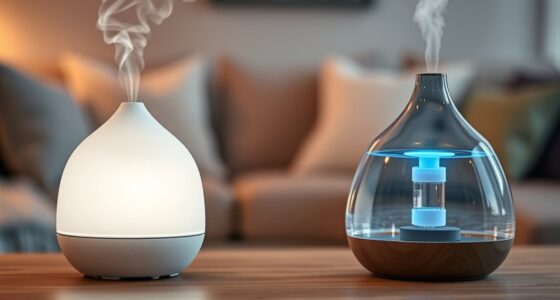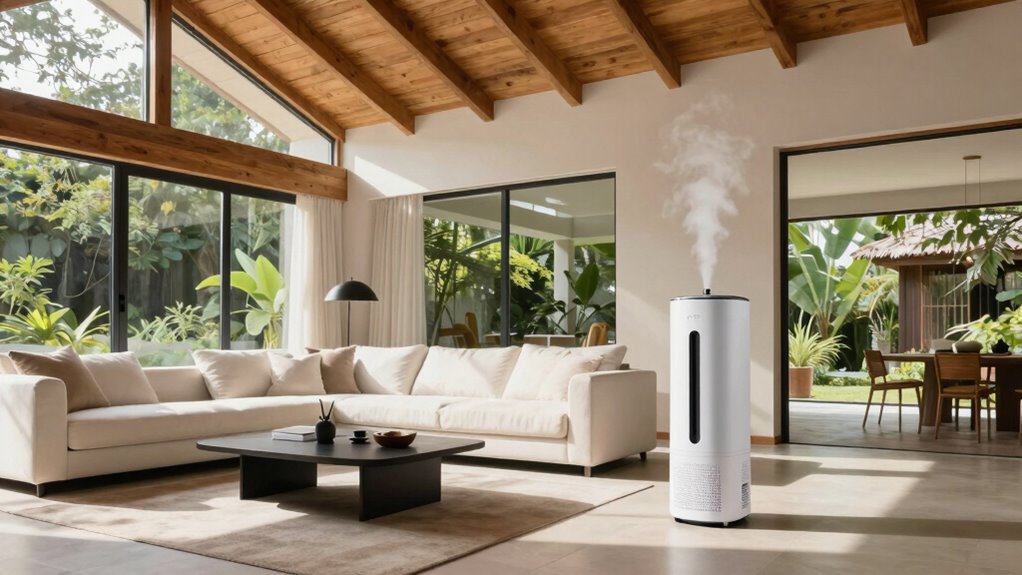

Sizing a humidifier for your open-plan home is trickier than it looks because you need to take into account the entire space’s volume, airflow, and design features like high ceilings or large windows. Simply choosing a unit based on individual rooms won’t cut it; you need to account for the whole area to prevent dryness, excess moisture, or mold. To find out how to get it just right, you’ll want to explore more about airflow, space specifics, and effective strategies.

Get home appliances delivered free with Prime
- Fast, free delivery on millions of items
- Prime Video, Amazon Music and more included
- Member-only deals all year
Key Takeaways
- Larger, open spaces require careful calculation of total volume to select the right humidifier capacity.
- Dispersed moisture in open-plan layouts makes achieving even humidity more challenging.
- Proper airflow management is essential to ensure consistent moisture distribution across the entire area.
- Oversized or undersized units can cause humidity imbalances, mold, or energy inefficiency.
- Interior features like high ceilings and large windows significantly influence humidifier sizing needs.
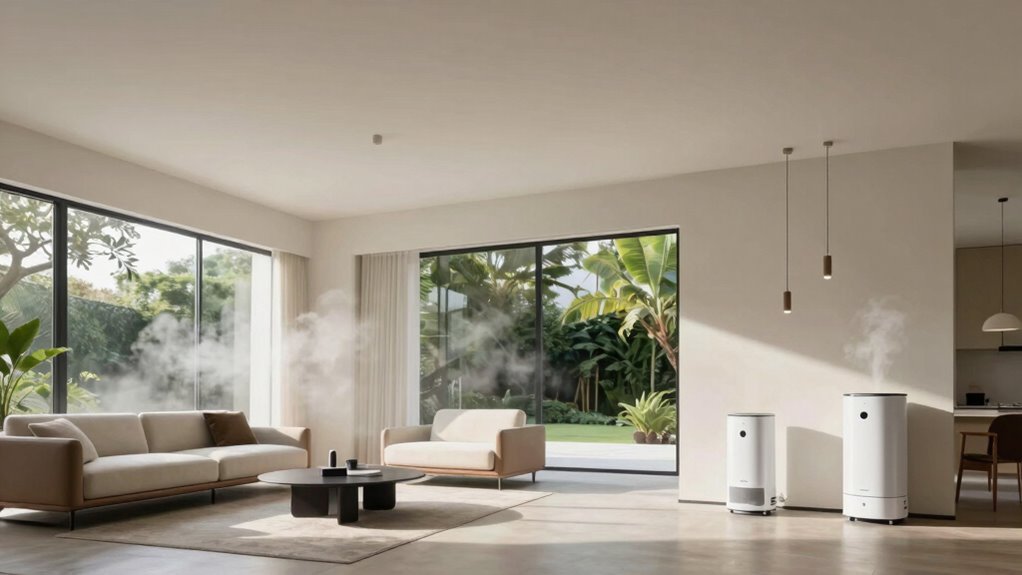
Open-plan homes offer spacious, flowing living areas, but their open design can make humidifier sizing more challenging. When you’re considering a humidifier for such a space, you need to account for the entire open area rather than just a single room. The absence of walls and partitions means the moisture you introduce will disperse across a larger, more complex area, making it harder to determine the correct size. If you choose a humidifier that’s too small, you won’t achieve the desired humidity levels, which can lead to dry skin, irritated eyes, or even respiratory discomfort. Conversely, selecting a unit that’s too large can result in excess moisture, leading to mold or damage to your interior design elements.
Open-plan homes require careful humidifier sizing to balance comfort and prevent moisture-related issues.
Energy efficiency becomes especially relevant in open-plan layouts. A properly sized humidifier not only maintains ideal humidity but also conserves energy by avoiding unnecessary operation. Overworking an undersized unit forces it to run longer, increasing energy consumption, while an oversized humidifier cycles on and off more frequently, wasting power and potentially causing humidity fluctuations. To maximize energy efficiency, you need to understand the airflow dynamics within your space. Larger, open areas tend to have better natural airflow, but they also require a more precise assessment of the volume that needs humidification. This means calculating the total cubic footage of the open space and choosing a humidifier that can handle that capacity effectively. Proper humidifier sizing is essential for maintaining comfort and efficiency.
Your interior design also plays a role in humidifier sizing. If your home features high ceilings, large windows, or expansive open-concept areas with minimal furniture, the air volume increases, demanding a larger unit. Conversely, if your space is more compact or heavily furnished, the humidity requirements may be lower. Remember, the goal isn’t just to humidify the air but to do so efficiently and subtly, so your design aesthetic remains intact. An oversized humidifier can produce visible moisture or noise, disrupting the clean, minimalist look you’ve carefully crafted. Additionally, understanding the airflow patterns within your home helps in selecting the right humidifier size, ensuring even moisture distribution across the open space. Proper airflow can improve the effectiveness of humidification and prevent uneven moisture levels.
Taking into account the air exchange rate can help optimize humidifier performance, especially in spaces with high ventilation. It is also important to consider how the climate outside your home impacts indoor humidity needs, as different regions may require different humidification strategies. Ultimately, selecting the right humidifier for an open-plan home involves considering both the total space and how your interior design influences airflow and moisture distribution. It’s about finding a balance that maximizes energy efficiency and enhances your home’s comfort without compromising style. With careful planning, you can ensure your open-concept space remains cozy, healthy, and visually appealing, all while avoiding the common pitfalls of improper humidifier sizing.
As an affiliate, we earn on qualifying purchases.
Frequently Asked Questions
How Does Furniture Placement Affect Humidifier Efficiency?
Furniture placement profoundly impacts humidifier efficiency by causing furniture obstruction and airflow disruption. When you place furniture too close to the humidifier, it blocks the moisture from circulating evenly. Keep furniture away from the humidifier’s output to allow proper airflow, ensuring the mist spreads throughout the room. Proper placement helps maintain consistent humidity levels and prevents damp spots or dry areas, making your humidifier work more effectively.
What Are Common Mistakes in Humidifier Maintenance?
Like a car needing regular tune-ups, your humidifier needs proper maintenance. Common mistakes include neglecting humidifier filter replacement, which can cause mold buildup and inefficiency. You also overlook water quality management, risking mineral deposits and bacteria growth. Always clean your humidifier thoroughly and replace filters as recommended. Regular upkeep guarantees it operates effectively, providing healthy humidity levels and preventing potential health issues caused by poor maintenance.
Can Multiple Humidifiers Be Used in Large Open Spaces?
Yes, using multiple humidifiers in large open spaces can help maintain consistent humidity levels, but it’s crucial to take air circulation into account. Proper placement ensures even distribution, preventing dry spots or over-humidified areas. You should monitor humidity levels regularly with a hygrometer and adjust the humidifiers accordingly. This way, you’ll achieve a balanced environment, improving comfort and air quality throughout the entire space.
How Often Should I Adjust Humidifier Settings?
You should adjust your humidifier settings whenever you notice humidity levels falling outside the ideal range of 30-50%. Check your humidity levels regularly, especially in open-plan homes where air circulation can vary. If the air feels dry or you notice condensation, tweak the settings accordingly. Consistent monitoring helps maintain comfortable humidity levels, ensuring your space stays healthy and balanced without over-humidifying or drying out the environment.
What Is the Best Type of Humidifier for Open-Plan Homes?
For open-plan homes, a whole-house humidifier works best because it maintains consistent air quality and humidity levels across large spaces. You should opt for an ultrasonic or steam humidifier, as they efficiently add moisture without making the air feel damp. These types help prevent dry air issues, controlling humidity levels to improve comfort and air quality throughout your entire home.
As an affiliate, we earn on qualifying purchases.
Conclusion
When sizing a humidifier for an open-plan home, remember it’s not just about square footage—consider the entire space’s airflow and layout. For example, in a recent case, a homeowner with a sprawling open living area found a smaller humidifier insufficient, leading to dry air. By adjusting the size based on the open design, they achieved a comfortable, balanced humidity level. So, always tailor your humidifier choice to your home’s unique layout for the best results.
energy efficient whole house humidifier
As an affiliate, we earn on qualifying purchases.
As an affiliate, we earn on qualifying purchases.
As an affiliate, we earn on qualifying purchases.
Halloween Picks
halloween
As an affiliate, we earn on qualifying purchases.