To choose the right size dehumidifier for each room, take into account its square footage and typical humidity levels. Smaller spaces like bathrooms need compact, lower-capacity units, while larger areas such as basements require more powerful models. Proper sizing ensures effective moisture control without wasting energy or creating excess noise. Don’t forget to balance energy efficiency with capacity, and if you want to find the perfect fit, there’s more to consider that can help you make the best choice.
Key Takeaways
- Measure your room’s square footage and assess humidity levels to determine the appropriate dehumidifier capacity.
- Match small spaces with compact, low-capacity units; larger rooms require higher-capacity models for effective moisture control.
- Consider room usage and noise sensitivity to select units that operate quietly and suit your environment.
- Avoid over- or under-sizing to prevent energy waste, inefficiency, and persistent humidity issues.
- Prioritize energy-efficient models with features that optimize performance based on room size and humidity conditions.
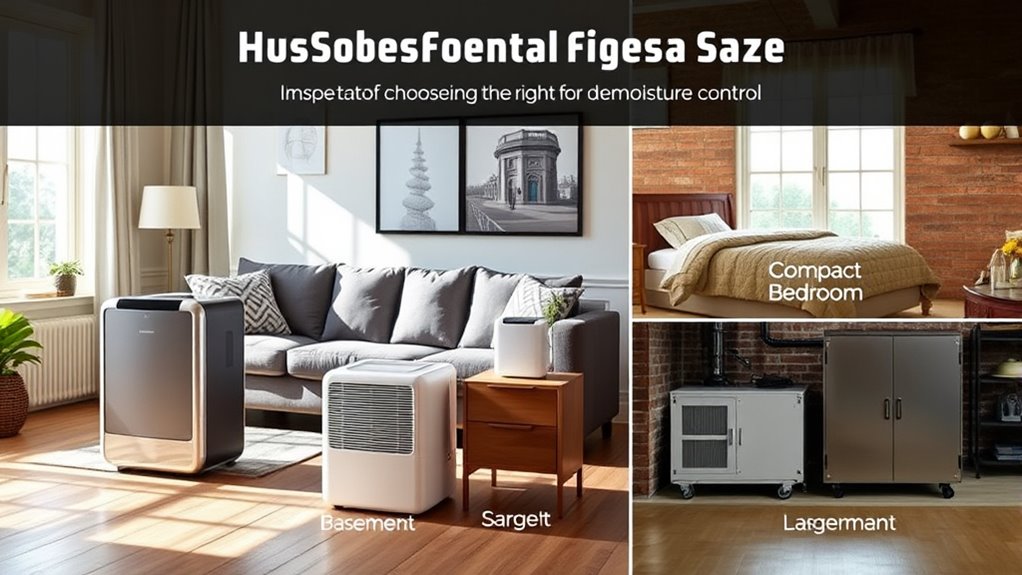
Selecting the right size dehumidifier is vital to effectively control moisture levels in your space. When choosing a unit, it’s important to consider not just the capacity but also how efficiently it operates. An appropriately sized dehumidifier will remove excess moisture without wasting energy, which benefits both your utility bill and the environment. Energy efficiency should be a top priority, especially if you plan to run the dehumidifier continuously. Look for models with high energy efficiency ratings, such as those with Energy Star certification, to ensure that you’re getting maximum moisture removal with minimal power consumption. This way, you’ll reduce energy costs while maintaining a comfortable, dry environment. Additionally, selecting a model with smart features can help optimize performance and energy use over time.
Noise levels are another critical factor to consider when selecting a dehumidifier. If you’re placing it in a bedroom, living room, or home office, a quiet operation is essential to avoid disruptions. Many modern dehumidifiers are designed with noise reduction technology, making them much less obtrusive during operation. Choosing a unit with a lower decibel rating ensures that it won’t interfere with your daily activities or sleep. Keep in mind that larger units tend to be noisier, so if noise sensitivity is a concern, opt for a compact model or one specifically engineered for quieter performance. Reading reviews or specifications can help you gauge how loud a particular dehumidifier might be in real-world use.
Beyond energy efficiency and noise levels, you need to match the dehumidifier’s capacity to the size of your room. A unit that’s too small won’t effectively control moisture, leading to persistent humidity problems. Conversely, oversizing can cause unnecessary energy use and increased noise. For small spaces like bathrooms or closets, a compact, lower-capacity model usually suffices. Medium-sized rooms, such as bedrooms or living areas, benefit from a mid-range unit, while large basements or open-concept spaces require higher-capacity dehumidifiers. To determine the right size, measure your room’s square footage and consider the typical humidity levels. If your space is prone to high humidity or has poor ventilation, opt for a slightly larger capacity to ensure effective moisture control. Properly sizing your dehumidifier can also help prevent automation inefficiencies that arise from improper unit selection.
Frequently Asked Questions
Can I Use One Dehumidifier for Multiple Rooms?
Yes, you can use one dehumidifier for multiple rooms if it has enough capacity. Consider the room size and dehumidifier capacity to guarantee it handles the humidity level effectively. For larger areas, a dehumidifier with a higher capacity is necessary, while smaller rooms may only need a compact model. Proper placement is key, and sometimes a single unit might not be sufficient for very large or multiple connected spaces.
How Loud Are Different Dehumidifier Sizes?
Dehumidifier noise levels vary with size; smaller units tend to be quieter, producing around 40-50 decibels, similar to a normal conversation. Larger models, suitable for bigger rooms, can reach 55-65 decibels, comparable to background music. Your room size influences noise, so if you prefer a quieter environment, opt for a smaller dehumidifier. Keep in mind that higher capacity models might generate more noise but handle larger spaces effectively.
Do Specific Room Types Require Special Dehumidifier Features?
You can’t judge a book by its cover, so consider room-specific needs. Some spaces, like basements or bathrooms, demand dehumidifiers with special features such as automatic shut-off, washable filters, or enhanced drainage options for humidifier maintenance. These features boost energy efficiency and guarantee ideal performance. Choosing the right dehumidifier for each room means you’ll keep humidity levels in check while saving energy and reducing maintenance hassles.
How Often Should I Empty the Dehumidifier’s Water Tank?
You should empty your dehumidifier’s water tank regularly, usually once a day or when it’s full, to guarantee ideal performance. Regular water tank maintenance prevents mold and odors. Many models offer drainage options like continuous drain hoses, so you can connect a hose for automatic drainage, reducing the need for frequent emptying. Check your dehumidifier’s indicator or manual to determine the right frequency for your specific unit.
Are Portable Dehumidifiers Effective for Large Spaces?
Imagine a large basement with persistent dampness; a portable dehumidifier can still be effective if it’s a high-capacity model. Portable units offer large space solutions, but their effectiveness depends on the room size and humidity level. For extensive areas, look for models with higher pints per day capacity. Proper placement and continuous drainage options also boost their performance, making portable units a viable solution for large spaces when chosen correctly.
Conclusion
Now that you know how to pick the right size dehumidifier, you’re all set to tackle excess moisture in each room. Remember, a tool that’s too small won’t do the job, while one that’s too big can waste energy. Think of it like fitting a square peg in a round hole—you want everything to fit just right. With the right size, you’ll keep your home comfortable and dry without breaking a sweat.