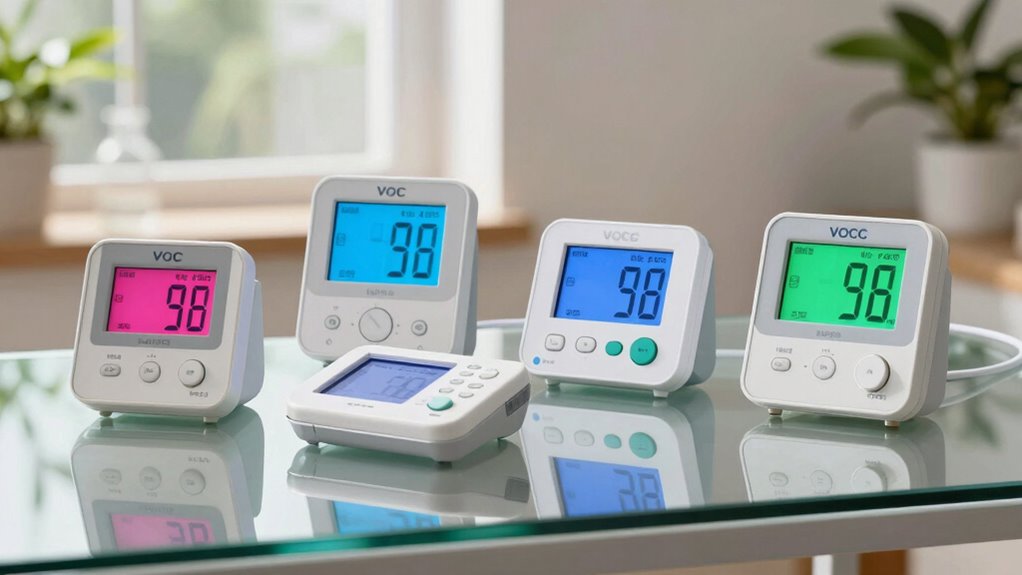

A VOC monitor for chemical sensitivity can help you spot changes in indoor air, but readings are screening information—not proof that a room is safe or a diagnosis of a reaction. I rank the Airthings Wave Enhance as best overall for its broader indoor-air context, while the Sainlogic 16-in-1 stands out for its large display and wide range of reported measurements, and the EG Air is a simpler option for shoppers focused on formaldehyde. The main tradeoff is between broad sensor coverage and ease of interpreting what a reading means; VOC and TVOC readings do not identify every chemical or its source. Read on for how these six options differ, what each can and cannot tell you, and which features fit your needs.

Get home appliances delivered free with Prime
- Fast, free delivery on millions of items
- Prime Video, Amazon Music and more included
- Member-only deals all year
Complete the kit


Key Takeaways
- Airthings Wave Enhance is the broad-context pick: it adds factors such as CO2, humidity, temperature, pressure, noise, and light alongside VOC monitoring, but its breadth may be more than a buyer seeking a simple reading needs.
- Sainlogic prioritizes at-a-glance coverage: its 7.2-inch display and extensive list of reported metrics may suit people who want several readings visible together, though more measurements do not automatically mean more chemical specificity.
- Formaldehyde-focused choices serve a narrower purpose: the EG Air centers on formaldehyde detection, while Temtop and AirKnight pair formaldehyde-related monitoring with other air-quality measures.
- Amazon Smart Air Quality Monitor is the simpler smart-home route: its appeal is connected monitoring rather than a long list of specialized chemical readings, so buyers should check whether its particular metrics match their concern.
- No pick identifies every irritant: VOC or TVOC readings can indicate changing conditions, but they do not name individual compounds, establish exposure safety, or replace targeted testing when a specific chemical is suspected.
| Temtop Air Quality Monitor PM2.5 PM10 Formaldehyde VOCs Temperature Humidity AQI Tester |  | Best Overall for Broad Pollutant Checks | Sensing parameters: PM2.5, PM10, formaldehyde (HCHO), VOCs, temperature, humidity, AQI | Sensor types: Laser particle sensor; electrochemical HCHO sensor | Display: Large IPS color display | VIEW ON AMAZON | See Our Full Breakdown |
| Sainlogic Indoor Air Quality Monitor, 16-in-1 VOC, CO2, HCHO, TVOC, PM2.5, PM1.0, PM10, Humidity, Temperature, 7.2” Display, AQI Alerts |  | Best for At-a-Glance Alerts | Parameters monitored: CO2, PM2.5, PM10, PM1.0, AQI, HCHO, TVOC, temperature, humidity | Display size: 7.2 inches | Listed sensor sensitivity: 0.001 | VIEW ON AMAZON | See Our Full Breakdown |
| EG Air Quality Monitor, Formaldehyde Detector, Pollution Meter, Sensor, Tester |  | Best Compact Spot-Check Monitor | Measures: Formaldehyde (HCHO), TVOC, PM2.5 | Display: 2.8-inch color LCD | Battery: 2200mAh rechargeable | VIEW ON AMAZON | See Our Full Breakdown |
| AirKnight Premium Indoor Air Quality Monitor with Sensors for VOC, CO2, Formaldehyde, AQI, PM2.5, PM10, Temperature, and Humidity |  | Best for Portable Multi-Pollutant Screening | Stated monitoring scope: VOC, CO2, formaldehyde, AQI, PM2.5, PM10, temperature, humidity | Product type: AT1000 10-in-1 indoor air quality monitor | Display: LCD | VIEW ON AMAZON | See Our Full Breakdown |
| Airthings Wave Enhance Indoor Air Quality Monitor for CO2, VOC, Humidity, Temperature, Pressure, Noise & Light Sensors |  | Best for App-Based Bedroom and Office Tracking | Model number: 322 | Sensors: CO2, VOC, humidity, temperature, pressure, noise, light | Connectivity: Bluetooth | VIEW ON AMAZON | See Our Full Breakdown |
| Amazon Smart Air Quality Monitor |  | Best for Alexa-Based Alerts | Measurements: PM2.5, VOCs, carbon monoxide, humidity, temperature | Connectivity: Works with Alexa | Setup: Plug in and connect through the Alexa app | VIEW ON AMAZON | See Our Full Breakdown |
| voc monitor for chemical sensitivity | Display | Connectivity |
|---|---|---|
| Temtop Air Quality Monitor PM2 | Large IPS color display | USB data export; Type-C cable for continuous monitoring |
| Sainlogic Indoor Air Quality M | — | — |
| EG Air Quality Monitor | 2.8-inch color LCD | — |
| AirKnight Premium Indoor Air Q | LCD | — |
| Airthings Wave Enhance Indoor | — | Bluetooth |
| Amazon Smart Air Quality Monit | — | Works with Alexa |
More Details on Our Top Picks
Temtop Air Quality Monitor PM2.5 PM10 Formaldehyde VOCs Temperature Humidity AQI Tester
For chemical sensitivity, I rank the Temtop first among these broad-coverage meters because it reports both VOCs and formaldehyde alongside PM2.5, PM10, and common comfort measures. That mix can help you check whether a room change coincides with shifts in several readings, while trend analysis and USB data export support longer-term comparisons. Its large IPS display and factory calibration also make setup more direct than the Sainlogic, which calls for manual calibration.
The tradeoff is that Temtop’s portable battery lasts only 6–8 hours, so extended monitoring calls for USB power. Its laser sensor measures particles, not every chemical or gas, and the supplied information gives no VOC sensor method or accuracy figures. I would treat readings as screening clues rather than proof that a space is safe; strong chemicals can also affect measurement accuracy.
Pros:- Measures VOCs and formaldehyde alongside PM2.5 and PM10.
- Trend analysis and USB data export support comparisons over time.
- Factory-calibrated and designed for straightforward operation.
- Rechargeable, portable design can be used indoors or outdoors.
Cons:- Portable battery life is limited to 6–8 hours.
- Does not detect gas or carbon monoxide leaks.
- No VOC accuracy or sensing-method details are provided.
Best for: People who want a portable, multi-parameter screen for comparing VOC, formaldehyde, and particle readings across rooms or short visits.
Not ideal for: Buyers who need a documented VOC-specific detection method, gas-leak detection, or uninterrupted monitoring without a USB power connection.
- Sensing parameters:PM2.5, PM10, formaldehyde (HCHO), VOCs, temperature, humidity, AQI
- Sensor types:Laser particle sensor; electrochemical HCHO sensor
- Display:Large IPS color display
- Connectivity:USB data export; Type-C cable for continuous monitoring
- Battery life:6–8 hours in portable mode
- Dimensions:6.97 x 1.26 x 2.56 inches
- Weight:14.4 ounces
- Temperature range:32°F to 122°F
Our verdict“Choose Temtop if you want broad pollutant readings and exportable trends in one portable unit, and can work around its short battery life.”
Sainlogic Indoor Air Quality Monitor, 16-in-1 VOC, CO2, HCHO, TVOC, PM2.5, PM1.0, PM10, Humidity, Temperature, 7.2” Display, AQI Alerts
The Sainlogic suits buyers who want air-quality changes to be hard to miss: its 7.2-inch adjustable display pairs readings with visual and audible alerts. For someone tracking chemical sensitivity at home, seeing TVOC and HCHO alongside CO2 and three particle sizes may make it easier to notice patterns than using a VOC-only readout. Compared with the Temtop, Sainlogic adds PM1.0 and CO2 and presents data on a larger screen, but Temtop offers stated trend analysis and USB export.
Its main compromises are manual calibration and a battery life of up to eight hours. It has no app or Wi-Fi, so alerts and readings stay on the device rather than reaching you remotely. The listed 0.001 sensitivity does not identify the measurement unit or establish chemical-specific accuracy, so I would use this as a general indoor screening tool, not as a detector for a particular compound.
Pros:- Tracks TVOC and HCHO with CO2, PM1.0, PM2.5, and PM10.
- Large adjustable display is easy to read from across a room.
- Visual and audible alerts can draw attention to changing readings.
- Rechargeable and wireless, with USB-C charging.
Cons:- Battery life is up to eight hours, limiting extended portable use.
- No app or Wi-Fi for remote monitoring or saved phone-based trends.
- Manual calibration is required for optimal accuracy.
Best for: Households or small offices that want large, room-visible readings and audible or visual alerts without setting up an app.
Not ideal for: People who need remote notifications, long unplugged monitoring, or verified sensitivity to a particular chemical.
- Parameters monitored:CO2, PM2.5, PM10, PM1.0, AQI, HCHO, TVOC, temperature, humidity
- Display size:7.2 inches
- Listed sensor sensitivity:0.001
- Temperature range:14°F to 122°F
- Humidity range:0% to 99% RH
- Battery capacity:2500mAh
- Battery life:Up to 8 hours
- Connectivity and charging:No app or Wi-Fi; USB-C recharging
Our verdict“Pick Sainlogic if prominent readings and on-device alerts matter more to you than app access or low-maintenance calibration.”
EG Air Quality Monitor, Formaldehyde Detector, Pollution Meter, Sensor, Tester
The EG monitor keeps its scope focused on three readings that can be useful when checking a room after bringing in furniture, cleaning, or staying in a hotel: formaldehyde, TVOC, and PM2.5. Its built-in fan supports air sampling, and the color display puts results on the device without requiring a phone. Compared with the Temtop, it is more narrowly specified and lacks Temtop’s stated trend analysis and data export; compared with the larger Sainlogic, it is a simpler portable spot-check option.
The listed battery can support monitoring for up to two days, but the product details do not explain sensor accuracy or how long a reading takes to settle. There is no app, and users need to interpret the displayed metrics themselves. I would choose it for checking a few indoor locations, not for diagnosing a specific exposure or monitoring outdoor air.
Pros:- Measures TVOC, formaldehyde, and PM2.5 in one portable unit.
- Built-in fan supports air sampling.
- Color LCD shows readings directly without an app.
- Rechargeable battery is listed for up to two days of monitoring.
Cons:- Limited to indoor use according to the product information.
- No smartphone connectivity or app-based history.
- Accuracy details and measurement guidance are not provided.
Best for: Travelers and renters who want a simple handheld screen for checking TVOC, formaldehyde, and particle readings in indoor spaces.
Not ideal for: Buyers who need outdoor monitoring, saved trend reports, smartphone access, or detailed accuracy documentation.
- Measures:Formaldehyde (HCHO), TVOC, PM2.5
- Display:2.8-inch color LCD
- Battery:2200mAh rechargeable
- Power:DC 5V micro USB
- Monitoring duration:Up to 2 days
- Air sampling:Built-in fan
Our verdict“Choose EG for straightforward indoor spot checks of TVOC and formaldehyde, but look to Temtop or Sainlogic for broader monitoring features.”
AirKnight Premium Indoor Air Quality Monitor with Sensors for VOC, CO2, Formaldehyde, AQI, PM2.5, PM10, Temperature, and Humidity
AirKnight earns a place for buyers who want a movable indoor monitor that covers VOC, formaldehyde, CO2, and particles in one readout. Its rechargeable design and LCD make it practical to shift between rooms or bring along during wildfire-related air checks. Compared with the EG, it adds CO2 and PM10 to the stated coverage; compared with Temtop, though, the supplied product details provide fewer specifics about sensors, calibration, and data export. That makes AirKnight’s broad list of measurements more compelling for general screening than for careful comparison of chemical readings over time.
The key tradeoff is limited technical documentation: no sensor accuracy figures or detailed measurement methods are supplied. Buyers also need to understand what each reading can and cannot show. I would not use it to confirm the presence or absence of a specific chemical, and its indoor positioning makes it a less clear choice for outdoor monitoring than a product explicitly described for both settings.
Pros:- Stated coverage includes VOC, formaldehyde, CO2, PM2.5, and PM10.
- LCD presents readings on the device.
- Rechargeable portable design can be moved between indoor locations.
- Useful range of readings for general indoor air screening.
Cons:- Sensor accuracy and measurement methods are not detailed in the supplied specifications.
- Product information does not explain calibration or data history features.
- Interpreting the range of air-quality readings requires familiarity with the metrics.
Best for: People who want a rechargeable indoor screen for checking several pollutant categories across rooms, including during wildfire smoke concerns.
Not ideal for: Buyers who require published sensor accuracy, clear calibration instructions, or reliable identification of a particular chemical.
- Stated monitoring scope:VOC, CO2, formaldehyde, AQI, PM2.5, PM10, temperature, humidity
- Product type:AT1000 10-in-1 indoor air quality monitor
- Display:LCD
- Power:Rechargeable; one lithium-ion battery included
- Dimensions:7.55 x 2.09 x 3.16 inches
- Weight:12 ounces
Our verdict“AirKnight is a reasonable portable screen for broad indoor checks, but Temtop is the clearer choice if documented sensing details and exported trends matter more.”
Airthings Wave Enhance Indoor Air Quality Monitor for CO2, VOC, Humidity, Temperature, Pressure, Noise & Light Sensors
Airthings Wave Enhance takes a different approach from the handheld meters: it is a compact, battery-powered indoor monitor designed to stay in a bedroom or home office, with Bluetooth app access for readings, notifications, and trends. Along with VOC and CO2, it tracks humidity, temperature, pressure, noise, and light, giving context that the EG monitor does not provide. That broader room picture may help you compare conditions over time, though it does not report formaldehyde or particulate matter in the listed sensor set.
For chemical sensitivity, that missing coverage matters: Temtop and Sainlogic explicitly list HCHO and particle readings, while Airthings does not. Full functionality also depends on Bluetooth and the app, unlike Sainlogic’s large standalone display. I would favor this model for ongoing room tracking and environmental context, not for checking a suspected formaldehyde source or conducting a quick multi-pollutant spot test.
Pros:- Tracks VOC and CO2 alongside humidity, temperature, pressure, noise, and light.
- Bluetooth app provides readings, notifications, and trend analysis.
- Two AA batteries allow cable-free placement.
- Compact design suits bedrooms and home offices.
Cons:- Does not list formaldehyde or particulate sensors.
- Full functionality depends on Bluetooth and the app.
- Designed for indoor monitoring rather than portable outdoor checks.
Best for: Bedroom and home-office users who want app-based VOC and CO2 trends alongside noise, light, humidity, and temperature.
Not ideal for: People seeking formaldehyde or particle readings, a standalone display, or monitoring outside indoor spaces.
- Model number:322
- Sensors:CO2, VOC, humidity, temperature, pressure, noise, light
- Connectivity:Bluetooth
- Power source:Battery-powered
- Batteries:2 AA included
- Use:Indoor monitoring
- Warranty option:Optional 5-year extended warranty
Our verdict“Choose Airthings for app-based room trends and broader comfort context, but choose Temtop or Sainlogic if formaldehyde and particle readings are priorities.”
Amazon Smart Air Quality Monitor
The Amazon Smart Air Quality Monitor is a practical fit for someone who wants VOC readings alongside several other indoor-air signals and already uses Alexa. It tracks PM2.5, carbon monoxide, humidity, and temperature as well as VOCs, then sends alerts and can trigger routines with compatible Alexa devices. Compared with the Sainlogic Indoor Air Quality Monitor, which has a built-in display and broader listed pollutant coverage, Amazon’s appeal is simpler setup and connection to an existing smart-home system rather than on-device data access. The tradeoff matters for chemical sensitivity: the listed data does not specify a VOC measurement range or identify individual compounds, and this monitor has no standalone display or detailed data storage. I’d choose it for convenient notifications, not as a substitute for compound-specific testing or a dedicated record of exposure.
Pros:- Tracks VOCs alongside PM2.5, carbon monoxide, humidity, and temperature.
- Alexa alerts can notify users when readings change.
- Compatible routines can connect air-quality readings with other Alexa devices.
- Plug-in setup through the Alexa app keeps installation straightforward.
Cons:- Full functionality depends on the Alexa ecosystem.
- No standalone display makes it less useful for quick checks without the app.
- Detailed data storage and compound-specific VOC identification are not listed.
Best for: Alexa users who want indoor VOC and air-quality alerts tied to compatible smart-home routines.
Not ideal for: People who need a screen for checking readings at the device, stored data for comparing exposure over time, or identification of specific chemicals.
- Measurements:PM2.5, VOCs, carbon monoxide, humidity, temperature
- Connectivity:Works with Alexa
- Setup:Plug in and connect through the Alexa app
- Alerts:Real-time air-quality alerts
- Indicators:Color-coded air-quality indicators
- Automation:Supports routines with compatible Alexa devices
- Monitoring location:Indoor air quality
Our verdict“Choose this if Alexa alerts and routines matter more than an on-device display or detailed VOC records.”

How We Picked
I ranked these monitors around the needs behind chemical sensitivity: whether the device reports VOC-related measures, whether it adds useful context such as formaldehyde, particles, humidity, or CO2, and how readily a household can view and act on readings. I also weighed usability features like display size, alerts, and connected monitoring, while treating sensor labels cautiously because a product listing alone cannot establish laboratory accuracy, selectivity, or performance for every compound.
The order reflects fit rather than a claim that one device detects all chemicals. Airthings leads for a broader picture of indoor conditions; Sainlogic follows for its visible, wide-ranging readout; and the remaining models rank by the narrower or more straightforward use cases their listed features suggest. I give no monitor credit for implied medical protection: none can diagnose sensitivity, confirm that a space is safe, or identify an unknown chemical source from a general VOC reading.
| voc monitor for chemical sensitivity | Connectivity |
|---|---|
| Temtop Air Quality Monitor PM2 | USB data export; Type-C cable for continuous monitoring |
| Sainlogic Indoor Air Quality M | — |
| EG Air Quality Monitor | — |
| AirKnight Premium Indoor Air Q | — |
| Airthings Wave Enhance Indoor | Bluetooth |
| Amazon Smart Air Quality Monit | Works with Alexa |
Factors to Consider When Choosing Voc Monitor For Chemical Sensitivity
Before choosing a monitor, I would start with the question you want it to answer. A device that shows changing VOC levels may help you notice patterns, but a suspected specific compound, a health concern, or a persistent odor may call for a different tool or professional assessment. These factors help separate useful monitoring from false confidence.
Decide Whether You Need VOC Trends or a Specific Chemical Reading
VOC and TVOC labels usually describe broad categories or combined readings, not a complete chemical inventory. If you are trying to learn whether air changes after cleaning, cooking, painting, or bringing in a new item, tracking trends may be useful. If you suspect a particular substance, a general VOC monitor may not detect it reliably or distinguish it from other compounds. Check whether the product names the specific substance you care about and what its sensor is intended to measure. A targeted test or qualified indoor-air professional may be more appropriate for a defined exposure question. The common mistake is treating a low general reading as proof that a specific chemical is absent.
Read Sensor Claims as Measures, Not Guarantees
A product may list VOC, TVOC, or formaldehyde, but those labels do not reveal the full sensor method, selectivity, or accuracy. Ask what units are displayed, whether the manufacturer explains expected limitations, and whether the device reports a direct measurement or an estimate. Do not compare numbers from different brands as if they were automatically interchangeable. A monitor that provides a consistent baseline in one room may be more useful for spotting change than one with a long metric list and unclear interpretation. Treat thresholds and alerts as prompts to investigate, not as medical or safety certifications. When a decision carries health or building-safety consequences, seek appropriate testing rather than relying on a consumer monitor alone.
Choose Supporting Sensors for the Decisions You Actually Make
Extra sensors can explain some changes in indoor conditions, but they do not all answer the same question. Humidity and temperature readings help describe the room environment, while particulate measurements track a different class of air pollution from gases. CO2 can offer context about occupancy and ventilation, but it is not a VOC measurement. A broad monitor may be useful if you want several conditions on one screen; a focused device may be easier to interpret if your concern is narrower. Avoid paying attention to a long sensor list without checking whether each reading will affect an action you can take. Prioritize relevant measures over the largest advertised count.
Think Through Display, Alerts, and Daily Use
A reading only helps if you can understand it and check it when needed. A large display can be convenient in a shared room, while app-connected monitoring may suit someone who wants to review changes away from the device. Alerts can draw attention to changes, but they may also create worry if the device does not explain what a reading means or what response is appropriate. Consider who will use the monitor, where it will sit, and whether a phone or an always-visible screen fits that routine. Check what information is available without an app and whether setup depends on a particular smart-home ecosystem. A simple, consistently used monitor can be more helpful than a feature-heavy device that rarely gets checked.
Plan for Placement, Calibration, and Maintenance
Room location can affect readings: placing a monitor directly beside a cleaning product, open window, vent, or cooking area may capture a local event rather than typical room conditions. Follow the manufacturer’s placement guidance and compare readings over time under similar conditions. Look for clear instructions about calibration, sensor life, cleaning, and replacement parts before buying. If upkeep is vague, it may be difficult to tell whether changing readings reflect the air or the sensor. Moving a device between rooms can also make comparisons harder if you do not record where and when readings were taken. A basic log of activities and readings can help connect spikes with possible sources without treating correlation as proof.
Set Expectations About What a Consumer Monitor Can Prove
These products are best treated as awareness tools, not medical devices or certificates of clean air. A monitor may show a change without identifying its cause, and a reading that appears normal cannot rule out every irritant or exposure. If symptoms are severe, persistent, or tied to a particular location, discuss them with a qualified health professional and consider suitable building or environmental testing. Paying more can make sense for clearer displays, broader context, or monitoring features you will use, but it cannot guarantee detection of every compound. Keep ventilation and source control in view rather than relying on a number alone. The most responsible buying choice is the one whose limits you can understand.
Frequently Asked Questions
Can a VOC monitor tell me which chemical is causing my symptoms?
Usually, a consumer VOC or TVOC reading does not identify individual compounds or link a chemical to a symptom. It can show that a reading changed, which may help you compare conditions before and after an activity. That pattern is a clue to investigate, not confirmation of a cause. If you suspect a specific chemical, check whether a suitable targeted test is available and ask a qualified professional about testing options. Do not use a general VOC reading alone to make medical decisions.
Should I choose a monitor with formaldehyde readings or a general VOC reading?
Choose based on the question you are trying to answer, not the number of metrics in the listing. A formaldehyde-labeled reading may be relevant if formaldehyde is your specific concern, while a general VOC measure can help you observe broader changes. Neither label guarantees detection of every relevant compound or establishes safety. Check the manufacturer’s description of the sensor and its limits before comparing devices. If you have a defined exposure concern, targeted testing may give more useful evidence than either broad category.
Can I compare VOC readings from two different monitor brands?
Do not assume readings from different brands are directly comparable. Devices can use different sensors, methods, units, and thresholds, and a general VOC number may not represent the same thing across models. For everyday monitoring, use one device consistently and look for changes under similar conditions. If you compare units, review their documentation and treat mismatches as a reason to investigate rather than proof that one is wrong. A calibrated or professional measurement may be needed for decisions that depend on precise concentrations.
Where should I place a monitor to understand typical room conditions?
Follow the product’s placement instructions and choose a location that reflects the room rather than a single nearby source. Avoid setting it right beside a vent, open window, cooking area, cleaning product, or freshly applied material unless you are deliberately checking that local source. Keep the placement consistent when comparing readings over time. If you want to investigate a suspected source, take a separate, planned reading near it and label the location and activity. One reading from one spot cannot represent every area of a home.
When should I seek professional testing instead of relying on a home monitor?
Consider professional guidance if you need to identify a particular chemical, verify an exposure, or make a health or building-safety decision. A consumer monitor can flag changes, but it may not identify the substance, measure every compound, or rule out a problem when readings look low. Persistent symptoms or a suspected source that remains after practical source-control steps also merit advice from appropriate health or indoor-environment professionals. Share the monitor’s readings and a record of activities, locations, and timing, while making clear that they are screening data. The right test depends on the suspected substance and the decision you need to make.
Conclusion
For the best overall, I would choose the Airthings Wave Enhance when broad indoor-air context matters alongside VOC monitoring. The best for a wide, at-a-glance readout is the Sainlogic 16-in-1, while the best value-style choice for a narrower formaldehyde focus is the EG Air if its listed measures match your needs. For a beginner who prefers a straightforward connected monitor, the Amazon Smart Air Quality Monitor may be the easier starting point, subject to checking that its metrics cover your concern. Temtop and AirKnight suit buyers who want formaldehyde-related readings combined with other air-quality measures. My final rule: choose the monitor for the question you need answered, and seek targeted testing when you need to identify a specific chemical.