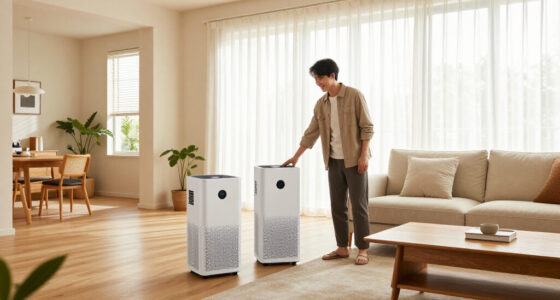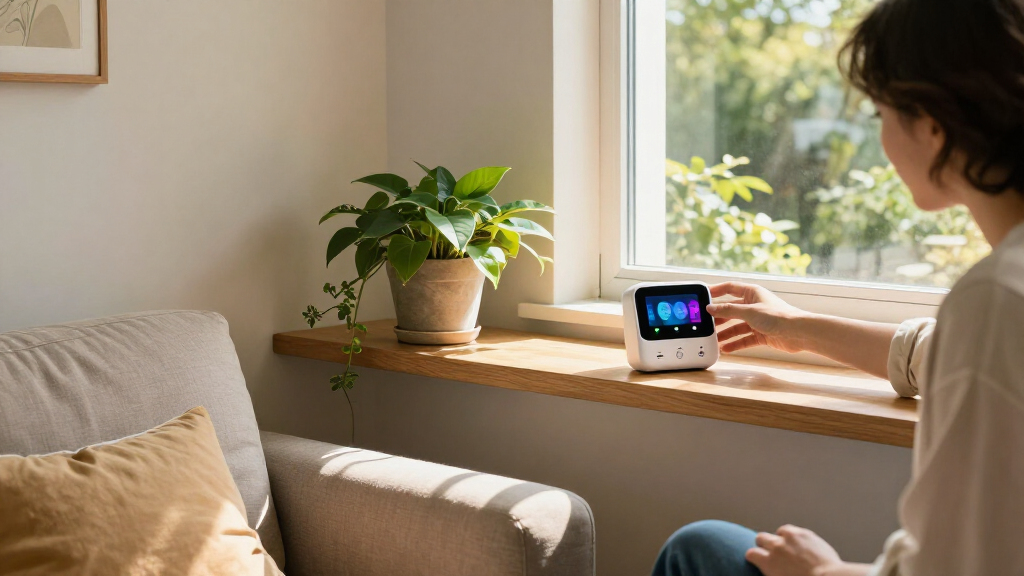

Smart indoor air quality monitors can track issues such as fine particles, carbon dioxide, humidity, and—in some models—radon, helping you decide when to ventilate or investigate a source. My best overall pick is the Airthings View Plus for its broader sensor coverage, including radon; the Amazon Smart Air Quality Monitor is a simpler choice for Alexa households, while the AprilAire ZAWTHCPV suits people who want a more home-system-focused monitor. The main tradeoff is between a clear, reliable set of useful readings and a long sensor list that may include measurements you do not need. App integrations, alert quality, and whether a device measures a pollutant directly also matter as much as the display. Read on for the full comparison and a guide to choosing the right monitor for your rooms and routines.

Get home appliances delivered free with Prime
- Fast, free delivery on millions of items
- Prime Video, Amazon Music and more included
- Member-only deals all year
Complete the kit



Key Takeaways
Airthings View Plus leads for breadth with a purpose: its radon monitoring separates it from most picks, which concentrate on particles, gases, temperature, or humidity.
The Amazon Smart Air Quality Monitor favors a straightforward smart-home setup: it is a more approachable fit for Alexa users than the sensor-heavy ZEMEOLLO, YNAK, and AirWhisper options.
Large sensor counts do not automatically mean better decisions: multi-in-one models can display many readings, but buyers should check which pollutants are measured and how useful the app and alerts are.
CO and CO₂ are different measurements: the Ring and Kidde products bring carbon monoxide monitoring into the lineup, while the GoveeLife H5140 is specifically identified with a CO₂ detector.
Room coverage and smart-home compatibility shape value: single monitors suit focused tracking, while the Amazon two-pack and generic two-pack can make sense for comparing conditions across rooms—if their sensor and app needs fit your home.
| Airthings View Plus Battery-Powered Radon and Air Quality Monitor |  | Best Overall for Broad Sensor Coverage | Model: 2960 | Sensors: Radon, PM2.5, CO2, VOCs, humidity, temperature, and air pressure | Connectivity: Wi-Fi | VIEW LATEST PRICE | See Our Full Breakdown |
| ZEMEOLLO 10-in-1 Indoor Air Quality Monitor |  | Best for Portable, On-Device Readings | Model: ZLJC2 | Measurements: CO2, HCHO, TVOC, benzene, PM2.5, PM10; highlights also list PM0.3–1, temperature, and AQI | Claimed accuracy: Error margin under ±5% | VIEW LATEST PRICE | See Our Full Breakdown |
| GoveeLife Smart Air Quality Monitor H5106 with LED Display |  | Best for PM2.5 Tracking and GoveeLife Automation | Model: H5106 | Measurements: PM2.5, temperature, and humidity | PM2.5 accuracy: ±15 µg/m³ from 0 to 100 µg/m³; ±15% from 100 to 1000 µg/m³ | VIEW LATEST PRICE | See Our Full Breakdown |
| YNAK 16-in-1 Indoor Air Quality Monitor with 5.5-Inch HD Display | 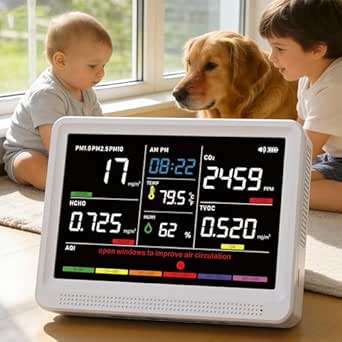 | Best for a Large, Readable Display | Model: USWBA03-NEWNEWNEW | Monitored parameters: CO2, PM2.5, PM1.0, PM10, HCHO, TVOC, temperature, humidity, and AQI | Display: 5.5-inch HD LED | VIEW LATEST PRICE | See Our Full Breakdown |
| Amazon Smart Air Quality Monitor |  | Best for Alexa-Based Alerts and Routines | Sensors: Temperature, humidity, carbon monoxide, PM2.5, and VOCs | Dimensions: 65 × 65 × 45 mm | Weight: 120 g without cable or adapter | VIEW LATEST PRICE | See Our Full Breakdown |
| BREATHE Airmonitor Plus Gen 2 Indoor Air Quality Monitor |  | Best for Broad Pollutant Coverage | Measurements: CO₂, PM1, PM2.5, PM10, TVOC, formaldehyde (HCHO), temperature, and humidity | CO₂ sensor: NDIR | Particle sensor: Laser | VIEW LATEST PRICE | See Our Full Breakdown |
| AprilAire ZAWTHCPV Smart 5-in-1 Wi-Fi Indoor Air Quality Monitor |  | Best for AprilAire System Owners | Measurements: CO₂, VOCs, PM2.5, humidity, and temperature | Connectivity: Wi-Fi | App: AprilAire Healthy Air | VIEW LATEST PRICE | See Our Full Breakdown |
| GoveeLife H5140 Smart Air Quality Monitor with CO₂ Detector |  | Best for Long-Term CO₂ Tracking | Measurements: CO₂, temperature, and humidity | CO₂ sensor: SCD4x photoacoustic NDIR | CO₂ accuracy: ±(40 ppm + 5%) | VIEW LATEST PRICE | See Our Full Breakdown |
| SONOFF SAWF-07P Smart Indoor Air Quality Monitor with PM2.5, PM10, Temperature, and Humidity Sensors |  | Best for Matter Smart Homes | Measurements: PM2.5, PM10, temperature, and humidity | PM2.5 accuracy: ±10 μg/m³ (0–100 μg/m³); ±10% (100–500 μg/m³) | Temperature accuracy: ±1°F | VIEW LATEST PRICE | See Our Full Breakdown |
| 2-Pack Smart Indoor Air Quality Monitor with LCD Display |  | Best for Basic Two-Room Coverage | Pack size: 2 monitors | Monitoring: Temperature, humidity, and unspecified air quality | Display: Large LCD | VIEW LATEST PRICE | See Our Full Breakdown |
| Amazon Smart Air Quality Monitor (2-Pack) | | Best for Alexa Automation | Monitored factors: PM2.5, VOCs, carbon monoxide, humidity, temperature | Connectivity: Alexa | Alerts: Phone notifications and Echo announcements | VIEW LATEST PRICE | See Our Full Breakdown |
| AirWhisper 16-in-1 Indoor Air Quality Monitor |  | Best for Fast, On-Screen Readings | Measured parameters: PM1.0, PM2.5, PM10, TVOC, HCHO, temperature, humidity | Update interval: 1.5 seconds | Battery runtime: 4–5 hours | VIEW LATEST PRICE | See Our Full Breakdown |
| Lwyinp MT13S 10-in-1 Indoor Air Quality Monitor |  | Best for Portable Multi-Sensor Checks | Model: MT13S | Sensors: CO2, HCHO, TVOC, AQI, PM2.5, PM1.0, PM10, temperature, humidity | Connectivity: Bluetooth | VIEW LATEST PRICE | See Our Full Breakdown |
| Ring Air Quality Monitor with CO and PM2.5 Monitoring |  | Best for Ring and Sidewalk Households | Dimensions: 1.83 x 2.56 x 2.56 inches | Power: 100–240 VAC, 50/60 Hz | Connectivity: Amazon Sidewalk | VIEW LATEST PRICE | See Our Full Breakdown |
| Kidde Smart Carbon Monoxide Detector with Indoor Air Quality Monitoring |  | Best for CO Protection with Air-Quality Extras | Model: COPDLQW | Power: 120V plug-in with two AA backup batteries | Connectivity: 2.4 GHz Wi-Fi | VIEW LATEST PRICE | See Our Full Breakdown |
| smart indoor air quality monitor | Connectivity | Power |
|---|---|---|
| Airthings View Plus Battery-Po | Wi-Fi | Battery-powered |
| ZEMEOLLO 10-in-1 Indoor Air Qu | — | — |
| GoveeLife Smart Air Quality Mo | Bluetooth and 2.4 GHz Wi-Fi | Wired Type-C; no built-in battery |
| YNAK 16-in-1 Indoor Air Qualit | — | — |
| Amazon Smart Air Quality Monit | 2.4 GHz Wi-Fi and Bluetooth LE 4.2 | 5 W adapter; 5.0 V, 1 A output |
| BREATHE Airmonitor Plus Gen 2 | 2.4 GHz Wi-Fi | Rechargeable battery or USB-C |
| AprilAire ZAWTHCPV Smart 5-in- | Wi-Fi | — |
| GoveeLife H5140 Smart Air Qual | App, Alexa, and Google Assistant | AC outlet |
| SONOFF SAWF-07P Smart Indoor A | — | Continuous power supply |
| 2-Pack Smart Indoor Air Qualit | — | — |
| Amazon Smart Air Quality Monit | Alexa | — |
| AirWhisper 16-in-1 Indoor Air | — | — |
| Lwyinp MT13S 10-in-1 Indoor Ai | Bluetooth | — |
| Ring Air Quality Monitor with | Amazon Sidewalk | 100–240 VAC, 50/60 Hz |
| Kidde Smart Carbon Monoxide De | 2.4 GHz Wi-Fi | 120V plug-in with two AA backup batteries |
More Details on Our Top Picks
Airthings View Plus Battery-Powered Radon and Air Quality Monitor
The Airthings View Plus earns my broad-coverage pick by measuring seven air factors, including radon, CO2, and PM2.5, alongside humidity, temperature, VOCs, and air pressure. That range makes it more useful for tracking several kinds of indoor concern than the Amazon Smart Air Quality Monitor, which covers five factors but does not measure radon. Battery power and a customizable eInk screen also make placement more flexible than the continuously powered GoveeLife H5106.
The tradeoff is a stronger dependence on connected services: app features require an account and internet access, and readings are saved to the cloud. I’d choose it for buyers who want wide sensor coverage and trend tracking, but not for anyone seeking offline-first data handling or a simple particulate monitor.
Pros:- Measures radon, PM2.5, CO2, VOCs, humidity, temperature, and air pressure
- Battery-powered design allows cable-free placement
- App provides readings and trends
- Can connect with other Airthings monitors for multi-room monitoring
Cons:- App features require an account and internet access
- Readings are saved to the cloud
Best for: Households that want radon readings alongside multiple air quality measurements and app-based trend tracking
Not ideal for: Buyers who avoid accounts or cloud-stored readings, or who only need a basic PM2.5 monitor
- Model:2960
- Sensors:Radon, PM2.5, CO2, VOCs, humidity, temperature, and air pressure
- Connectivity:Wi-Fi
- Power:Battery-powered
- Display:Customizable eInk screen
- Operating temperature:4 to 40°C / 39 to 104°F
- Sensor type:Electrochemical
- Warranty:Optional five-year extended warranty; registration required within 30 days
Our verdict“Choose the View Plus if broad coverage that includes radon matters more than offline use or local-only data.”
ZEMEOLLO 10-in-1 Indoor Air Quality Monitor
The ZEMEOLLO is the most straightforward portable choice here for buyers who want a color screen and local alerts without relying on an app for everyday readings. It covers CO2, formaldehyde, TVOC, benzene, PM2.5, and PM10; its product highlights also list PM0.3–1, temperature, and AQI. Compared with the app-connected Airthings View Plus, it puts more emphasis on a glanceable display and portability than on cloud-based history and multi-room links.
Its rechargeable battery is rated for up to 20 hours, useful for moving it between rooms or taking it on the go. The tradeoff is that the provided information does not independently verify its accuracy or long-term sensor reliability. I’d favor it over the larger-display YNAK 16-in-1 when portability and stated runtime matter more than screen size, while treating its readings as guidance rather than verified precision measurements.
Pros:- Measures several gases and particulate matter types
- HD color display gives visual alerts without requiring an app
- Portable design with up to 20 hours of claimed battery life
- One-button operation keeps basic use simple
Cons:- Accuracy and long-term sensor reliability claims are not independently verified in the provided information
- No app-based remote monitoring or trend history is specified
Best for: People who want a portable, rechargeable monitor with visible readings and alerts in several rooms or locations
Not ideal for: Buyers who need independently verified accuracy, long-term trend history, or a connected app for remote monitoring
- Model:ZLJC2
- Measurements:CO2, HCHO, TVOC, benzene, PM2.5, PM10; highlights also list PM0.3–1, temperature, and AQI
- Claimed accuracy:Error margin under ±5%
- Display:HD color screen with visual alerts
- Battery:2000 mAh rechargeable lithium battery
- Claimed battery life:Up to 20 hours
- Charging:USB charging cable included
- Temperature units:Celsius and Fahrenheit
Our verdict“Pick the ZEMEOLLO for portable, on-device readings, but look elsewhere if verified accuracy or connected history is a priority.”
GoveeLife Smart Air Quality Monitor H5106 with LED Display
The GoveeLife H5106 is a focused pick for buyers who care most about PM2.5 changes over time, rather than a long list of gases. Its readings refresh every two seconds, and Wi-Fi support enables remote checks, data export, and automation with compatible GoveeLife devices. That makes it a more connected particulate-focused option than the ZEMEOLLO 10-in-1, which emphasizes portable on-device readings but does not specify app-based history or automation.
The narrower sensor set is the defining compromise: this model measures PM2.5, temperature, and humidity, not CO2, radon, or VOCs like the Airthings View Plus. It also needs continuous power, so placement depends on an outlet. I’d choose it for a room where plugged-in monitoring and GoveeLife routines are useful; buyers wanting cable-free placement or broad pollutant coverage should choose another monitor.
Pros:- Refreshes readings every two seconds
- Supports remote monitoring over Wi-Fi
- Offers 13-day graphs and data export for up to two years
- Can automate compatible GoveeLife devices
Cons:- Requires continuous power and has no built-in battery
- Measures only PM2.5, temperature, and humidity
- Time display requires 2.4 GHz Wi-Fi
Best for: GoveeLife users who want fast PM2.5 updates, remote checks, and data export from a permanently powered room monitor
Not ideal for: People who need battery-powered placement or measurements for CO2, radon, and VOCs
- Model:H5106
- Measurements:PM2.5, temperature, and humidity
- PM2.5 accuracy:±15 µg/m³ from 0 to 100 µg/m³; ±15% from 100 to 1000 µg/m³
- Temperature accuracy:±0.54°F
- Humidity accuracy:±3% RH
- Refresh time:2 seconds
- Connectivity:Bluetooth and 2.4 GHz Wi-Fi
- Power:Wired Type-C; no built-in battery
- Data storage:13-day graphs; data export for up to two years
Our verdict“Choose the H5106 if PM2.5 tracking and GoveeLife automation matter more than broad pollutant coverage or portable placement.”
YNAK 16-in-1 Indoor Air Quality Monitor with 5.5-Inch HD Display
The YNAK makes its case with a 5.5-inch HD display and broad readings that include CO2, particulate matter, HCHO, TVOC, temperature, humidity, and AQI. Its large screen is easier to scan across a room than the compact display on the Amazon Smart Air Quality Monitor, which relies on a multicolor LED and Alexa app for detail. Seven AQI alert functions add visible warnings without requiring a phone check.
Its “16-in-1” label needs context: the supplied data describes nine monitored parameters and seven alert functions, rather than 16 distinct sensors. Battery runtime is rated for up to 10 hours, shorter than the ZEMEOLLO 10-in-1 claim of up to 20 hours. Strong odors or perfumes can affect sensor accuracy, so I’d pick this for an easy-to-read stationary display, not for buyers who need dependable measurements around fragrance-heavy environments.
Pros:- Large 5.5-inch display with three brightness levels
- Tracks CO2, several particulate sizes, HCHO, TVOC, temperature, humidity, and AQI
- Seven AQI alert functions and a mute button
- USB-C charging with an AC adapter included
Cons:- Battery runtime is rated for up to 10 hours
- Perfumes and strong odors can affect sensor accuracy
- The 16-in-1 count combines nine monitored parameters with seven alert functions
Best for: Households that want a large, readable screen and on-device alerts for a wide range of indoor measurements
Not ideal for: People who need long battery runtime or plan to use the monitor near perfumes and other strong odors
- Model:USWBA03-NEWNEWNEW
- Monitored parameters:CO2, PM2.5, PM1.0, PM10, HCHO, TVOC, temperature, humidity, and AQI
- Display:5.5-inch HD LED
- AQI alerts:7 alert functions
- Battery runtime:Up to 10 hours
- Charging:USB-C; AC adapter included
- Temperature accuracy:±1 to ±3°F
- Humidity accuracy:±2% to ±3% RH
- Warranty:12 months
Our verdict“Choose the YNAK for a large glanceable display and broad on-device alerts, not for long untethered use or odor-sensitive readings.”
Amazon Smart Air Quality Monitor
The Amazon Smart Air Quality Monitor is the simplest fit for households already using Alexa: it measures five indoor factors, presents status through a color-coded LED, and supplies detail in the Alexa app. Poor-air alerts and compatible Alexa routines can prompt connected devices to respond, a more direct automation path than the Airthings View Plus, whose strengths are broader sensing and trend tracking rather than Alexa routines.
That convenience comes with ecosystem limits. You need the Alexa app and compatible devices to use the alerts and automation, and the monitor is intended for indoor use. Its factor list includes carbon monoxide, but buyers seeking radon coverage should look to the Airthings instead. Compared with the sensor-heavy YNAK 16-in-1, Amazon offers a simpler connected experience, not a large detailed display or broad particulate measurements.
Pros:- Tracks temperature, humidity, carbon monoxide, PM2.5, and VOCs
- Provides phone notifications and Echo announcements
- Supports Alexa routines for compatible devices
- Includes a power adapter and setup guide
Cons:- Alerts and automation depend on the Alexa app and compatible devices
- Indoor use only
- Does not measure radon
Best for: Alexa households that want air quality notifications and routines involving compatible connected devices
Not ideal for: Buyers who need radon readings, a large on-device display, or alerts and automation without Alexa-compatible equipment
- Sensors:Temperature, humidity, carbon monoxide, PM2.5, and VOCs
- Dimensions:65 × 65 × 45 mm
- Weight:120 g without cable or adapter
- Connectivity:2.4 GHz Wi-Fi and Bluetooth LE 4.2
- Status indicator:Multicolor LED
- Power:5 W adapter; 5.0 V, 1 A output
- Operating temperature:0–40°C
- Operating humidity:0–80%
- Compatibility:Echo devices and Alexa app version 2021.16 or later
Our verdict“Choose this monitor if Alexa alerts and routines are your priority; pick the Airthings View Plus if radon and broader coverage matter more.”
BREATHE Airmonitor Plus Gen 2 Indoor Air Quality Monitor
The BREATHE Airmonitor Plus Gen 2 earns its place for buyers who want a wider pollutant picture than simpler monitors provide. It tracks eight readings, including CO₂, several particle sizes, TVOC, and formaldehyde, alongside temperature and humidity. Its NDIR CO₂ sensor and laser particle sensor give the measurement list more substance than a device that only labels air quality generally. Compared with the GoveeLife H5140, which focuses on CO₂ and comfort readings, BREATHE adds particles and gases; the GoveeLife counters with much longer data history. App alerts, export, and 90-day graphs suit people who want to follow changes over time, while the color display offers readings at a glance. The tradeoff is mobility: six-hour battery life is handy for room checks, not all-day cordless monitoring, and Wi-Fi requires 2.4 GHz.
Pros:- Tracks eight pollutant and environmental measurements, including formaldehyde and multiple particle sizes.
- NDIR CO₂ and laser particle sensors are specified.
- App offers configurable alerts, historical graphs, and data export.
- Color display and USB-C operation support both at-a-glance and continuous monitoring.
Cons:- Battery life is limited to up to six hours.
- Wi-Fi app connectivity requires a 2.4 GHz network.
Best for: Households that want readings for particles, CO₂, VOCs, and formaldehyde in one monitor, plus app history and export.
Not ideal for: Buyers seeking a monitor that can run cordless all day, or those whose home Wi-Fi only uses 5 GHz.
- Measurements:CO₂, PM1, PM2.5, PM10, TVOC, formaldehyde (HCHO), temperature, and humidity
- CO₂ sensor:NDIR
- Particle sensor:Laser
- Connectivity:2.4 GHz Wi-Fi
- Battery life:Up to 6 hours
- Data history:Up to 90 days
- Power:Rechargeable battery or USB-C
- Display:Color display
Our verdict“Choose BREATHE if you want broad pollutant coverage and exportable trends, and can keep it plugged in for longer monitoring sessions.”
AprilAire ZAWTHCPV Smart 5-in-1 Wi-Fi Indoor Air Quality Monitor
The AprilAire ZAWTHCPV is the most compelling choice here for someone who wants air readings to connect with home air-treatment equipment, rather than live only in a monitoring app. It measures CO₂, VOCs, PM2.5, humidity, and temperature, then shares trends, alerts, and guidance through the AprilAire Healthy Air app. With compatible AprilAire filtration or ventilation equipment and a supported Wi-Fi thermostat, readings can help drive mitigation—a practical distinction from the SONOFF SAWF-07P, which offers Matter compatibility and broad smart-home links but is described as a monitor-and-alert device. This AprilAire model is less flexible outside its own ecosystem: system control depends on compatible components, and the app is required for its digital features. Buyers who want several particle sizes, formaldehyde readings, or a screen-forward instrument may prefer the broader BREATHE monitor.
Pros:- Measures five useful air and comfort factors, including CO₂ and PM2.5.
- App provides readings, trends, alerts, and guidance.
- Can integrate with select AprilAire filtration and ventilation systems.
- Offers three indicator-light settings and a three-year warranty.
Cons:- Digital readings and guidance require the AprilAire Healthy Air app.
- Mitigation integration depends on compatible AprilAire equipment and thermostat, with the thermostat sold separately.
Best for: Homeowners with compatible AprilAire filtration or ventilation equipment who want indoor readings tied to air-quality mitigation.
Not ideal for: People without AprilAire equipment or a compatible thermostat, or buyers who want a standalone monitor with a broad pollutant list and no app dependence.
- Measurements:CO₂, VOCs, PM2.5, humidity, and temperature
- Connectivity:Wi-Fi
- App:AprilAire Healthy Air
- System integration:Select AprilAire filtration or ventilation systems and compatible Wi-Fi thermostats
- Indicator lights:Three settings
- Warranty:3 years
- Included:Healthy Air Monitor and power supply
Our verdict“Pick AprilAire if you already have compatible equipment and want monitoring connected to your home’s air-treatment system.”
GoveeLife H5140 Smart Air Quality Monitor with CO₂ Detector
The GoveeLife H5140 keeps its scope focused: it measures CO₂, temperature, and humidity, then adds a clock, configurable alerts, voice-assistant support, and up to two years of recorded data. That long history is its strongest distinction from the BREATHE Airmonitor Plus Gen 2, whose broader pollutant coverage includes particles and formaldehyde but whose history runs up to 90 days. For a bedroom, office, or classroom where ventilation patterns matter more than a full pollutant inventory, the H5140’s five-second refresh and buzzer, app, and email alerts make changes easier to catch. Its accuracy is also specified for CO₂. The compromise is that it cannot report particulate matter or VOCs, and it needs AC power; smart features and clock display also rely on app connectivity. Outdoor calibration may be needed through the app.
Pros:- Tracks CO₂, temperature, and humidity with a five-second refresh rate.
- Stores up to two years of historical data and supports CSV export.
- Customizable buzzer, app, and email alerts.
- Works with Alexa and Google Assistant.
Cons:- Measures no particulate matter or VOCs.
- Requires AC power for continuous operation.
- Clock display and smart features require app connectivity, and outdoor calibration may be needed.
Best for: People tracking room ventilation and CO₂ patterns over months, especially in a room with a convenient outlet.
Not ideal for: Buyers who need particle or VOC readings, cordless placement, or a monitor that works without app connectivity for smart features.
- Measurements:CO₂, temperature, and humidity
- CO₂ sensor:SCD4x photoacoustic NDIR
- CO₂ accuracy:±(40 ppm + 5%)
- Refresh rate:5 seconds
- Data history:Up to 2 years
- Power:AC outlet
- Connectivity:App, Alexa, and Google Assistant
- Included:Air quality monitor and Type-C cable
Our verdict“Choose the H5140 for long-term CO₂ and comfort tracking with alerts, but choose BREATHE if you need a wider range of pollutants.”
SONOFF SAWF-07P Smart Indoor Air Quality Monitor with PM2.5, PM10, Temperature, and Humidity Sensors
For smart-home owners, the SONOFF SAWF-07P’s defining strength is not pollutant breadth but platform compatibility. It supports Matter alongside Apple Home, Alexa, Google Home, SmartThings, and Home Assistant, while monitoring PM2.5, PM10, temperature, and humidity. A 3.73-inch display and readings updated every two seconds make it useful without opening an app; sound, LED, and app alerts can flag user-set thresholds. It also keeps up to 12 months of history with export, a more generous record than the BREATHE Airmonitor Plus Gen 2’s 90 days. But SONOFF does not measure CO₂ or gases, so it cannot stand in for AprilAire’s CO₂-and-VOC coverage or GoveeLife’s CO₂ tracking. Its stated PM2.5 accuracy varies by concentration range, and it needs continuous power.
Pros:- Supports Matter and several major smart-home platforms.
- Displays PM2.5, PM10, temperature, and humidity on a 3.73-inch screen.
- Provides sound, LED, and app alerts for customizable thresholds.
- Stores up to 12 months of historical data with export.
Cons:- Does not measure CO₂ or gaseous pollutants.
- Requires continuous power.
- PM2.5 accuracy is specified with different tolerances across measurement ranges.
Best for: Matter or multi-platform smart-home users who want visible particle readings, customizable alerts, and a year of data history.
Not ideal for: Buyers focused on CO₂, VOCs, or formaldehyde, or anyone needing a battery-powered monitor for flexible placement.
- Measurements:PM2.5, PM10, temperature, and humidity
- PM2.5 accuracy:±10 μg/m³ (0–100 μg/m³); ±10% (100–500 μg/m³)
- Temperature accuracy:±1°F
- Humidity accuracy:±3% RH
- Response time:2 seconds
- Display size:3.73 inches
- Connectivity and smart-home compatibility:2.4 GHz Wi-Fi; Matter, Apple Home, Amazon Alexa, Google Home, SmartThings, and Home Assistant
- Historical data:12 months
- Power:Continuous power supply
Our verdict“Choose SONOFF if smart-home integration and particle monitoring matter more to you than CO₂ or gas readings.”
2-Pack Smart Indoor Air Quality Monitor with LCD Display
This two-monitor pack is aimed at buyers who value coverage in two locations and a simple screen more than detailed pollutant analysis. The product description lists temperature, humidity, and “air quality,” but does not identify which pollutants it measures or give accuracy figures. That makes it a much less informative choice than the BREATHE Airmonitor Plus Gen 2, which names eight measurements, or the GoveeLife H5140, which specifies CO₂ measurement and long-term data tracking. The large LCD and plug-and-play positioning may suit a home, office, or RV where a quick readout is enough. A rechargeable backup battery offers some resilience during power interruptions, though its capacity and runtime are not provided. I would treat these as basic environmental displays, not as a substitute for a monitor chosen to track a particular pollutant.
Pros:- Includes two monitors for placement in separate rooms.
- Large LCD presents readings directly on the device.
- Rechargeable backup battery can support operation during power outages.
- Designed for home, office, RV, and travel use.
Cons:- The specific air-quality measurements are not stated.
- No measurement accuracy figures are provided.
- Battery capacity and runtime are unspecified.
Best for: Buyers who want two simple displays for checking basic temperature, humidity, and unspecified air-quality readings in separate rooms or during travel.
Not ideal for: People who need named pollutant measurements, published accuracy, app history, or a known battery runtime.
- Pack size:2 monitors
- Monitoring:Temperature, humidity, and unspecified air quality
- Display:Large LCD
- Battery:Rechargeable lithium battery
- Voltage:110–220V
- Package dimensions:4.7 × 2.3 × 2.2 inches
Our verdict“Choose this pack for two basic readouts, but select a monitor such as GoveeLife or BREATHE if you need to know which pollutants are being measured.”
Amazon Smart Air Quality Monitor (2-Pack)
This two-monitor set is a strong fit for Alexa households that want air readings to trigger practical changes around the home. It tracks PM2.5, VOCs, carbon monoxide, temperature, and humidity, then shares color-coded status, app scores, and alerts. The standout difference from the Ring Air Quality Monitor is its Alexa Routines support: compatible devices can respond to readings, and the second monitor makes it easier to watch more than one room. Built-in temperature and humidity readings can also pair with an Amazon Smart Thermostat. The tradeoff is ecosystem dependence: setup and detailed information run through the Alexa app, and automations need compatible devices. Like the Ring monitor, this is not a replacement for a certified carbon monoxide alarm.
Pros:- Tracks five air-quality and climate factors
- Two monitors support coverage in separate rooms
- Color-coded status, app scores, and alerts make readings easier to interpret
- Alexa Routines can trigger compatible connected devices
Cons:- Detailed information and setup require the Alexa app
- Automation depends on compatible Alexa devices
- Carbon monoxide monitoring does not make it a substitute for a certified alarm
Best for: Alexa users who want to monitor two rooms and link air readings to compatible climate devices
Not ideal for: Buyers who want an app-independent monitor or do not own compatible Alexa devices for routines
- Monitored factors:PM2.5, VOCs, carbon monoxide, humidity, temperature
- Connectivity:Alexa
- Alerts:Phone notifications and Echo announcements
- Automation:Alexa Routines for compatible devices
- Setup:Plug in and connect through the Alexa app
- Pack size:2 monitors
Our verdict“Choose this two-pack if Alexa is already central to your smart home and you want readings to inform connected-device routines.”
AirWhisper 16-in-1 Indoor Air Quality Monitor
AirWhisper suits buyers who want a quick visual readout without relying on a phone for every check. Its color display refreshes readings every 1.5 seconds and shows PM1.0, PM2.5, PM10, TVOC, HCHO, temperature, and humidity. That makes it more direct for checking several particle sizes than the Amazon Smart Air Quality Monitor, while Amazon’s two-pack is the better fit for Alexa alerts and home routines. AirWhisper can run unplugged, so it can move between rooms or into a vehicle, but its 4–5-hour battery life limits how long it can stay portable. There is also a naming mismatch worth noting: the product is labeled 16-in-1, while the provided details list seven measured indicators. I would choose it for its display and listed readings, not the headline count.
Pros:- Lists PM1.0, PM2.5, PM10, TVOC, and HCHO readings
- Color display refreshes readings every 1.5 seconds
- Rechargeable battery allows short-term use away from an outlet
- Includes a Type-C cable, power adapter, and 12-month warranty
Cons:- Battery runtime is limited to 4–5 hours
- The 16-in-1 title is not matched by the seven indicators listed in the product details
- Does not list Alexa routines or smart-home alerts like the Amazon Smart Air Quality Monitor
Best for: People who want to watch particle and gas readings directly on a portable screen, without opening an app
Not ideal for: Buyers seeking long battery operation, Alexa-based automation, or a clearly itemized 16-measurement set
- Measured parameters:PM1.0, PM2.5, PM10, TVOC, HCHO, temperature, humidity
- Update interval:1.5 seconds
- Battery runtime:4–5 hours
- Charging port:USB Type-C
- Dimensions:1.6 x 5.3 x 6.7 inches
- Weight:14.4 ounces
- Warranty:12 months
Our verdict“Pick AirWhisper for fast, visible readings and short stints of portable monitoring, but not for sustained battery use or Alexa automation.”
Lwyinp MT13S 10-in-1 Indoor Air Quality Monitor
The MT13S is aimed at buyers who want a broad set of readings in a device they can carry from home to a vehicle or another indoor space. Its listed sensors include CO2, formaldehyde, TVOC, particulate matter, temperature, and humidity, with a color screen that changes indicators when readings cross stated safety thresholds. Compared with AirWhisper, which highlights rapid screen updates and a specified battery runtime, the MT13S gives buyers a wider stated sensor list but omits key details about measurement ranges and battery life. Bluetooth is described for clock calibration, not as a full smart-home platform, so this is less suited to automated responses than the Amazon Smart Air Quality Monitor. I would treat it as a portable, at-a-glance option rather than a clearly documented connected monitoring system.
Pros:- Lists a broad range of gases, particles, and climate readings
- Three-color display flags readings that exceed stated thresholds
- Portable design is suited to use in multiple indoor settings
- Bluetooth can calibrate the clock
Cons:- Product details do not specify battery life
- Measurement ranges are not provided
- Bluetooth is described for clock calibration, not Alexa-style monitoring automation
Best for: People who want a portable screen with CO2, formaldehyde, particle, and climate readings for different indoor locations
Not ideal for: Buyers who need published measurement ranges, documented battery runtime, or app-based alerts and smart-home automation
- Model:MT13S
- Sensors:CO2, HCHO, TVOC, AQI, PM2.5, PM1.0, PM10, temperature, humidity
- Connectivity:Bluetooth
- Display:High-definition color screen with 3-color air quality indicators
- Color:Black
- Included:Air quality monitor, charging cable, user manual
- Number of items:1
Our verdict“Choose the MT13S for a portable, broad-reading display, but skip it if published sensor ranges and runtime are deciding factors.”
Ring Air Quality Monitor with CO and PM2.5 Monitoring
Ring’s monitor keeps its scope focused: it tracks carbon monoxide, PM2.5, temperature, and humidity, then sends alerts and suggestions such as opening a window or running an air purifier. Its compact plug-in design needs no base station, which makes it a simpler fit for Ring households than the display-focused AirWhisper or the multi-room Alexa two-pack. The main catch is connectivity: it uses Amazon Sidewalk, so availability depends on coverage where it will be installed. Its limits matter just as much as its convenience: it does not measure CO2 or radon, and it is explicitly not a certified carbon monoxide alarm. I’d use it for supplementary indoor-air awareness and guidance, while keeping a certified CO alarm for life-safety protection.
Pros:- Monitors CO, PM2.5, temperature, and humidity
- Alerts include practical suggestions for improving indoor conditions
- Requires no base station
- Compact plug-in design fits indoor use
Cons:- Not a substitute for a certified carbon monoxide alarm
- Does not measure CO2 or radon
- Amazon Sidewalk coverage may vary by location
Best for: Ring or Amazon Sidewalk users who want compact plug-in monitoring and actionable alerts for PM2.5 and CO
Not ideal for: Buyers without Sidewalk coverage, those seeking CO2 or radon readings, or anyone looking for a certified CO alarm
- Dimensions:1.83 x 2.56 x 2.56 inches
- Power:100–240 VAC, 50/60 Hz
- Connectivity:Amazon Sidewalk
- Operating conditions:32°F to 120°F (0°C to 49°C)
- Temperature measurement range:15°C to 30°C
- Humidity measurement range:30% to 70% RH
- PM2.5 measurement range:0 to 500 µg/m³
- CO measurement range:0 to 70 ppm
- Warranty:One-year limited warranty
Our verdict“Pick the Ring monitor as a supplementary air-quality device if Sidewalk is available, but keep a certified CO alarm in place.”
Kidde Smart Carbon Monoxide Detector with Indoor Air Quality Monitoring
Unlike the Ring Air Quality Monitor, which explicitly is not a certified CO alarm, the Kidde combines indoor-air readings with a UL 2034-listed carbon monoxide detector and an 85 dB alarm. It monitors low-level CO, TVOC, temperature, and humidity, sends app alerts over 2.4 GHz Wi-Fi, and includes AA backup batteries for power interruptions. Alexa and Google Home compatibility give it broader smart-home reach than the Alexa-only Amazon Smart Air Quality Monitor, though its air-sensing range is narrower: it does not list PM2.5 or CO2. Kidde’s core appeal is safety coverage first, with environmental readings as an added layer. Some extended air-quality insights require an optional subscription, and buyers need a compatible 2.4 GHz Wi-Fi connection.
Pros:- UL 2034, 5th Edition and ETL Listed
- Monitors low-level CO, TVOC, temperature, and humidity
- AA battery backup supports coverage during power outages
- Works with Alexa and Google Home
Cons:- Extended air-quality insights require an optional paid subscription
- Requires a 2.4 GHz Wi-Fi connection for app alerts
- Does not list PM2.5 or CO2 monitoring
Best for: Households prioritizing a certified plug-in CO alarm with app alerts, battery backup, and basic indoor-air readings
Not ideal for: Buyers focused on particulate or CO2 monitoring, or those without 2.4 GHz Wi-Fi who want connected alerts
- Model:COPDLQW
- Power:120V plug-in with two AA backup batteries
- Connectivity:2.4 GHz Wi-Fi
- Monitored factors:Carbon monoxide, temperature, humidity, TVOC
- Alarm volume:85 dB
- Smart home compatibility:Amazon Alexa and Google Home
- Standards:UL 2034, 5th Edition; ETL Listed
- Warranty:10-year limited warranty
Our verdict“Choose Kidde if certified CO detection is your priority and you want connected alerts plus a modest set of air-quality readings.”

How We Picked
I ranked these monitors by how well their stated capabilities translate into useful household decisions: which pollutants and environmental conditions they track, whether they provide clear readings and practical alerts, and how easily they fit into a smart-home routine. I gave more weight to clearly identified sensors and a distinct use case than to a high advertised sensor count alone. Radon coverage, carbon monoxide detection, CO₂ measurement, particulate monitoring, and multi-room options each address different needs, so a broader feature list did not automatically place a product higher.
I also considered day-to-day usability, including display readability, app or Wi-Fi functions, setup complexity, and whether the product’s main purpose is easy to understand. The ranking favors monitors with a clear role and useful coverage, then distinguishes simpler smart-home picks, specialist safety-focused devices, and multi-sensor models that may suit buyers who want more readings. Product names and advertised features alone cannot establish measurement accuracy or replace certified safety equipment; where the listed details do not clarify a capability, I treat that uncertainty as a buying caveat.
Factors to Consider When Choosing Smart Indoor Air Quality Monitors
Before choosing a monitor, decide what decision you want its readings to help you make: ventilate, find a particle source, track humidity, or investigate a specific hazard. A longer sensor list can be appealing, but the right fit depends on the room, your smart-home setup, and whether you will act on the data.
Match Sensors to a Specific Concern
Start with the pollutant or condition you want to track, rather than choosing by the number of readings on the box. Fine-particle monitoring can help reveal changes from cooking, smoke, or other indoor sources, while CO₂ readings can offer clues about ventilation and occupancy. Radon requires a monitor that explicitly supports radon measurement; a general air-quality score cannot stand in for that reading. Humidity and temperature are useful context, but they do not tell you whether a hazardous gas is present. Check the sensor list for the exact pollutant names and distinguish carbon monoxide (CO) from carbon dioxide (CO₂). If a product description is vague about what it measures, treat that as a reason to verify details before buying.
Separate Monitoring From Life-Safety Protection
An air-quality monitor and a certified smoke or carbon monoxide alarm do not necessarily serve the same job. A monitor may provide trends or app notifications, while a dedicated alarm is designed to warn occupants of a life-threatening event. Do not rely on a general-purpose monitor as a replacement for required alarms, even when its feature list includes CO monitoring. Check the product’s certification, alarm behavior, power requirements, and placement instructions for its safety function. This distinction matters especially for Ring and Kidde options, whose CO-related capabilities can sound similar but should be judged against the exact product documentation. Keep required alarms installed and maintained according to local guidance.
Treat App Alerts as Part of the Product
A reading is most useful when you can understand what changed and what action may help. Before choosing, check whether the app shows trends, provides threshold alerts, and explains readings in a way you can act on. Confirm whether the monitor depends on Wi-Fi, a particular voice assistant, or a compatible hub; a smart feature that does not work in your home adds little value. Consider who needs to receive alerts and whether the device can be checked without opening an app. If you prefer a glanceable reading, a built-in display can matter more than extra app integrations. Avoid buying on the promise of automation alone: confirm which actions the device can actually trigger.
Plan Placement and Room Coverage
One monitor describes conditions near its own sensors, not every room in a home. A kitchen, bedroom, basement, and nursery can have different sources and ventilation patterns, so decide which space needs attention first. A two-pack may be more useful than one feature-rich unit if your goal is to compare rooms, but check whether both devices share an app and whether their readings can be viewed together. Placement near a window, vent, cooking appliance, or humidifier can skew the picture of typical room conditions. Follow the manufacturer’s location guidance and leave space for air to reach the sensors. If you plan to move a monitor between rooms, remember that short snapshots may not reflect longer-term patterns.
Look Beyond the Sensor Count
Multi-in-one models can be convenient, but the listed sensor count does not reveal measurement quality, calibration needs, or how clearly results are presented. Look for specifics on the pollutant being measured, the update behavior, and any maintenance or calibration instructions. A smaller sensor set can be the better choice when it focuses on the issue you care about and makes readings easy to interpret. Ask whether a displayed number is a direct measurement, an estimate, or a broad air-quality score. Also check what happens during Wi-Fi outages and whether the device still shows readings locally. Paying for more sensors makes sense only when those measurements help you make a real household decision.
Choose Power and Upkeep for Your Routine
Power design affects where a monitor can live and how often you will interact with it. A battery-powered model can be easier to place away from outlets, while a plug-in unit may suit a fixed location and reduce battery upkeep. Review the expected battery life or power needs, replacement availability, and whether the display stays active or requires a wake-up. Sensor maintenance can also vary, so check cleaning, calibration, and replacement instructions before committing to a model. If you want continuous monitoring, a device that is simple to keep powered and connected is more useful than one with features you rarely access. Include long-term upkeep in your choice rather than treating setup as the only effort.
Frequently Asked Questions
Should I choose a monitor with more sensors or one focused on radon, CO, or CO₂?
Choose based on the question you need answered, not the total sensor count. If radon is your concern, a model that explicitly measures radon is more relevant than a general multi-sensor unit without that capability. CO and CO₂ are different gases with different purposes, so verify the exact measurement before buying. A focused device may also make its readings easier to interpret. If you have several concerns, compare the specific sensors and alert functions rather than assuming one monitor covers them all.
Can an indoor air quality monitor replace my carbon monoxide alarm?
No—do not assume that a monitor with CO-related features replaces a certified carbon monoxide alarm. Check the product documentation for the device’s certifications, alarm function, and intended use, and follow local requirements for dedicated alarms. Some products track or display measurements without serving as a life-safety alarm. Keep required CO alarms installed and maintained even if you add an air-quality monitor. The Ring and Kidde products should be judged by their documented safety functions, not by their names alone.
Is a two-pack a better choice than one more capable monitor?
A two-pack can be a better fit when you want to compare conditions across rooms or monitor two locations at once. A single monitor with broader sensors may be more useful when one specific pollutant, such as radon, is your priority. Check that both units can be managed in the same app and that the readings are presented in a way that makes room-to-room comparison useful. Also account for the possibility that rooms need different sensor capabilities. Choose based on coverage needs, not the number of devices alone.
How much should I rely on a monitor’s air-quality score?
Treat a combined score as a quick summary, not a substitute for the underlying readings. Scores can make trends easier to scan, but they may not explain which pollutant changed or what action could help. Check whether the app displays individual measurements, units, and thresholds alongside the score. That context is particularly helpful when comparing devices with different sensor sets. For a health or safety concern, use the relevant direct measurement and follow appropriate professional or public-health guidance.
Will a Wi-Fi air monitor still help if my internet goes down?
That depends on the model: some monitors may continue to show local readings, while app alerts, remote access, or automations can depend on an internet connection. Check the product documentation for offline behavior before buying, especially if you need a visible reading at the device. A built-in display can offer a useful fallback, but it does not guarantee every feature works offline. Consider whether you need remote alerts or simply want to check conditions in the room. For safety alerts, maintain dedicated certified alarms that do not depend on a smart-home connection unless their documentation specifically supports that use.
Conclusion
For the broadest all-around monitoring, I recommend the Airthings View Plus, especially for buyers who want radon included alongside other air-quality readings. My best value pick is the GoveeLife H5106 for buyers who want a clear display and focused everyday monitoring without choosing a sensor-heavy model. For a more premium, home-system-oriented setup, consider the AprilAire ZAWTHCPV; for beginners already using Alexa, the Amazon Smart Air Quality Monitor offers a simpler starting point. Choose the GoveeLife H5140 if CO₂ tracking is your priority, the Airthings if radon matters, or a two-pack if monitoring separate rooms is the main goal. Before ordering, verify each model’s exact sensors, app requirements, and safety certifications—those details matter more than a long feature list.