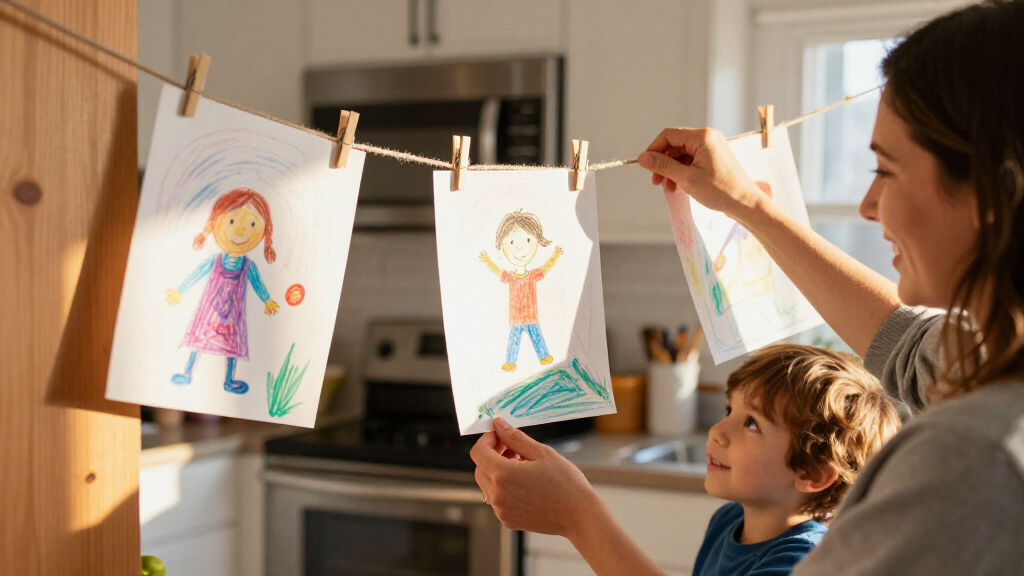

TL;DR
Hunker has proposed a simple alternative to displaying children’s artwork across the refrigerator: place a clipboard on a picture ledge and use it to show a rotating selection of drawings. The approach is a home-decor suggestion, not a reported product launch or study; claims about its effects on children’s confidence are not backed by evidence in the source.
Home-design outlet Hunker has suggested a clipboard on a picture ledge as a tidier way to display children’s artwork than attaching papers to the refrigerator. The setup gives families a designated place to feature drawings and makes it possible to change the displayed work without filling the kitchen appliance with loose sheets.

Get home appliances delivered free with Prime
- Fast, free delivery on millions of items
- Prime Video, Amazon Music and more included
- Member-only deals all year
According to Hunker, the proposal is straightforward: install a picture ledge, set at least one clipboard on it, and clip a child’s current drawing or painting to the board. Hunker suggests placing the ledge where the artwork can be seen and combining the clipboard with other art or decorative objects for a more intentional display. The article names Kate and Laurel’s Floating Wall Shelf as one product example, but the idea does not depend on that particular brand.
Hunker says a new sheet can be placed over the previous one, allowing a child or parent to rotate the featured artwork. Older pieces can be lifted from the stack and revisited rather than left on view indefinitely. The article also suggests using a children’s art frame with a mat as an alternative or companion to a clipboard; it names the GiggleCraft Wood Kids Art Frame as an example.
Hunker presents the arrangement as a home-decor idea, not a tested design product or a report of a new study. Its practical case is that concentrating selected pieces on a ledge may reduce the paper-covered appearance of a refrigerator while giving families a repeatable way to display new work.
A Dedicated Spot for Children’s Art
Hunker’s suggestion addresses two everyday concerns: families may want to recognize children’s creative work, while a refrigerator crowded with papers can make a shared kitchen feel visually busy. The article proposes a ledge as a separate display area and a clipboard as a simple way to change the featured piece. The result can make the artwork feel chosen and presented rather than added to a growing pile.
Hunker argues that showing a child’s work alongside other art can signal that it is valued. That is an interpretation offered by the article, not a measured outcome: Hunker supplies no research demonstrating that this particular display method improves self-esteem. Families may still find the arrangement meaningful as a way to involve children in selecting what goes on the wall and to keep favorite pieces accessible.
Products Worth Considering

eufy C28 Robot Vacuum and Mop with 15,000 Pa Suction

Philips Hue Play Floor Lamp, RGBWWIC LED, 53 Inch, Black

Google Nest Thermostat E Smart Thermostat with Temperature Sensor Bundle – White
As an affiliate, we earn on qualifying purchases.
From Refrigerator Door to Art Ledge
Hunker contrasts the familiar household practice of attaching school projects, drawings and notes to a refrigerator with a more deliberate display: a small wall shelf holds a clipboard, and the clipboard holds the selected artwork. The change is about where and how pieces are shown, not a claim that refrigerator displays are harmful or that every family needs a separate art area.
Hunker describes two related arrangements. A clipboard provides an easy-to-change display surface; a children’s frame with a mat gives the piece a more conventional framed appearance while still allowing artwork to be replaced. Both can be placed on a ledge, potentially alongside other objects. The article does not provide installation measurements, pricing comparisons or independent product testing.
What the Decor Idea Cannot Establish
Hunker does not report whether families who use the setup reduce clutter, how children respond to it, or whether displaying artwork this way affects confidence. Its suggestion that treating drawings like “real art” can empower a child is a design rationale, not a finding supported by evidence cited in the article. The report also does not specify a required shelf size, installation method, or a best location for the display.
Product availability and suitability may vary, and the shelf and frame named by Hunker are examples rather than independently evaluated recommendations. Readers should check the instructions and mounting requirements for any shelf they choose, particularly when installing it where children can reach it.
How Families Can Try the Setup
Hunker’s suggestion is to choose a picture ledge that fits the wall, add a clipboard, and select one piece to display. Families can let a child decide when to replace it, keep older drawings in the clipboard stack, or move especially valued pieces into a frame. Adding another frame or clipboard is an option, not a requirement.
Hunker reports no follow-up study or product launch tied to the idea. The practical next step is simply to test whether a dedicated display suits the household’s space and routines, while checking wall-mounting guidance before installation.
Key Questions
What is the suggested alternative to putting children’s art on the refrigerator?
Hunker suggests placing a clipboard on a picture ledge and clipping a drawing or painting to it. The ledge can hold other art or decorative pieces as well.
How does the clipboard make it easier to change the display?
As Hunker describes it, a new piece can be clipped over the previous one, so families can rotate the artwork without taking down and replacing magnets or rearranging papers across the refrigerator.
Does the article show that this method boosts children’s confidence?
No. Hunker says a dedicated display may communicate that a child’s work matters, but the source provides no research or measured evidence that the setup improves self-esteem.
Can families use a frame instead of a clipboard?
Yes. Hunker suggests a children’s art frame with a mat as an alternative or as an additional display option. It names the GiggleCraft Wood Kids Art Frame as one example, without reporting independent product testing.
Source: rss